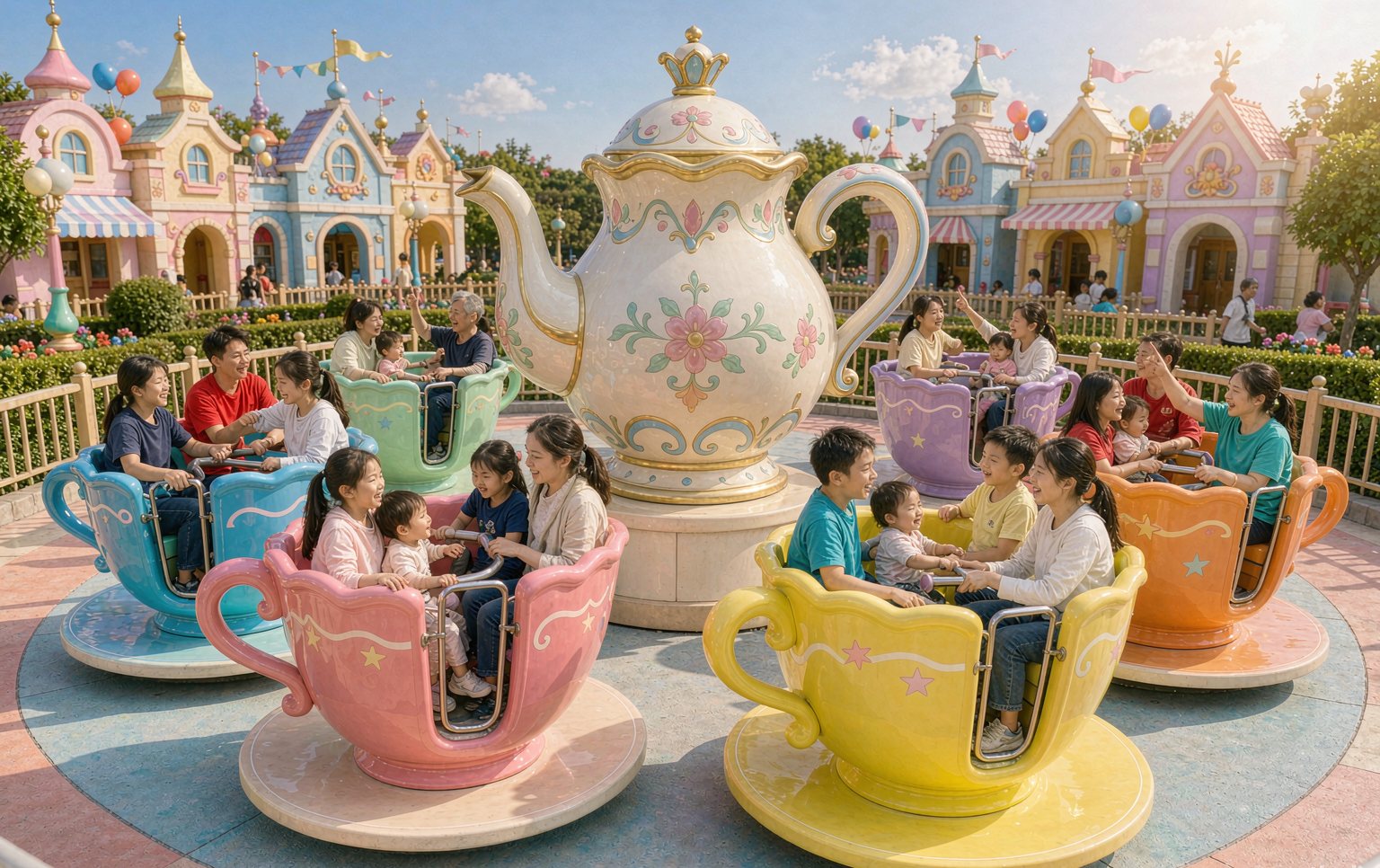
A teacup ride earns its keep on floor space that most thrill machines cannot use. A 12-cup unit fits a 10 m by 10 m zone, yet can move 600 to 900 guests per hour. That combination keeps it near the top of buying lists for family parks, malls and FECs. This guide is written for buyers who need numbers, not adjectives. We cover cup counts, footprint, power, throughput math, indicative pricing and the documents a serious supplier should provide. Every figure here is a planning range. Confirm your final scope with a formal quotation.
Why a teacup ride works on tight sites
Small venues rarely lack visitors. They lack usable square meters. A teacup ride delivers a recognizable spinning experience without the height, setback and noise of a major coaster. Guests of almost any age can ride together, which widens the paying audience. Parents stay close to children, so the attraction also solves a supervision problem for operators.
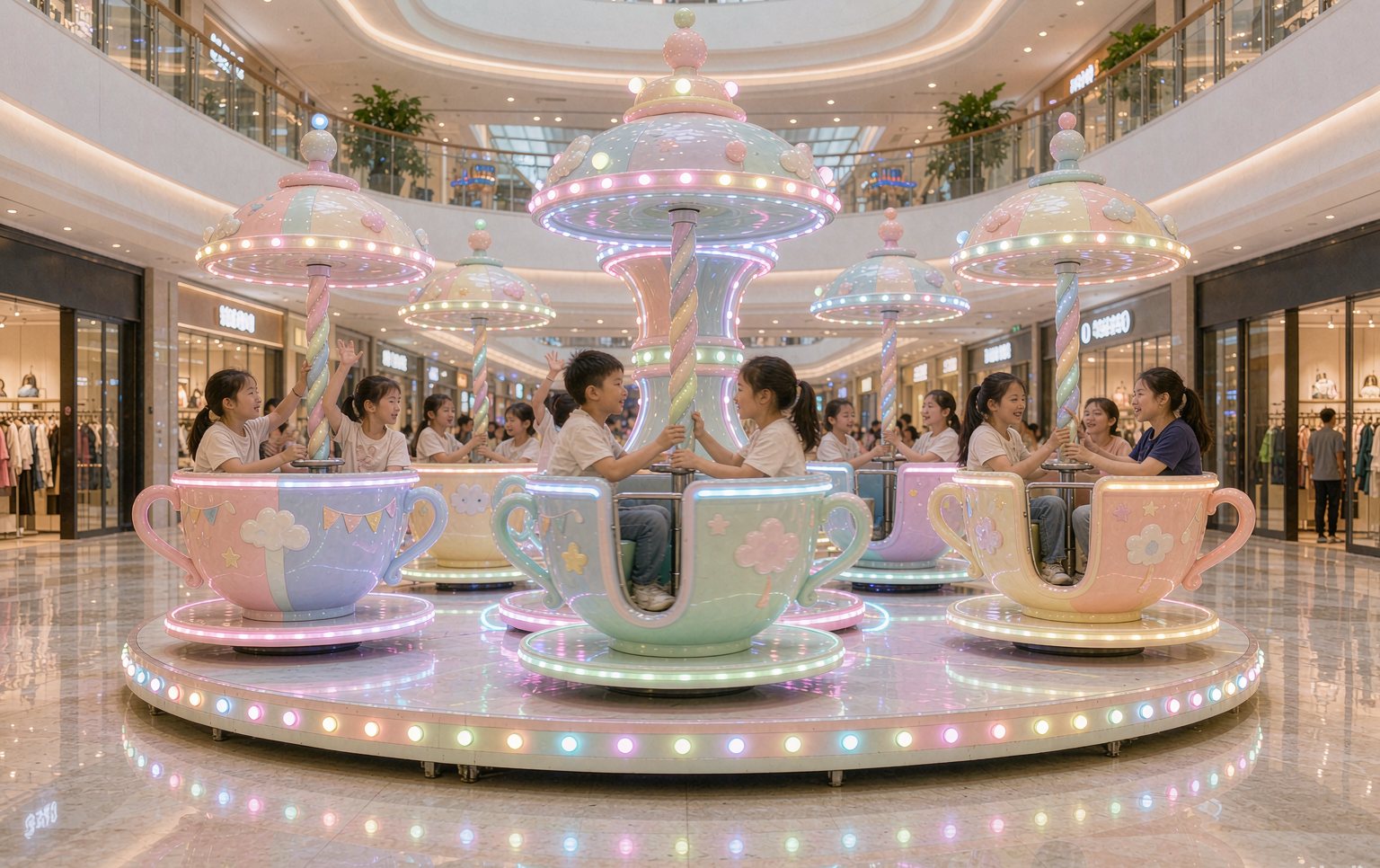
The machine tolerates both indoor and outdoor placement. Indoors, it becomes a reliable all-weather earner for a family zone. Outdoors, it works as a mid-scale anchor between kiddie rides and larger attractions. Revenue does not depend on one peak hour, because cycle times are short and loading is simple. For a compact park, that flexibility is worth more than raw thrill.
Buyers who want a starting point can review our teacup ride for sale overview. That page focuses on models and configurations. This guide takes a different angle. It looks at floor space, operating math and the decisions that protect your budget.
Six, eight or twelve cups: choosing the right size
Cup count is the first decision, but it is not the whole decision. Seats per cup, platform diameter and loading layout all change the real footprint. Ask for a dimensioned drawing before you compare prices. The figures below are typical planning values, not a substitute for a manufacturer layout.
| Configuration | Seats per cup | Typical zone | Cycle time | Typical use |
|---|---|---|---|---|
| 6 cups | 4 to 5 | 7 m × 7 m | 2 to 3 min | Mall corners, small FECs |
| 8 cups | 4 to 6 | 9 m × 9 m | 2 to 3 min | Indoor family zones |
| 12 cups | 4 to 6 | 11 m × 11 m | 3 to 4 min | Parks and plazas |
An 8-cup teacup ride is often the balanced choice. It looks substantial from a distance, yet still fits a 100 m2 family zone. Twelve cups raise visible appeal and hourly capacity, but they also raise power draw and platform cost. Six cups suit sites where every square meter must earn twice.
Indicative range — confirm with a formal quotation. Footprint numbers above are typical planning ranges only.
Teacup ride price: where the money goes
Buyers often compare one headline number and miss the scope behind it. A quotation can cover the machine only, or it can include delivery, installation and training. Ask for a line-item breakdown before you decide which supplier is cheaper. A lower machine price can hide expensive exclusions.
- Structure and drive: central turntable, cup motors, gearboxes and bearings.
- Cups and finishes: fiberglass shells, seating, handrails and themed artwork.
- Control system: operator console, speed settings, emergency stops and sensors.
- Effects: lighting, music and optional interactive elements.
- Project services: freight, foundation work, installation, training and spare parts.
For planning only, a compact 6-cup unit often sits in the low tens of thousands of US dollars. A larger 12-cup machine with theming can reach several times that figure. Indicative range — confirm with a formal quotation. Custom artwork, export packing and on-site commissioning usually appear as separate lines.
Ask which components are branded and which are generic. Replacement motors and bearings should be available locally or from a stocked supplier. This matters more after year two than a small discount at purchase.
Theming is the usual source of price variation. Standard cups use molded shapes and simple paint. Custom artwork, character themes and detailed lighting need design time and approval cycles. Decide early whether the visual story is worth the added cost. Late changes after production starts are expensive.
Freight also deserves attention. A machine that looks affordable at the factory can become costly after packing, port charges and inland delivery. Ask for both ex-works and landed estimates. Then compare the same scope on every bid.
Space, floor and power requirements
Start with the platform, not the brochure. A teacup ride needs a level, load-bearing slab and clear space around the rotating platform. Allow room for guests to queue, for staff to move and for maintenance access. A tight layout raises loading time and cuts hourly revenue.
Verify ceiling height, column positions and floor load before signing anything. Indoor sites also need ventilation and enough lighting for safe boarding. Power is usually three-phase, but the exact rating depends on cup count and options. Have your electrician confirm supply capacity before ordering. Outdoor sites need drainage and a stable base, not loose ground.
Think about guest flow in two directions. One queue enters, and waiting families need somewhere to stand without blocking circulation. A narrow aisle next to a teacup ride can become a bottleneck on weekends. Mark the boarding line and the exit path on your layout drawing. Walk the route with a tape measure before you approve it.
Throughput math: how many riders per hour
Suppliers quote impressive hourly figures. You can check them with simple arithmetic. Hourly riders equal seats times cycles per hour times load factor. Use a realistic load factor of 0.65 to 0.80, not a full house every cycle.
Consider an 8-cup teacup ride with six seats per cup. That gives 48 seats per cycle. With 2.5 minutes per cycle, you get about 24 cycles per hour. At a 0.75 load factor, the ride serves roughly 864 riders per hour. Real results fall when staff are slow or queues are poorly organized.
Use the same formula for each candidate machine. Then compare the result with your expected visitor flow. A high-capacity ride in a low-traffic corner still underperforms. Place it where families already gather, and keep the queue visible.
Also count staff time. Most small rides need one operator and one helper during peak hours. If your labor budget is tight, shorter cycles can increase costs. A slower machine with easier loading may deliver better daily margin.
Safety, controls and documents to request
Safety language is easy to print and hard to verify. Ask for documents, not promises. Relevant frameworks can include EN 13814 and ASTM F2291, depending on the destination market. CE marking applies only where the equipment and destination require it. A responsible supplier explains which standards apply to your specific order.
Request the operating manual, maintenance schedule, electrical drawings and a list of wear parts. Ask how emergency stops work and how the system behaves after a power cut. Training records matter too. Your team should know the daily checks before the first paying guest arrives.
For a deeper purchase framework, read our guide to buying amusement rides from China. It covers factory checks and contract terms in more detail.
Ask who signs the handover documents. A named engineer is more useful than a general sales promise. Keep copies of every certificate with your insurance records.
Delivery, installation and commissioning
Production time depends on customization and factory workload. Plan a window of several weeks rather than assuming immediate dispatch. Shipping method depends on machine size and the chosen Incoterm. A 12-cup unit may need partial disassembly to fit a container.
Installation starts only after the foundation is ready and cured. Allow time for mechanical assembly, alignment, electrical work and test runs. Commissioning should include empty runs, loaded runs and a documented handover. Ask who pays if the site is not ready on the agreed delivery date.
During handover, run the machine at every speed setting. Check that emergency stops work from the console and from remote points. Listen for vibration after ten minutes of continuous operation. Photograph serial plates and keep them with your maintenance file.
For a cost comparison, our carousel ride price guide shows how customization and delivery scope change another family ride’s budget.
Common mistakes when buying a teacup ride
Most disappointing purchases start with a short checklist, not a bad machine. The following errors are easy to avoid before payment.
- Comparing cup counts without checking seats per cup and loading time.
- Ignoring the clearance needed for queues, staff movement and maintenance.
- Ordering before an electrician confirms the site supply.
- Accepting verbal claims about standards without asking for documents.
- Forgetting to budget for wear parts and training in the first year.
A teacup ride is a mechanical asset, not a decoration. Treat foundation, power and service access as part of the product. Suppliers who discuss these items early usually deliver smoother projects.
How to compare suppliers without guessing
Use the same written request for every candidate. Drawings, scope and documents then become comparable. A supplier who answers slowly during quoting will rarely improve after payment.
- Ask for a dimensioned layout and a power schedule.
- Request photos of the exact model, not a similar installation.
- Confirm which parts are included in the quoted price.
- Ask for standard compliance documents relevant to your market.
- Check the spare parts list and expected replacement intervals.
- Confirm installation scope, training and warranty terms in writing.
- Negotiate a payment schedule tied to documented milestones.
Shortlist two or three suppliers, not ten. Deep comparison of a few bids beats shallow comparison of many. If you want a model for a compact site, our family-friendly amusement rides roundup explains where spinning rides fit a balanced lineup.
FAQ: questions buyers ask before ordering
How much space does a teacup ride need?
A compact 6-cup layout can fit a zone around 7 m by 7 m. Larger 12-cup machines often need about 11 m by 11 m. These are planning ranges, so confirm the final drawing.
Can a teacup ride operate outdoors all year?
Many units work outdoors, but local weather sets the limits. Wind, heavy rain and low temperatures can stop operation. Provide drainage, a stable base and a clear weather policy.
Is a teacup ride suitable for toddlers?
Children often need a minimum height and adult supervision. Rules vary by operator and market. Publish your own limits before opening, and train staff to enforce them.
What maintenance does a teacup ride require?
Daily checks cover restraints, floors, emergency stops and unusual noise. Motors, bearings and drive components need scheduled inspection. Keep a written log for every shift.
Where should a teacup ride sit in a park?
Place it near family circulation, not behind a thrill zone. Good visibility drives impulse riders. For area planning, see our indoor amusement park equipment list.
How do I estimate payback before buying?
Multiply expected riders by ticket price, then subtract daily operating costs. Compare that margin with total delivered cost. Our amusement park ROI guide walks through the calculation step by step.
Planning a bumper car or amusement ride installation?
Send us your site size, expected visitor volume and budget range — our engineering team will reply within 24 hours with a layout sketch and an indicative quotation, no obligation.