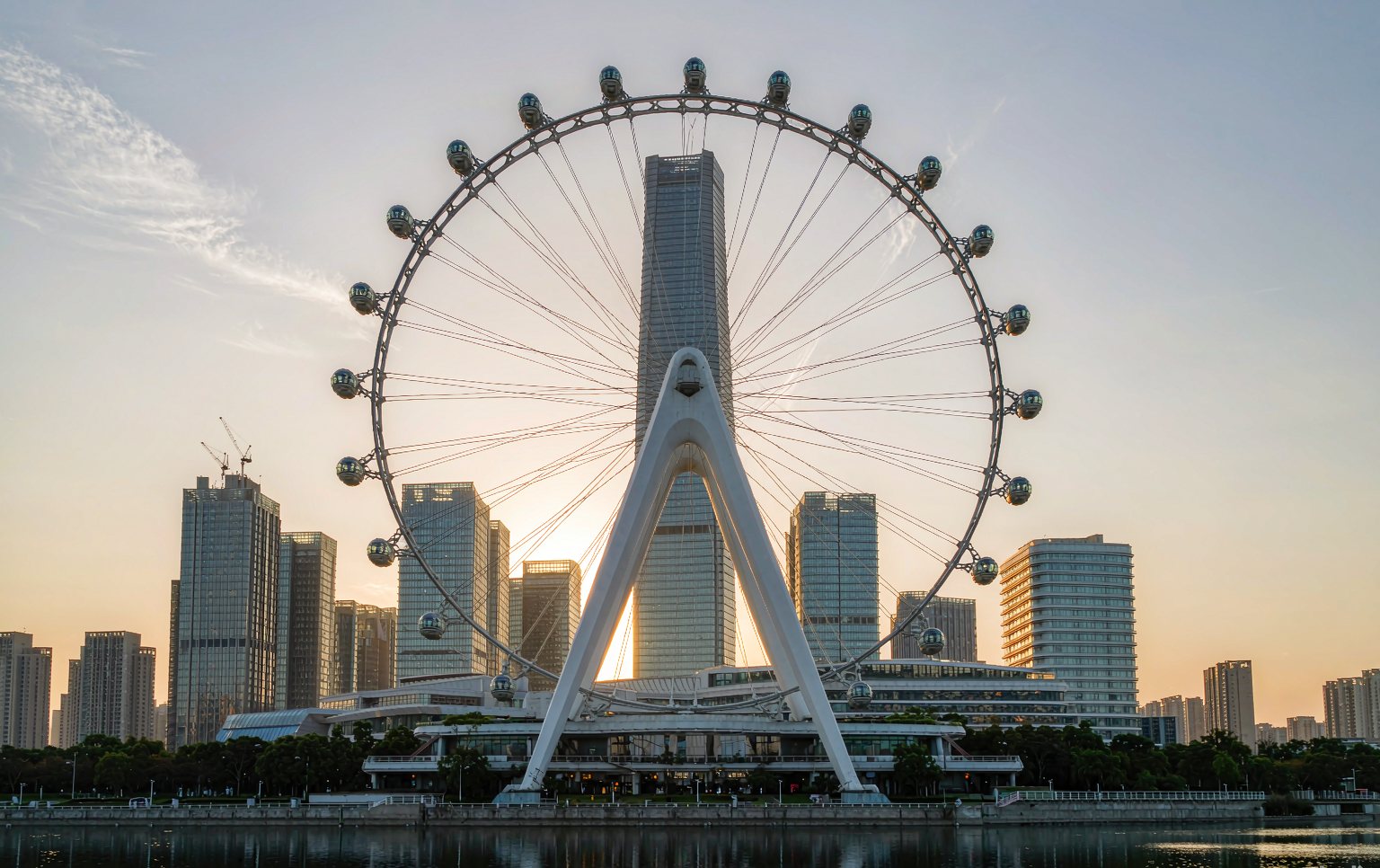
Choosing between a ferris wheel vs observation wheel is not a naming exercise. It is a decision about height, throughput, guest experience and approval cost. A 30 m family wheel typically seats 24 to 32 riders per cycle and turns every 12 to 18 minutes. A 60 m observation wheel may carry more people per revolution. It also needs a larger foundation, a longer inspection regime and a higher ticket. This guide compares both options on the numbers buyers use: hourly riders, site load, indicative investment and payback conditions. All prices are indicative ranges. Confirm every figure with a formal quotation.
The short answer: which wheel fits which site
A classic ferris wheel suits a family park, plaza, fairground or mall-facing outdoor site. It delivers a recognisable silhouette, moderate height and a ticket price most visitors will pay without planning. Buyers who need a reliable family attraction usually compare 20 m to 45 m models first. These wheels are easier to phase into an existing park and easier to insure in many markets.
An observation wheel is a landmark purchase. It makes sense where a skyline view, waterfront or tourism district can support a premium ticket and where the land area is already secured. The same ride can anchor a master plan, but it brings heavier civil works and a longer permitting path. Start with four numbers: daily footfall, available plot, ground conditions and the local inspection regime. They decide the answer faster than any product catalogue.
Ferris wheel vs observation wheel: the real differences
The terms overlap in the market. Many suppliers call every large passenger wheel a ferris wheel, while others reserve observation wheel for taller, enclosed-cabin models. Ignore the label and read the specification. The useful distinctions are the support structure, cabin type, hub height, cycle time and the way the ride is shipped and assembled.
A traditional wheel uses an A-frame or twin-leg support, a steel rim with radial spokes, and gondolas that hang from pivots. Cabins may be open or enclosed. Modules can often be trucked in sections and bolted on site. This construction supports a wide range of heights and keeps the visual language familiar to guests and regulators.
Larger observation wheels usually use enclosed, climate-controlled cabins on a taller hub. The structure and drive package are heavier, and the loading platform becomes a small building in its own right. Rotation is deliberately slow so guests can view the surroundings. Neither type is automatically safer or more durable; that depends on design, fabrication quality and maintenance. Ask for wind limits and operating thresholds for the exact model, not for the category.
Side-by-side comparison table
These planning bands are not offers. A ferris wheel vs observation wheel comparison only works when cabin count, cycle time and site works are listed side by side. Height alone moves the budget less than most buyers expect. Use the table to eliminate options, then request a layout drawing for your plot.
| Criterion | Family ferris wheel, roughly 20–45 m | Observation wheel, roughly 50–80 m |
|---|---|---|
| Typical setting | Park, plaza, fairground, retail-adjacent site | Waterfront, tourism district, city landmark site |
| Seats per cycle | 48–160, depending on cabin count | 160–320 with larger enclosed cabins |
| Cycle time | 10–18 minutes | 18–30 minutes |
| Foundation | Spread footings or pile caps sized from a soil report | Large piled or raft foundation; detailed ground study required |
| Power and backup | Drive and lighting load plus a smaller standby supply | Higher connected load, larger backup and more extensive cabling |
| Indicative equipment band, USD | 180,000 – 1,200,000 | 1,500,000 – 6,000,000+ |
| Approval effort | Standard ride approval route in most markets | Longer design review, civil sign-off and commissioning |
Indicative range — confirm with a formal quotation. The two investment bands are deliberately broad because height alone is a poor price predictor. A 40 m wheel with premium lighting and accessible cabins can cost more than a basic 50 m wheel. Compare like-for-like scope before comparing numbers.
Gondolas, loading and hourly throughput
Hourly capacity is where a beautiful wheel becomes a business case. Start with a simple formula: cabins multiplied by seats per cabin, multiplied by cycles per hour, multiplied by a realistic occupancy rate. Never use 100 percent occupancy. Boarding order, hesitant guests and accessibility needs reduce the practical figure.
- Count the cabins and confirm the rated passengers per cabin in writing.
- Divide 60 by the cycle time in minutes to get theoretical cycles per hour.
- Apply an occupancy factor of 65 to 80 percent for planning.
- Test the queue area against the resulting rider count at peak times.
- Ask how many attendants the manufacturer recommends for the loading platform.
Worked example: a 24-cabin wheel with four seats, a 15-minute cycle and 75 percent occupancy carries about 288 riders per hour. A 32-cabin observation wheel with six seats, a 24-minute cycle and 80 percent occupancy reaches roughly 384 riders per hour. That advantage disappears if the larger wheel cannot sell enough premium tickets to fill those cabins.
Loading design also affects labour cost. Wide platforms, level boarding and clear queue rails reduce staff time and guest hesitation. For accessibility, confirm whether a cabin can be loaded with a wheelchair and how that step changes cycle time. Details like these belong in the operating plan, not in a sales brochure.
Site, foundation and utility requirements
The wheel is only the visible part of the project. Before signing, commission a geotechnical report and give the supplier the plot dimensions, access roads and overhead constraints. Foundation design follows soil bearing capacity, settlement behaviour and the load paths of the support legs. On an observation wheel, the ground works can rival the equipment price.
Check clearances against nearby buildings, trees and power lines. Confirm the manufacturer’s wind operating limit and the procedure for stopping and securing the wheel. Plan drainage, lightning protection, cable routes and a standby power supply. A generator that only starts after a full outage protects the drive and the guests still on board.

Indicative price ranges and quote variables
Suppliers quote hardware, installation and site work in different ways. A low equipment price can hide a large civil or crane allowance. Ask every bidder to separate the same cost lines so you can compare the total installed project. The bands below are for early budget planning only.
| Cost line | Family wheel, 20–45 m | Observation wheel, 50–80 m |
|---|---|---|
| Equipment, FOB port | 180,000 – 1,200,000 USD | 1,500,000 – 6,000,000+ USD |
| Foundation and civil works | 40,000 – 250,000 USD | 500,000 – 2,500,000 USD |
| Freight and crane hire | 25,000 – 150,000 USD | 200,000 – 900,000 USD |
| Installation and commissioning | 20,000 – 120,000 USD | 150,000 – 600,000 USD |
| First-year spares and training | 10,000 – 40,000 USD | 30,000 – 120,000 USD |
Indicative range — confirm with a formal quotation. Exchange rates, steel prices, shipping routes and local labour rules all change the final number. Gondola finishes, illuminated rims, accessible cabins and control system redundancy are common add-ons. Ask for a priced option list rather than accepting a single bundled figure.
Revenue and payback math
Build the model from riders per hour, not from the wheel’s height. A family wheel carrying 288 riders per hour at a 9 USD ticket produces 2,592 USD in gross revenue per full hour. Run that figure against realistic opening days, weather losses and the hours when queues are actually full. Never multiply the peak hour by every opening hour.
Observation wheels need a different assumption. They win when a 15 to 25 USD ticket holds and when the wheel also drives retail, food and photo spend. If the market only supports an ordinary family ticket, the larger asset will struggle to repay its civil works. Use your own footfall data and test at least a conservative and a base case before placing a deposit. Our amusement park ROI calculation guide sets out the wider park-level method.
Safety standards and approval documents
Different markets apply different frameworks. In Europe, EN 13814 is the common ride design and manufacturing standard. In the United States, ASTM F2291 is widely used, and state or local authorities add their own rules. CE marking or any other declaration must match the actual equipment and destination. Ask for the documents the supplier really holds, and check their scope and issue date.
A serious file normally includes structural calculations, weld procedures and inspection records. It should also cover drive and braking descriptions, operating manuals, spare parts lists and a commissioning report. For a tall wheel, also request the wind assessment and the foundation interface drawing. Send the package to your local inspector before shipment, not after installation. You can review the CE certification requirements for amusement equipment while preparing that conversation.
Lead time, shipping and installation
A standard family wheel often leaves the factory in roughly three to six months, depending on cabin count and custom work. A large observation wheel takes longer because engineering, fabrication and factory acceptance testing expand. Confirm the production slot in the contract and state which drawings must be approved before steel is cut. Late design changes are the most common cause of delay.
Shipping is measured in modules, not in a single machine. Large rims travel in sections on flatbed trailers and may require route permits. On site, a crane plan, qualified riggers and a closed assembly zone are essential. The custom ferris wheel design and manufacturing page shows how layout decisions feed into fabrication. Ask who owns crane delays and weather stops.
Common mistakes when comparing offers
The first mistake is comparing height without comparing cabin count and cycle time. The second is treating a quotation as a full project budget. The third is assuming the term observation wheel automatically includes enclosed, air-conditioned cabins. Read the bill of materials and the general arrangement drawing before you compare prices.
Avoid this mistake: ordering the wheel before the geotechnical report is signed off. Soil conditions can change a foundation from a simple pad design to a piled solution. That change affects both the budget and the programme, and it is rarely covered by the equipment supplier.
Also check that the quoted capacity is realistic for your staffing plan. A wheel rated for 400 riders per hour means little if the platform can only process 200 with the attendants you intend to employ. Put the promised throughput, cycle time and staffing assumption in the contract appendix.
How to shortlist a supplier
Shortlist on evidence you can inspect. Factory videos, weld records and a reference site you can call are more useful than a polished brochure. For a cross-border purchase, ask the supplier to name the export documents and the port of loading. A clear answer early usually predicts a smoother project later.
- Request the general arrangement drawing and a cabin layout for your exact model.
- Ask which standards apply to your market and which certificates the factory holds.
- Check weld inspection procedures and request recent factory records.
- Confirm the drive, braking and backup arrangements in writing.
- Get a modular packing list and the expected number of transport loads.
- Agree the installation scope, site conditions and delay responsibilities.
- Compare first-year spare parts and local service arrangements.
Finally, check how the supplier answers questions. A team that asks about your soil report is more credible than one that only quotes a price. Any ferris wheel vs observation wheel offer should stand up to these checks. You can also compare ferris wheel price bands and cost drivers before requesting a tailored quotation.
FAQ: ferris wheel vs observation wheel questions
Is an observation wheel just a bigger ferris wheel?
Not necessarily. The term usually implies a taller hub, enclosed cabins and slower cycles. Structures and support systems also differ. Ask for height, cabin count, cycle time and foundation drawings instead of relying on the name.
Which option has the better return for a small park?
A 20 to 40 m family wheel is usually easier to finance for a small park. It needs less ground work and suits a lower ticket. A landmark wheel only works when tourism volumes support a premium price.
Can either wheel operate in strong wind?
Both types have model-specific wind operating limits. The manufacturer must state those limits and the safe shutdown procedure. Local rules may impose stricter thresholds, so check with your inspector before opening.
What is the typical ordering lead time?
Standard family wheels are often produced in three to six months. Large observation wheels take longer due to engineering, fabrication and testing. Confirm the schedule and drawing approval milestones in the contract.
Where should I start if I only have a plot drawing?
Send the drawing, soil information and expected visitor numbers to the supplier. Ask for two layout options with capacity and installed cost ranges. That comparison is more useful than choosing a height first.
Planning a bumper car or amusement ride installation?
Send us your site size, expected visitor volume and budget range — our engineering team will reply within 24 hours with a layout sketch and an indicative quotation, no obligation.