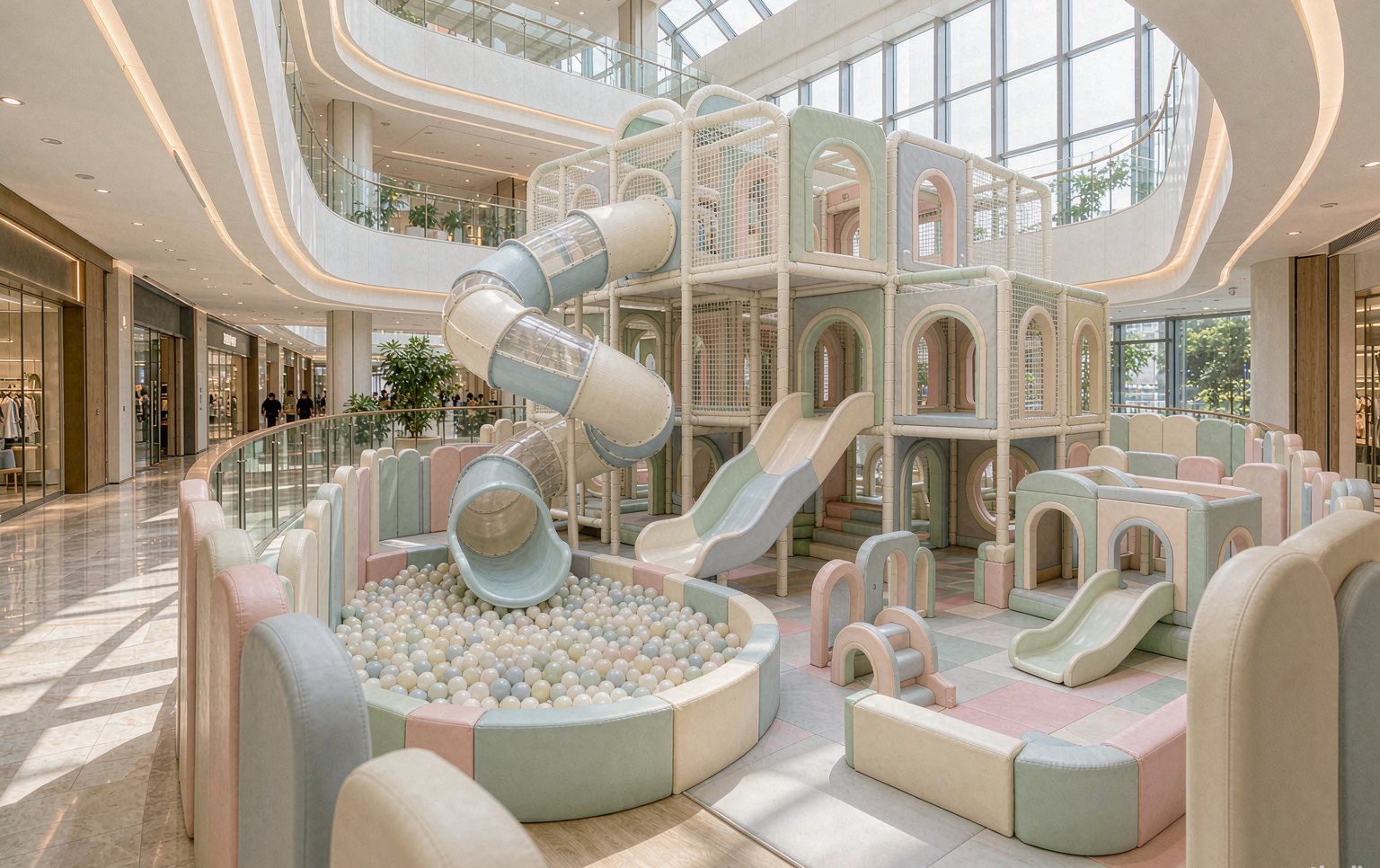
Planning a 1,000 m2 family entertainment center starts with one question: what indoor amusement park equipment fits the floor, the budget and the local demand? The answer is rarely a single ride. It is a mix of soft play, midway rides, trampoline or climbing attractions, and arcade units working together. This guide gives you a practical equipment list and an indicative budget split. It also covers the site requirements buyers miss most, plus a payback model you can run with your own numbers. All figures below are ranges only — confirm with a formal quotation.
Treat the numbers here as a planning framework, not a price list. Every market has different freight, duty, labor and inspection costs. A supplier who quotes a single round number without asking about your ceiling height or power supply has not done the job yet.
Why a 1,000 m2 FEC is the sweet spot in 2026
A 1,000 m2 floor is large enough to divide into distinct zones but small enough to supervise with a lean team. That balance is why operators keep choosing this format. You can serve toddlers, school-age children and adults on one site without buying a single attraction that appeals to everyone.
Demand also favors indoor venues. Weather does not close a mall-based center, and operating hours are not tied to daylight. Developers in Asia, the Middle East and Latin America are adding family entertainment anchors to mixed-use projects. For an investor, that means a steadier visitor base than a seasonal outdoor park can offer.
The trade-off is capital concentration. You commit a large sum before the first ticket is sold. That is exactly why the equipment list and the budget split deserve more attention than the decoration budget.
Indoor amusement park equipment by zone
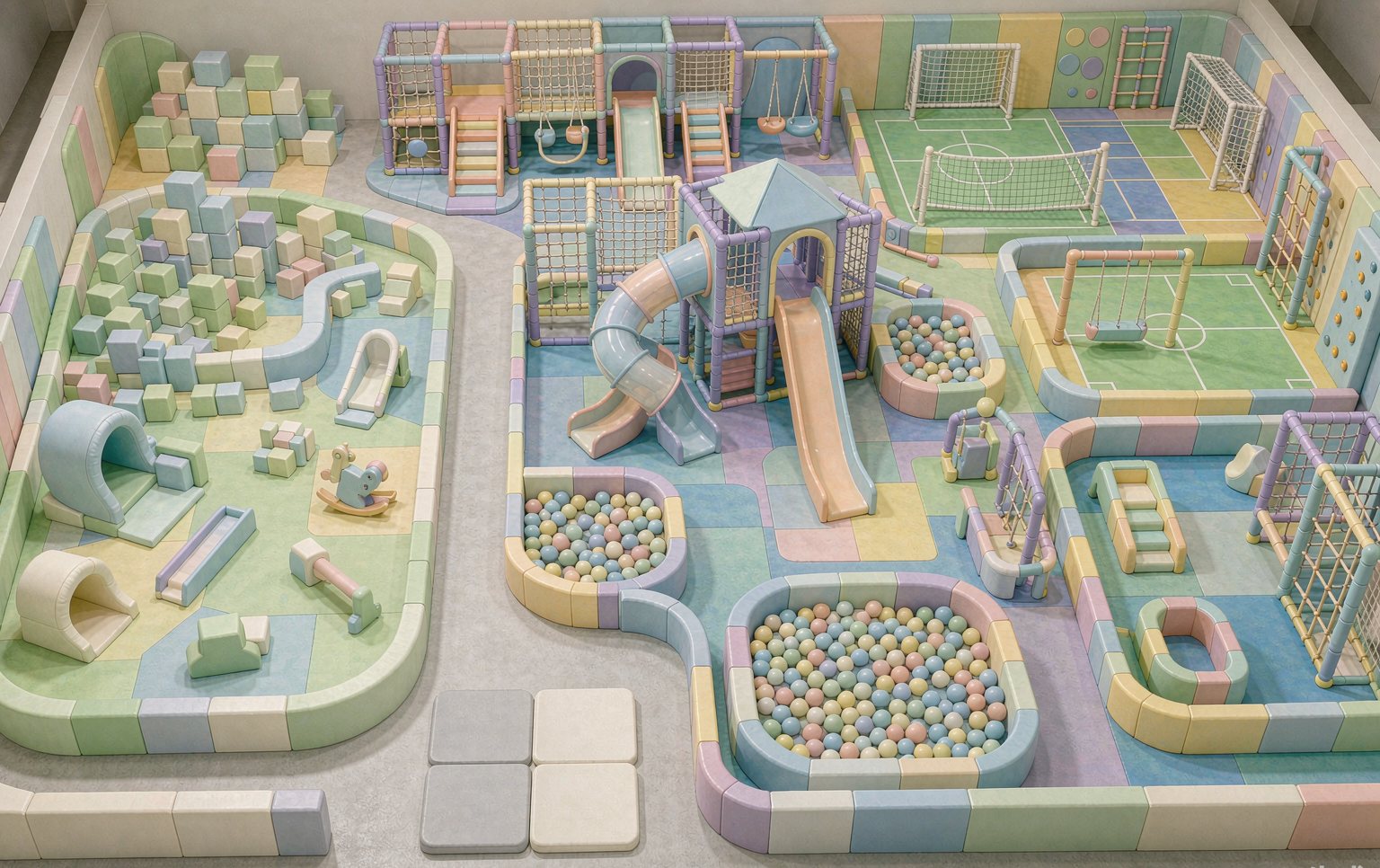
Before you compare models, divide the floor. Most successful 1,000 m2 centers use four to five zones. Each zone has its own dwell time, ticket price and staffing need.
- Soft play and toddler zone (150–250 m2): multi-level structures, slides, ball pools and padded Toddler areas. Low ticket price, long dwell time, minimal staff.
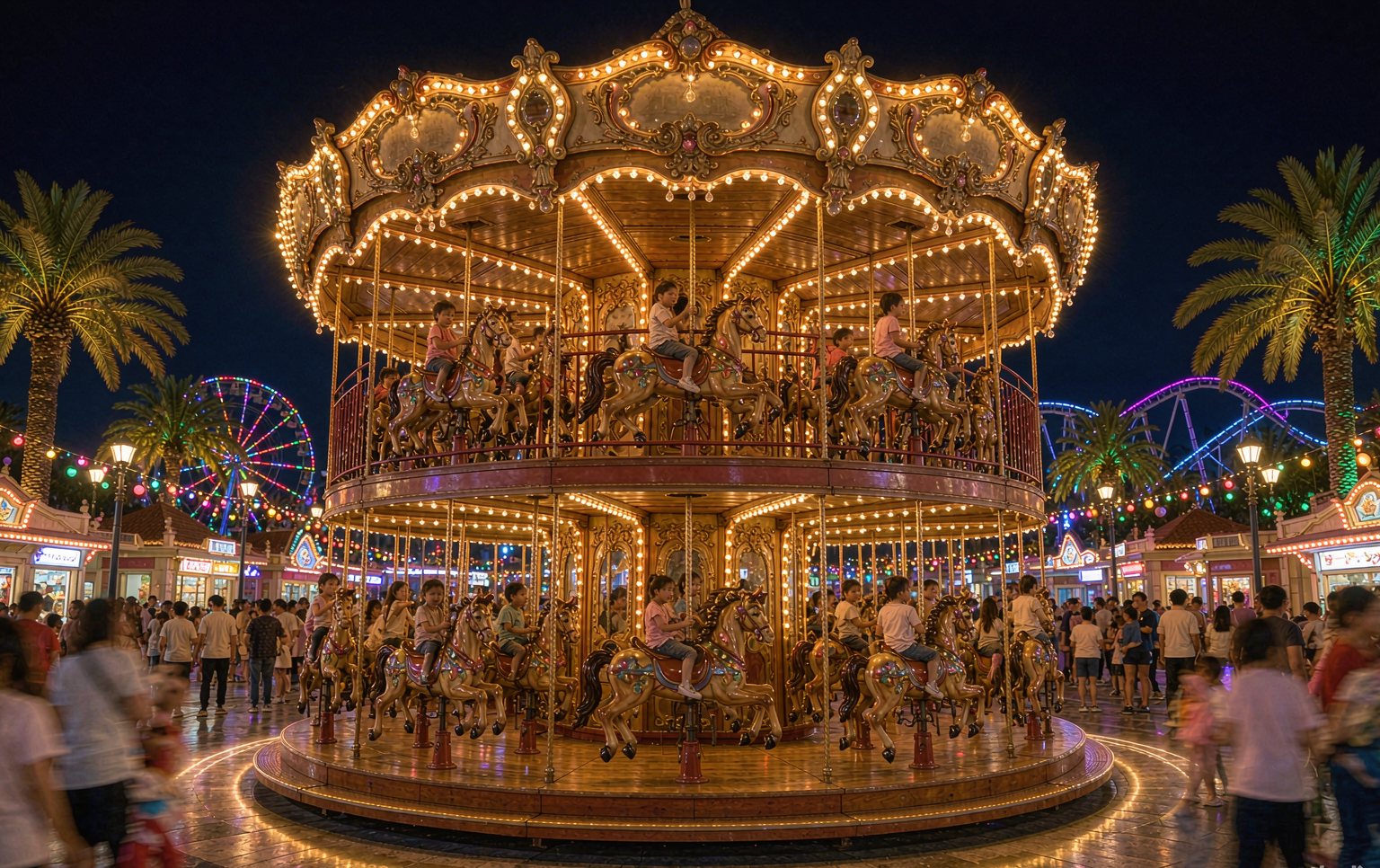
- Midway ride zone (200–300 m2): carousel, teacups, mini bumper cars or a compact pendulum ride. Higher per-ride revenue, higher maintenance.
- Active zone (200–300 m2): trampoline courts, climbing walls, ninja courses or a ropes structure. Strong teen and adult appeal.
- Arcade and redemption zone (100–150 m2): machines, prize counter and ticket systems. The highest-margin square meter on the floor.
- Support zone (150–250 m2): reception, party rooms, café, restrooms, storage and first aid. Often underestimated, always needed.
Keep noisy, fast attractions away from the toddler zone. Keep food away from trampoline courts. A clean separation improves both safety and perceived value, and it makes insurance conversations far easier.
The core equipment list for a 1,000 m2 build
The table below describes a balanced middle configuration. It is indicative only — confirm with a formal quotation. Quantities assume roughly 300 visitors per day and a mixed local audience.
| Attraction | Typical qty | Footprint | Indicative FOB range (USD) |
|---|---|---|---|
| Multi-level soft play structure | 1 unit | 180–220 m2 | 45,000–85,000 |
| Toddler padded play area | 1 unit | 60–80 m2 | 12,000–25,000 |
| 16-seat carousel | 1 unit | 50–70 m2 | 35,000–60,000 |
| Teacups or mini tea party ride | 1 unit | 40–55 m2 | 22,000–38,000 |
| Mini bumper cars (ceiling grid) | 8–12 cars | 100–140 m2 | 45,000–80,000 |
| Trampoline courts with foam pit | 6–10 courts | 180–250 m2 | 40,000–75,000 |
| Climbing wall or ninja course | 1 unit | 60–90 m2 | 18,000–40,000 |
| Arcade and redemption machines | 20–35 units | 100–150 m2 | 25,000–60,000 |
| Party room fit-out and seating | 2–3 rooms | 80–120 m2 | 10,000–22,000 |
Add freight, duty, installation, flooring and local labor on top. Those items commonly add 25–40% to the equipment figure. If your budget is fixed at USD 400,000 landed, work backward from that number rather than forward from a wish list.
For a broader view of how complete packages are assembled, see our complete amusement park equipment package guide. It explains which items suppliers normally bundle and which are quoted separately.
Indicative budget breakdown
Most investors want one number. A more useful answer is the share each line consumes. The split below reflects typical turnkey FEC projects and is indicative only — confirm with a formal quotation.
| Budget line | Share of total | What it covers |
|---|---|---|
| Rides and mechanical attractions | 30–38% | Carousel, teacups, bumper cars, pendulum |
| Soft play and active attractions | 22–30% | Play structures, trampolines, climbing, ninja |
| Arcade and redemption | 8–14% | Machines, ticket system, prize counter |
| Build-out and finishes | 12–18% | Flooring, padding, partitions, lighting, signage |
| Freight, duty and installation | 8–14% | Container, customs, on-site assembly, commissioning |
| Design, training and spare parts | 3–6% | Layout drawings, operator training, first-year spares |
Notice that rides alone rarely exceed 40% of the total. New buyers often budget for machines and forget the build-out. Flooring, padding and HVAC frequently decide whether a venue opens on schedule.
If inflatable structures are part of your plan, our guide to commercial inflatable play equipment covers types, setup and buying tips in detail.

Space, ceiling height and floor loading
Ceiling height is the first filter. A standard carousel needs roughly 4.5 m of clear height. Bumper cars with a ceiling grid need about 5 m. Trampoline courts and climbing structures can require 6 m or more once you account for fall zones and overhead padding.
Measure the clear height under beams, sprinkler pipes and HVAC ducts, not the advertised building height. Many malls quote a structural height that drops by half a meter once services are installed. Send your supplier a section drawing before you sign a lease.
Floor loading matters just as much. Mechanical rides concentrate weight on a few anchor points. Trampoline courts and soft play spread load more evenly but still need a level, resilient subfloor. Add drainage falls for any ground-level entry, and keep a 1.2 m circulation path around every attraction.
Power, HVAC and fire safety
Build a power schedule before you order equipment. List every ride, arcade bank, light circuit and air compressor with its running and peak draw. Most FECs need a three-phase supply, and bumper car grids can pull significant current during peak hours.
Ventilation is the hidden operating cost. A full hall of children and active adults generates heat and humidity quickly. Plan air changes per hour with your HVAC contractor, then price the monthly energy bill. It becomes one of your largest fixed costs.
Fire safety is local, so verify requirements with your authority early. Sprinkler coverage, material flame ratings, exit widths and padded-surface certification are commonly checked. Ask your supplier for flame-retardant certificates on foam and vinyl, and keep printed copies on site for inspection.
Capacity and payback: a worked example
Use a simple formula to sanity-check any attraction: hourly riders equals seats multiplied by cycles per hour multiplied by occupancy. Then multiply by ticket price and by operating days. Write down every assumption so you can test them later.
Here is a worked example. Assume 300 visitors per day, 330 open days per year and USD 12 average spend per head. Annual revenue is about USD 1.19 million. At a 35% operating margin, that leaves roughly USD 415,000 to service capital.
A USD 600,000 total investment would pay back in about 17 months before tax. That is a model, not a promise. Change the occupancy rate to 200 visitors and the payback extends sharply. Run three scenarios — conservative, base and optimistic — before you commit.
Our amusement park ROI calculator walks through the same logic with adjustable inputs. Use it to pressure-test the figures your supplier gives you.
Safety documents and certification to request
Ask for a document list, not a verbal assurance. For rides, request the design dossier, structural calculations, weld inspection records and the factory acceptance test report. Request the operating and maintenance manual in English.
Certification depends on your market. CE declaration documents are relevant for the European market, while ASTM F2291 and related standards are widely referenced in North America. Only ask for certificates the supplier actually holds, and verify each document with the issuing body before payment.
Also confirm who performs installation and who signs off commissioning. A supplier that trains your staff and supplies a first-year spare parts kit reduces early downtime far more than a small discount does.
Lead time, shipping and installation
Standard equipment usually ships in 45–70 days after deposit and approved drawings. Custom theming, color matching or engineered rides can extend that to 90–120 days. Peak season and Chinese New Year add further delay, so build a buffer into your opening date.
Consolidate orders into as few containers as practical. A 40HQ container holds roughly 65–75 cubic meters, and soft play often ships compressed. Confirm Incoterms in writing, including who clears customs and who pays destination charges.
Installation is a separate schedule. Allow one to three weeks for assembly, depending on the number of rides and the condition of the site. Reserve time for local inspection, staff training and a soft opening before your public launch.
How to choose a supplier: a checklist
Use the same short list for every quotation you compare. It makes differences obvious and removes the guesswork.
- Confirm the company manufactures the rides, not just resells them. Ask for a factory video and a live walkthrough.
- Check that engineering drawings and structural calculations are included, not sold separately.
- Ask which certificates the exact model holds, then verify the document numbers independently.
- Request a ballpark layout based on your real floor dimensions before you pay a deposit.
- Get the spare parts list and recommended stock for the first 12 months.
- Confirm training, warranty length and who responds to a fault call, in writing.
- Compare landed cost, not just FOB price. Freight and duty can swing the ranking.
- Speak to a reference customer with a similar venue size and market.
Common mistakes to avoid
Do not buy rides before fixing the layout. A great price on a 16-seat carousel is worthless if it blocks your main aisle or cannot fit under a beam. Lock the floor plan first, then shop.
Do not treat the cheapest quote as the lowest cost. Missing anchor bolts, thin padding, omitted training and a weak spare parts kit all reappear as expenses in year one. Ask what each quote excludes.
Do not skip a professional site survey. Power, floor level, ceiling services and exit routes are easier to measure on paper than to fix after installation. A half-day survey can save weeks of rework.
If you want a second reference point, our guide to buying amusement rides from China explains the contracting and inspection steps in more depth.
FAQ
How much does indoor amusement park equipment cost for 1,000 m2?
An indicative total runs USD 350,000–750,000 for equipment and build-out, excluding land and construction. Confirm with a formal quotation based on your actual floor plan and local requirements.
How long does it take to open a 1,000 m2 FEC?
From approved drawings to soft opening, plan on five to nine months. That includes production, freight, customs, installation, inspection and staff training.
What ceiling height do I need for bumper cars?
A ceiling-grid bumper car track typically needs around 5 m of clear height. Battery-powered cars remove that constraint but add charging time and lower daily throughput.
Can I start with fewer rides and expand later?
Yes. Design the electrical capacity and floor layout for phase two from day one. Adding a ride later is cheaper when conduits and anchors are already in place.
Which attraction earns the most per square meter?
Arcade and redemption units usually lead on margin per square meter. Soft play wins on dwell time and repeat visits. A balanced mix outperforms any single attraction.
Planning a bumper car or amusement ride installation?
Send us your site size, expected visitor volume and budget range — our engineering team will reply within 24 hours with a layout sketch and an indicative quotation, no obligation.