
If your guests crave stronger sensations, a dedicated pendulum rides zone is the natural next step when expanding beyond family attractions.
Why a Tagada Ride for Sale Keeps Showing Up in Profit Reports
Ask operators which attraction delivers the best revenue-per-square-meter in their park, and the tagada ride for sale listings they browsed last season usually tell the story. The disco tagada — sometimes called a disco pang, disco cup, or jumping dolphin ride — has become one of the most requested machines we ship out of our factory. It is loud, it is social, and it fills up with 30 to 40 riders at a time who almost always come back for a second lap.
For a B2B buyer, the commercial case is unusually clean. One operator runs the show from a control podium. No track, no lifts, no water treatment, no complex foundations on most models. An airbag perimeter replaces hard restraint systems, which cuts both purchase cost and daily inspection labor. When you price a tagada ride for sale against almost any other 30-plus-capacity attraction, the numbers favor the disco format — and that is before you count the operator technique factor that turns a good show into a sold-out show.
How a Disco Tagada Ride Actually Works
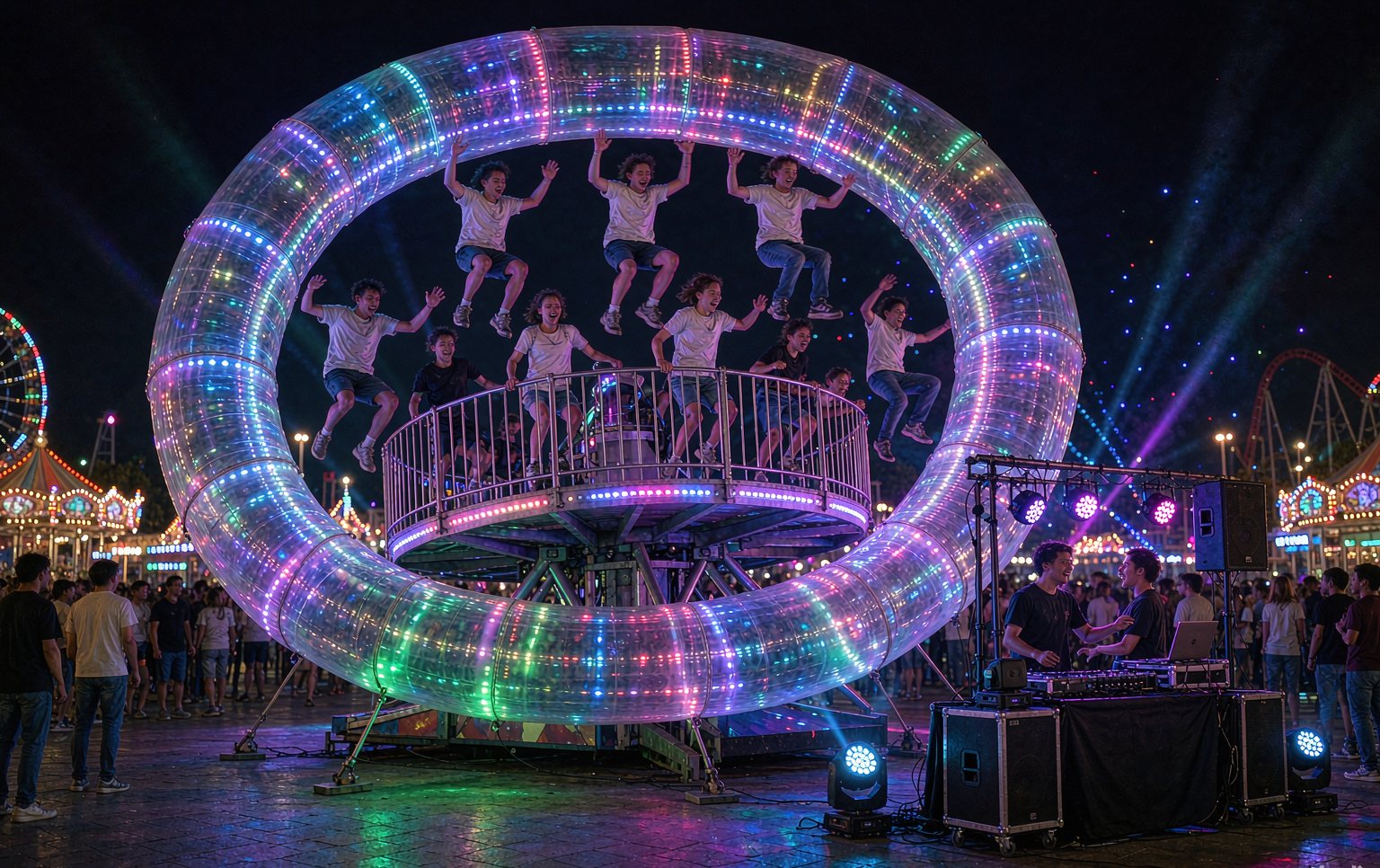
A tagada is a large, slightly dished circular platform — the “cup” — mounted on a hydraulic or mechanical drive system. Riders sit on the padded floor in a ring, facing inward. The platform spins, bounces, and tilts in programmable cycles while music drives the rhythm. Around the entire perimeter runs an inflatable airbag wall, angled outward, that riders lean against and bounce off. There are no seats, no lap bars, and no shoulder harnesses; the airbag and the rider’s own grip do the work.
The ride program is the product. A skilled operator varies spin speed, bounce frequency, and tilt angle in response to the crowd — harder cycles for teens and young adults, gentler programs for family sessions. This is why the same machine can run three different show formats in one day, and why operator training is included with every unit we deliver.
Core Specifications and Capacity
Before comparing any tagada ride for sale, anchor yourself in the specification ranges that dominate the export market:
- Platform diameter: typically 7 to 11 meters depending on model
- Rider capacity: 30–40 riders per cycle (some compact 24-seat versions exist for FECs)
- Drive: hydraulic or motor-driven eccentric system with variable frequency control
- Perimeter: high-frequency laminated PVC airbag with electric blower and backup blower
- Power requirement: roughly 15–40 kW depending on model size
- Footprint with queuing: allow 14 m × 14 m minimum for a mid-size unit
- Throughput: 400–700 riders per hour at a 4–5 minute cycle including load/unload
That throughput figure deserves emphasis. A family coaster of similar footprint might move 500 riders per hour with four attendants and a control-room operator. The tagada matches or beats it with one person at the podium and one attendant at the gate. Labor is the silent killer of attraction P&Ls, and this ride keeps it minimal.
Capacity also scales with session design. Because riders stay on the platform between bounces, load-and-unload is fast — the previous group exits while the music resets, and the next 30–40 riders board within two minutes. Parks that run continuous sessions during peak hours routinely exceed 600 riders per day on a single machine. That is why many buyers who browse a tagada ride for sale end up ordering two: one unit creates a queue, and the second one monetizes it. When you compare that revenue curve to a similarly priced flat ride, the disco format wins on both volume and replay rate.
The Operator Technique Factor: Your Show Is the Product
Unlike a coaster that runs itself, a tagada performs only as well as the person running it. The best operators read the platform: they slow the spin when a group is struggling to stay seated, hit the bounce drops on the beat of the music, and build anticipation with a “one more bounce” fake-out before the finale. Riders film these moments, and the clips do your marketing for you.
Three practical notes for buyers:
- Train two operators minimum so you always have a show-quality runner on shift.
- Script your music — the bounce programs are timed to tracks, and consistent playlists make shows repeatable.
- Set session pricing — many parks sell tagada sessions as a premium ticket because the social experience justifies it.
We include operator training with every tagada ride for sale shipment, covering show programming, load discipline, and emergency stop procedures. Buyers who invest in operator quality routinely see 20–30% higher rider counts per day than buyers who treat it as a self-serve machine.
Indicative Price Bands for Tagada Rides
Below are indicative ex-works price ranges for any tagada ride for sale based on current export configurations. All figures are indicative, ex-works, configuration dependent — theming, music systems, and trailer chassis move the final number.
| Configuration | Capacity | Indicative Price (USD, ex-works) | Typical Buyer |
|---|---|---|---|
| Compact / FEC tagada | 24 seats | $25,000 – $45,000 | Family entertainment centers, indoor parks |
| Standard park tagada | 30–36 seats | $45,000 – $85,000 | Regional parks, traveling funfairs |
| Large disco tagada | 38–40 seats | $85,000 – $130,000 | Major parks, high-traffic touring circuits |
| Trailer-mounted tagada | 30–36 seats | $60,000 – $110,000 | Carnival operators, multi-site promoters |
| Custom-themed model | 30–40 seats | $100,000 – $160,000 | Branded parks, IP-driven venues |
For context, a tagada delivers capacity comparable to a mid-size family coaster at a fraction of the capital cost — which is why we often recommend it as the anchor of a thrill zone rather than a supporting act. If you are comparing across categories, our guide to thrill rides for sale breaks down how the tagada stacks up against frisbees, top spins, and drop towers on cost per rider.
Trailer-Mounted vs Park Models
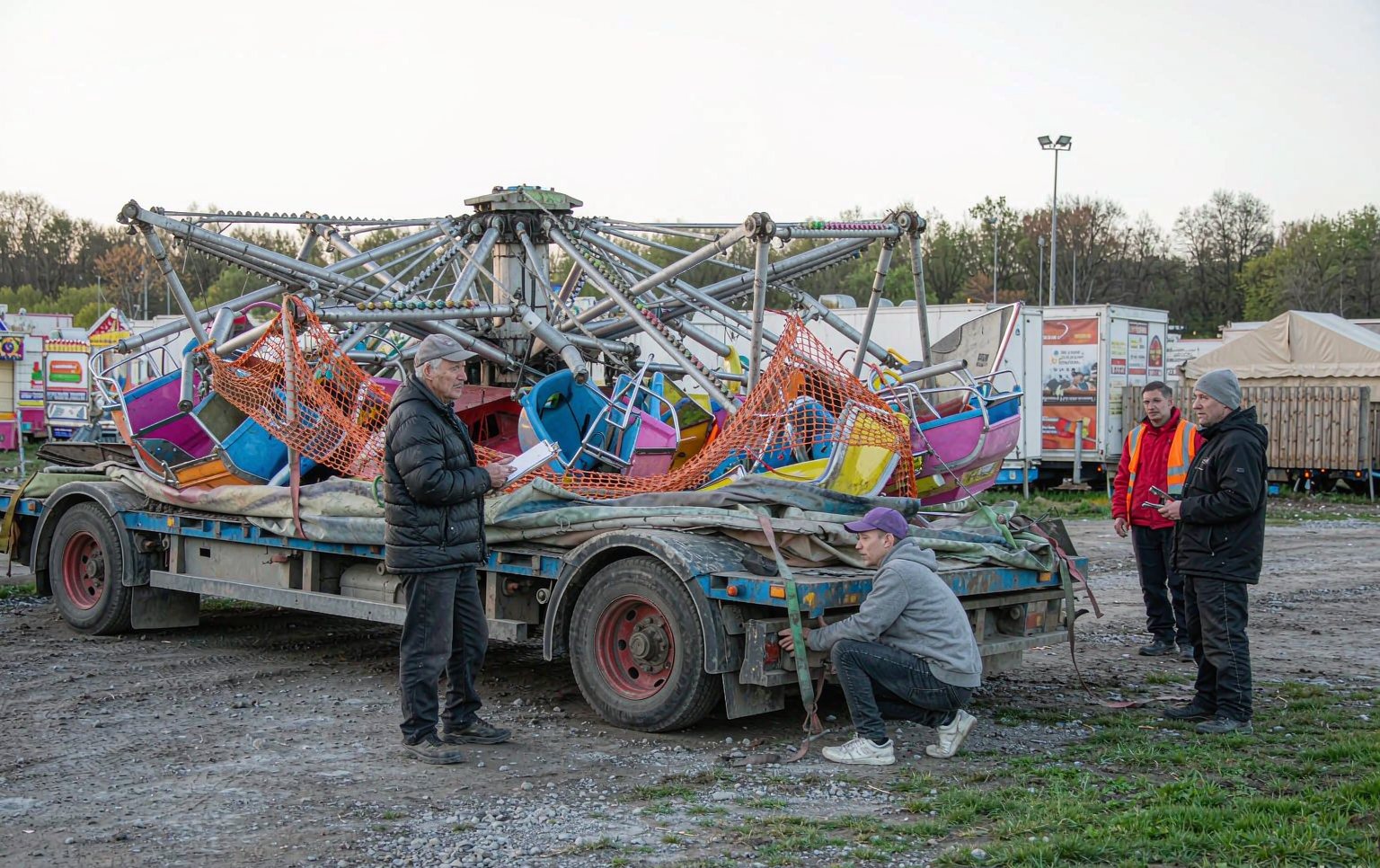
The single biggest configuration decision is mobility. A park-model tagada is installed on a concrete foundation, wired to the site grid, and stays put. A trailer-mounted version integrates the platform, airbag blowers, and control systems onto a road-legal chassis with an onboard generator, letting a carnival operator set up and tear down in hours.
Choose trailer-mounted if you tour fairs, festivals, or multiple sites — the premium over a fixed unit pays for itself in two or three extra booking dates per season. Choose a park model if you operate a fixed venue: you save the chassis cost, gain a slightly larger platform option, and simplify daily setup to a single power-up sequence. Some buyers start with a trailer unit to test demand at rotating locations, then commission a permanent install once the numbers are proven. Either way, every tagada ride for sale in our catalog shares the same platform, airbag system, and control software, so your operators’ training transfers between formats.
A few more differentiators worth weighing before you sign:
- Foundation work: park models need a level concrete slab; trailer units need only firm, level ground.
- Power supply: park models run on site power; trailer units carry an onboard generator for remote venues.
- Weather exposure: outdoor park models should include platform covers and airbag drainage; trailer units are rigged and covered daily.
- Resale value: road-legal units hold value better because the buyer pool includes touring operators.
Safety Considerations Buyers Should Verify
The tagada’s open format is exactly why scrutiny matters. The airbag replaces individual restraints, so the quality of that airbag system, the platform surface, and the emergency systems define the ride’s real safety level. When evaluating any tagada ride for sale, put these items on your inspection checklist:
- Airbag integrity: double-wall laminated PVC, rated drop height, backup blower with automatic changeover
- Platform surface: high-grip padding, no exposed seams in the rider zone, drainage for outdoor units
- E-stop system: redundant emergency stops at the podium and gate, ramp-down program rather than hard stop
- Certification: CE marking and EN 13814 compliance; ASTM documentation for US-bound units
- Height and health signage: clear minimum height, and posted advisories for pregnancy, back, and heart conditions
- Factory test records: every unit should ship with logged load and endurance testing
Beyond the checklist, ask each supplier how the airbag anchors to the platform ring and how often the fabric must be replaced under daily operation. A well-built airbag lasts several seasons; a thin single-wall bag will fade and leak within months of sun exposure. Also confirm the platform speed governor — a compliant tagada ride for sale must cap rotation and bounce forces within EN 13814 limits regardless of what the operator programs. These details separate a machine that passes inspection from one that generates insurance claims, and they are the questions our engineers answer first on every factory tour.
Our factory runs full-load testing on every unit before shipment, and we hold CE, EN 13814, ISO 9001, and ASTM compliance across the range. A 2-year warranty covers the drive and control systems, with lifetime technical support and spare parts supply — the airbag and blowers are consumables, so confirm spare availability and pricing before you sign any contract.
Payment Terms, Lead Times, and Shipping
Standard commercial terms are straightforward: a 30% deposit by T/T secures your production slot, with the 70% balance due before shipment. Lead time for a standard tagada is 25–45 days; custom-themed or trailer-mounted builds run 35–60 days. Sea freight is the norm — a disassembled 36-seat park model typically ships in two to three 40-foot containers, while the trailer-mounted unit ships as a single oversized load.
On-site installation for park models takes 10–25 days depending on foundation readiness, handled by our professional installation team. Include a commissioning week in your planning: that is when our technicians train your operators on the show programs that make this ride profitable. Buyers planning a full venue should read our theme park project guide to sequence the tagada order correctly against foundations, power, and theming — and our amusement ride supplier guide explains how to vet a factory before wiring any deposit.
Frequently Asked Questions
How much does a tagada ride for sale actually cost delivered to my country?
Budget $45,000–$160,000 ex-works depending on size and configuration, plus sea freight, import duties, and installation. A 36-seat park model delivered to most ports typically lands 20–35% above the ex-works figure. We quote CIF or DAP terms on request so your total landed cost is clear before you commit.
Is a tagada ride safe without seatbelts or restraints?
Yes, when built and operated correctly. The inflatable airbag perimeter, high-grip floor, rider orientation, and cycle programming replace mechanical restraints. Compliance with EN 13814 (CE) and, for the US market, ASTM F2291 design standards, plus documented factory load testing, are the proof points to demand from any supplier.
What age is a disco tagada suitable for?
Most operators set a minimum height of 1.2–1.3 m, which translates to roughly ages 8 and up for standard shows. Family sessions with gentler programs can admit younger riders at the operator’s discretion. The core audience is teens and young adults, but a well-run family session fills the platform too.
How many staff does a tagada need per shift?
One operator at the control podium and one attendant at the gate is the standard staffing for a park model — two people total, which is the main labor-cost advantage over comparable-capacity rides. Trailer units at fairs usually add a setup crew only during install and teardown.
Can I get a tagada ride for sale customized with my park’s theme?
Yes. Platform artwork, airbag color schemes, canopy theming, LED lighting packages, and custom sound systems are all configurable. Custom builds add roughly 10–30% to the base price and 10–15 days to lead time. Share your brand assets early so the design is locked before production begins.
Request a Quote for Your Tagada Ride
The disco tagada is one of the few attractions that combines headline capacity, minimal staffing, and show-quality guest experience at a mid five-figure price. Whether the tagada ride for sale you need is a compact 24-seat unit for an FEC, a 40-seat anchor for a thrill zone, or a trailer-mounted machine for the fair circuit, Anxin Amusement builds and tests every platform in our own factory.
Tell us your site dimensions, target audience, and expected throughput, and we will return a detailed quotation with configuration options, delivery terms, and installation planning. Request a quote today and put a money-making disco platform on your park map next season.