
Looking to fill out the toddlers’ corner as well? Browse our complete range of fun rides for kids designed for ages two to ten.
Why a Kiddie Train for Sale Belongs in Your Purchase Plan
A kiddie train for sale is one of the most dependable entry-level revenue generators an operator can buy. It serves the widest demographic in the industry — families with children aged roughly 2 to 10 — yet demands a fraction of the capital, footprint, and staffing of mid-tier family rides. Because a single operator can run the attraction and throughput is steady rather than seasonal, payback periods of 6 to 14 months are realistic for well-sited units. At Anxin Amusement, we have supplied trains for more than 15 years to parks, malls, resorts, and city squares across 24+ countries, and the format remains one of our most requested kiddie categories.
This guide is written for procurement teams, park owners, and family entertainment center (FEC) developers evaluating a kiddie train for sale in 2026. We compare track and trackless formats, cover capacity, theming, batteries, siting, and indicative pricing, and finish with payment terms, lead times, and a pre-purchase checklist.
Track vs Trackless Kiddie Trains: Choosing the Right Format
The first decision every buyer faces is whether the train runs on a fixed track or on wheels with no track at all. Both formats are classified as kiddie trains, but they suit very different venues.
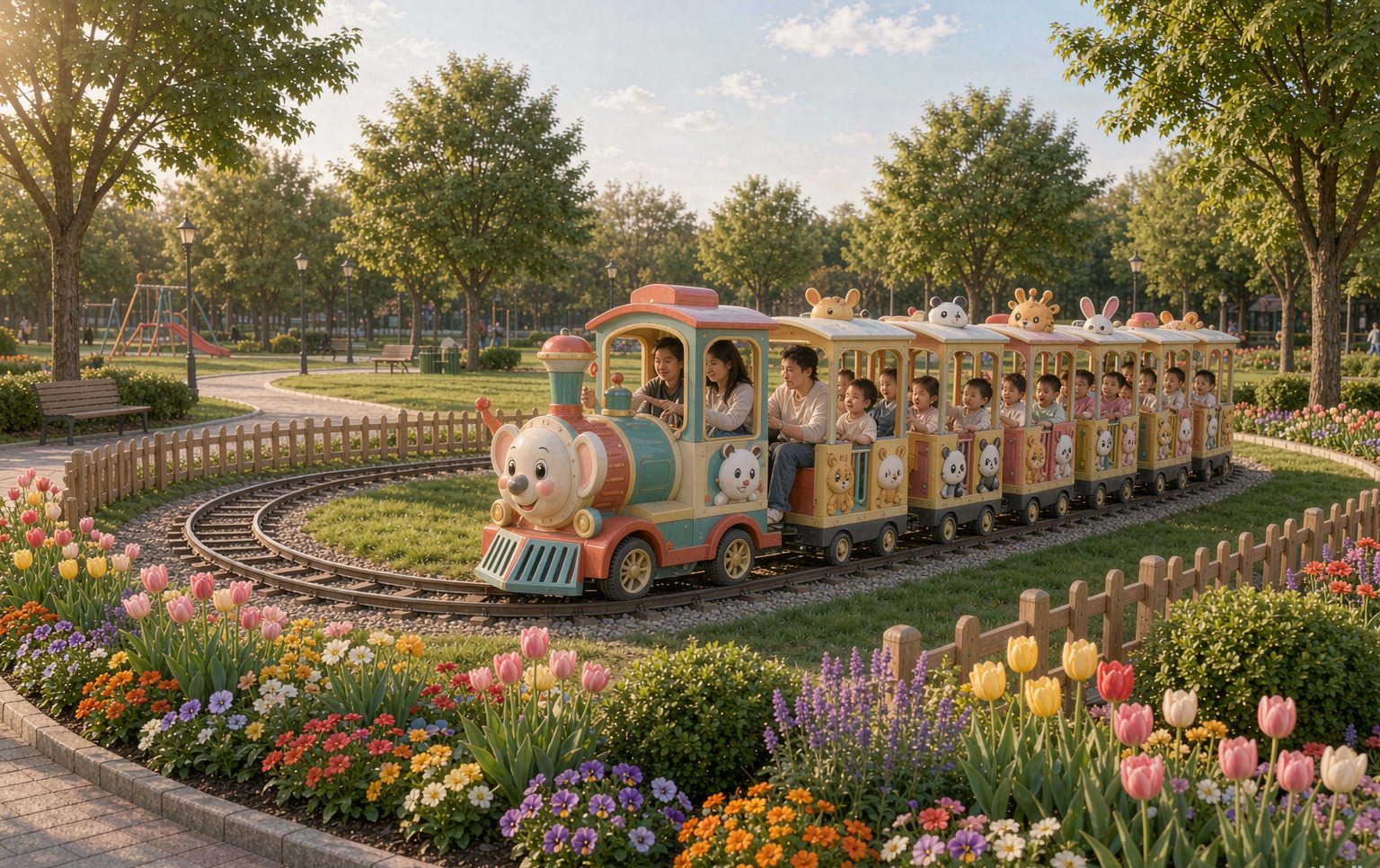
Track trains run on a loop of steel or aluminum rail, typically laid in an oval or custom closed circuit. The locomotive picks up power from the rail or towes battery-powered cars, and the route never changes. Fixed geometry gives parents confidence, simplifies safety briefings, and allows tight, decorative landscaping around the circuit. Tracks suit outdoor parks, playgrounds, and destinations where the train itself is a landscape feature. The trade-offs are civil works (foundation, drainage, track leveling) and zero flexibility once installed.
Trackless trains are road-going vehicles guided by a driver. The locomotive pulls two to four passenger cars that follow on articulated couplings. Because no track is needed, a trackless train can circulate through a shopping mall corridor, a zoo pathway, a resort promenade, or a parking lot converted for weekend events. Relocation takes minutes, which makes trackless models ideal for operators who serve multiple venues or rent the attraction out. The trade-offs: you need smooth, level surfaces, and throughput depends on the loop you can drive.
Many operators who browse our kiddie rides for sale catalog ultimately buy one of each — a trackless unit for daily mall operation and a track model for seasonal park peaks. If your venue is a fixed destination with room for civil works, go track. If flexibility and multi-venue operation matter more, go trackless.
When you compare any kiddie train for sale, ask the supplier three questions up front: what is the drivetrain (rail-powered, battery, or hybrid), what is the turning geometry of the full consist, and what is the lead time for spare couplings and wheels. The answers reveal more about build quality than any catalog photo, and a factory that engineers its own chassis and fiberglass shells — rather than reselling — will answer all three with specific numbers.
Capacity and Theming: 12–24 Kids in Animal, Retro and Royal Shells
Passenger capacity for a kiddie train for sale typically ranges from 12 to 24 children per dispatch. A standard consist pairs one locomotive with three cars at 4 seats each (12 kids); larger consists add a fourth or fifth car, reaching 16–20 seats, while 24-seat configurations pair a more powerful locomotive with wider cars. Adults can usually ride alongside toddlers on the larger track models, which lifts perceived value for families and increases effective ticket yield.
Theming is where a train earns its premium. Our most popular shell families include:
- Animal theme: elephant, lion, or dinosaur locomotives with animal-face cars — the default choice for zoos, playgrounds, and preschool-heavy venues.
- Retro theme: 19th-century steam-style boilers, brass-finish chimneys, and wood-look cladding that photograph beautifully in city squares and heritage districts.
- Royal theme: crown motifs, gold trim, and carriage-style cars favored for malls, wedding venues, and holiday events.
Shells are molded in automotive-grade fiberglass (FRP), gel-coated in your chosen palette, and finished with automotive paint and clear coat for UV and scratch resistance. Custom livery — your mascot, park logo, or sponsor branding — is available on request and typically adds 7–12 days to production.
Indoor and Outdoor Siting: Footprint and Turnaround Circles
Siting determines both safety and revenue, so plan it before you order.
Track trains: a compact oval circuit for a 1+3 consist needs roughly 10 m × 15 m including safety clearance; a more generous loop with scenery runs 15 m × 25 m or larger. Track gauge is typically 600–762 mm, and the rail bed requires a leveled, drained concrete or compacted gravel base. Allow extra width on curves — the cornering envelope of a 4-car consist is wider than the car body itself.
Trackless trains: footprint is defined by your driving loop, not the machine. The critical spec is the turnaround circle: a full consist needs a minimum turning radius of about 3.5–4.5 m to reverse direction without reversing maneuvers. Indoors, map corridors, door widths (minimum 1.2 m per car), floor loading, and pillar clearance before committing. Ceiling clearance of 2.4 m suffices for all standard shells.
Outdoors, plan for queue shading, a boarding platform or marked boarding zone, and wheel-stop barriers where the loop crosses pedestrian desire lines. Most of our clients pair the train with other amusement rides for sale in a designated family zone, which concentrates the highest-spending visitors in one circuit.
Indoor operation adds a few extra checks: confirm floor load capacity (a loaded 4-car consist distributes roughly 150–250 kg per car wheel-set), verify ventilation if you opt for lead-acid batteries in an enclosed space, and agree a charging corner with your facility manager. These details are easy to settle before shipping and expensive to solve after arrival.
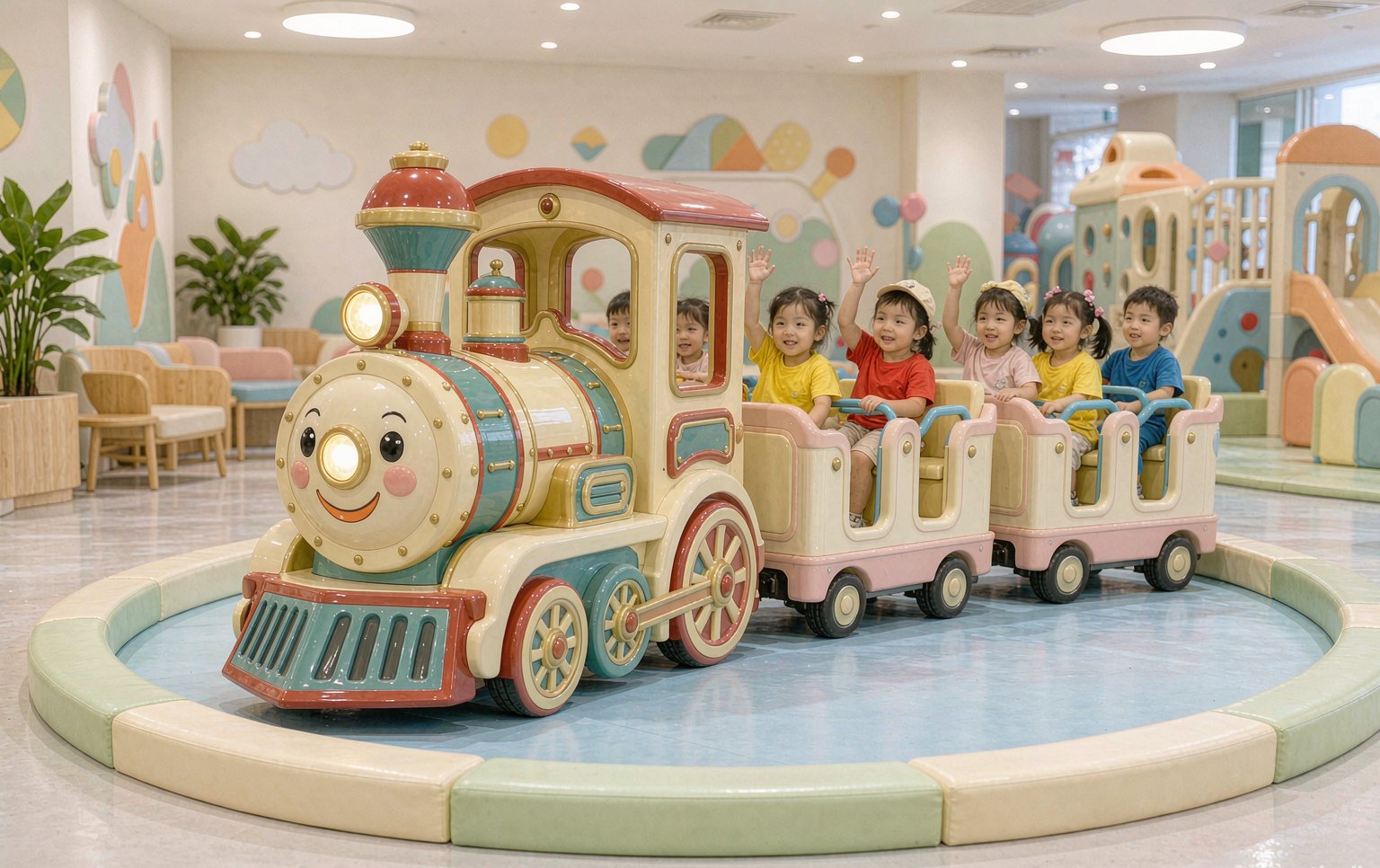
Battery Systems and Charging
Power is the quiet cost driver in train ownership, so spec it deliberately.
Lead-acid battery sets remain standard on entry configurations. They are inexpensive and serviceable anywhere, but heavier, slower to charge (8–10 hours), and shorter-lived — expect 300–500 cycles before noticeable range loss.
Lithium (LiFePO4) packs are our recommended upgrade for trackless models and any unit running 6+ hours daily. They charge in 2–4 hours, roughly double cycle life, cut battery weight by 60%, and maintain consistent speed as they discharge. Range for a loaded 4-car trackless consist is typically 25–40 km per charge — a full day of mall circulation.
Charging infrastructure is simple: a standard 220V (or 110V on request) outlet on a dedicated circuit per locomotive. For dual-shift operations, specify a spare battery set with quick-swap connectors so charging happens off-vehicle. All drivetrains carry CE certification, and every unit is factory-tested under load before dispatch in line with our EN 13814 and ISO 9001 quality procedures.
Kiddie Train Price Bands
Below are indicative ex-works price bands based on our current 2026 quotation data. Final pricing for any kiddie train for sale depends on configuration, theming depth, battery choice, and order volume.
| Configuration | Capacity | Power | Indicative Price (USD) |
|---|---|---|---|
| Trackless train, 1 loco + 3 cars | 12–14 kids | Lead-acid | $9,000 – $15,000 |
| Trackless train, 1 loco + 4 cars | 16–20 kids | Lithium LiFePO4 | $15,000 – $22,000 |
| Track train (oval circuit), 1 loco + 3 cars | 12–18 kids | Rail-powered / battery | $13,000 – $20,000 |
| Track train, large consist 1 loco + 4–5 cars | 20–24 kids | Rail-powered / battery | $20,000 – $32,000 |
| Custom themed shells (retro/royal, bespoke livery) | — | — | +$3,000 – $8,000 |
Prices are indicative, ex-works China, and configuration dependent. They exclude shipping, import duties, track materials for track models, and on-site installation.
Budget roughly 15–25% on top of ex-works pricing for sea freight, insurance, and port charges, and factor civil works of $2,000–$8,000 for a track bed on outdoor installations. Compared with mid-tier family rides in the $60,000+ range, the payback math is what makes every kiddie train for sale such a compelling first purchase.
One more pricing note for first-time importers: ordering two or three units together — a common move for mall chains and rental operators — typically cuts per-unit freight by 10–20% and unlocks volume pricing on the train itself. Ask our sales team to quote mixed configurations in a single container plan.
Payment Terms, Lead Times and After-Sales Support
Standard commercial terms are straightforward:
- Payment: 30% deposit by T/T to start production; 70% balance before shipment. L/C is negotiable for established buyers and larger orders.
- Lead time: 25–45 days for standard configurations; 35–60 days for custom theming, oversized consists, or combined park orders.
- Packing: steel-frame crating with bubble wrap for FRP shells; cars and locomotive shipped partially disassembled to reduce container cost (a 1+4 consist fits a 20ft container with cars nested).
- Installation: track models ship with layout drawings and video guidance; our engineers can supervise on-site assembly, typically 3–7 days for a train circuit.
- Warranty and support: 2-year warranty, lifetime technical support, and guaranteed spare-parts supply (batteries, motors, couplings, control boards).
- Operator training: driving, charging, daily inspection, and passenger management procedures delivered with documentation and video.
Before wiring any deposit, work through this pre-purchase checklist:
- Confirm venue surface and turning circle against the supplier’s footprint drawing.
- Verify certifications required in your market (CE/EN 13814, ASTM, or local equivalents).
- Decide battery chemistry based on daily operating hours and charging windows.
- Confirm seat count and adult-accommodation needs against your target family profile.
- Agree the theming package, paint colors, and branding in writing before production.
- Clarify Incoterms (EXW/FOB/CIF), port of loading, and who clears customs.
- Request the spare-parts list and first-stocking recommendation with the quotation.
Buyers planning a larger venue build-out should review our theme park project guide for how a train fits into a full ride lineup and zoning plan.
Frequently Asked Questions
1. What is the minimum space needed for a kiddie train for sale?
A trackless consist needs only a smooth driving loop with a 3.5–4.5 m turning radius — many mall operators run figure-eight routes through 400–600 m² of corridor space. A track model needs roughly 10 m × 15 m for a compact circuit plus safety clearance, more if you want scenic landscaping. Send us your site plan and we will return a footprint drawing before you commit.
2. How many children can a kiddie train carry per ride?
Standard consists carry 12–24 kids depending on configuration: 1 locomotive plus 3 cars seats about 12, while 4–5 car consists with wider shells reach 20–24. On larger track models, adults may sit beside toddlers, which families value highly. At a 5-minute cycle with brisk boarding, a 16-seat train can realistically serve 150–200 riders per operating hour in peak periods.
3. Should I buy a track or trackless kiddie train for sale listing?
Choose track if your venue is a fixed destination and you want the train as a permanent landscape feature with the highest perceived safety. Choose trackless if you operate in malls, need to relocate seasonally, or serve multiple venues with one asset — a kiddie train for sale in trackless format is essentially a mobile business. Many clients order both to cover indoor and outdoor seasons.
4. How long does a battery last and how do I charge it?
Lead-acid sets deliver 300–500 cycles with 8–10 hour charging; LiFePO4 lithium packs deliver 1,500+ cycles with 2–4 hour charging. All chargers run from a standard 220V or 110V outlet on a dedicated circuit. For heavy daily use we recommend lithium with a spare quick-swap set, so charging never interrupts operating hours. Range on a full lithium charge is typically 25–40 km.
5. What is the delivery time and warranty for a kiddie train for sale order?
Standard configurations ship 25–45 days after deposit; custom theming or oversized consists take 35–60 days. Sea freight adds 15–40 days depending on destination. Every unit carries a 2-year warranty with lifetime technical support and a guaranteed spare-parts supply, and our team provides operator training and installation supervision for track installations.
Conclusion: Request Your Kiddie Train Quote Today
A kiddie train for sale remains the lowest-risk, fastest-payback attraction in the family ride market — whether you run a mall, a zoo, a resort, or a full amusement park. Decide your format, lock your capacity and theming, and the rest is logistics we handle daily. Every unit ships CE-certified, factory-tested, and backed by a 2-year warranty with lifetime support. Browse our complete custom ride solutions or request a quote today: send your site dimensions and target capacity, and our engineers will return a configuration proposal with an itemized quotation within 24 hours.