
To round out a water zone, see what a commercial water rides manufacturer includes in a log flume package: capacity, pricing and installation scope.
Why an Inflatable Water Park for Sale Is One of the Smartest B2B Investments of 2026
Operators across resort destinations, lakefront municipalities and adventure-park developers are searching for an inflatable water park for sale because the category delivers theme-park excitement at a fraction of hard-structure cost. A floating aqua park turns an ordinary lake, lagoon, quarry or calm bay into a revenue-generating attraction within weeks, not years. Compared with concrete water slides and filtration-heavy pool complexes, an inflatable water park requires minimal civil works, can be relocated seasonally, and scales module by module as attendance grows.
As a manufacturer that has delivered 200+ rides and attractions to customers in 24+ countries over 15+ years, Anxin Amusement supplies complete floating aqua park packages — from single tower-and-slide modules to multi-hundred-square-meter obstacle courses. This guide explains what you are actually buying: materials, anchoring, compliance, pricing, logistics and warranty — the details that separate a three-season asset from a one-season liability.
What You Are Actually Buying: Modules and Layout Options
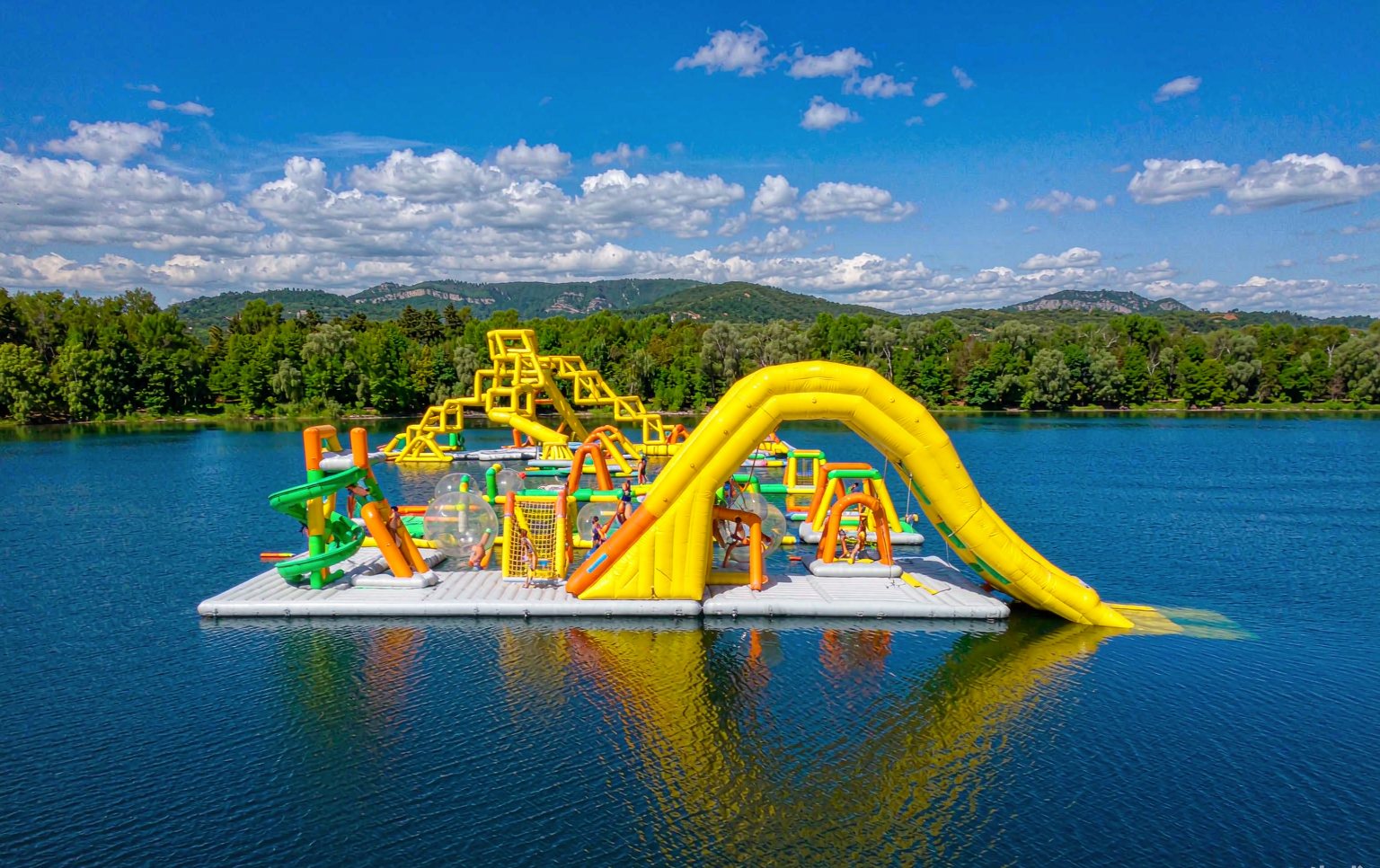
Every inflatable water park for sale is assembled from interchangeable modules, and understanding that modular logic is the key to controlling budget and capacity.
Core modules include:
- Inflatable towers and slide platforms — the visual anchors of the park, typically 3–8 m tall, with climb walls and open or enclosed slides
- Trampoline and bounce surfaces — sealed-air decks where guests jump, flip and splash
- Obstacle and balance elements — bridges, beams, wiggle bridges, hurdles and gaps that create challenge loops
- Rocket slides and action towers — high-throughput slides with deeper-water landings
- Rest and transfer islands — low platforms connecting modules into continuous circuits
- Kids’ zones — shallow-draft, low-height modules separated from the adult course by water gaps or safety buoys
Layouts typically follow a circuit principle: guests progress through increasing difficulty levels, which improves throughput and lets lifeguards supervise along defined sight lines. A compact resort layout may occupy 100–300 m², while a destination park for 300+ concurrent guests can exceed 1,500 m². Because modules are modular, you can start small and reinvest early-season cash flow into expansion — a genuine advantage over fixed water-park infrastructure.
When planning capacity, work backwards from your business model rather than forward from the equipment. Estimate your daily ticket volume, average session length (typically 45–90 minutes for aqua park sessions), and peak-hour turnover. A 300 m² circuit handling 15-minute rotation cycles can process 100+ guests per hour with four lifeguards. Multiply your target revenue per guest by realistic attendance across your season — not your best week — and size the park to the conservative number. Oversizing ties up capital and dilutes utilization; undersizing creates queue frustration that shows up in reviews. Most manufacturers will model several layouts against your figures, so bring real numbers to the negotiation table.
0.9mm PVC Tarpaulin: The Material That Decides Lifespan
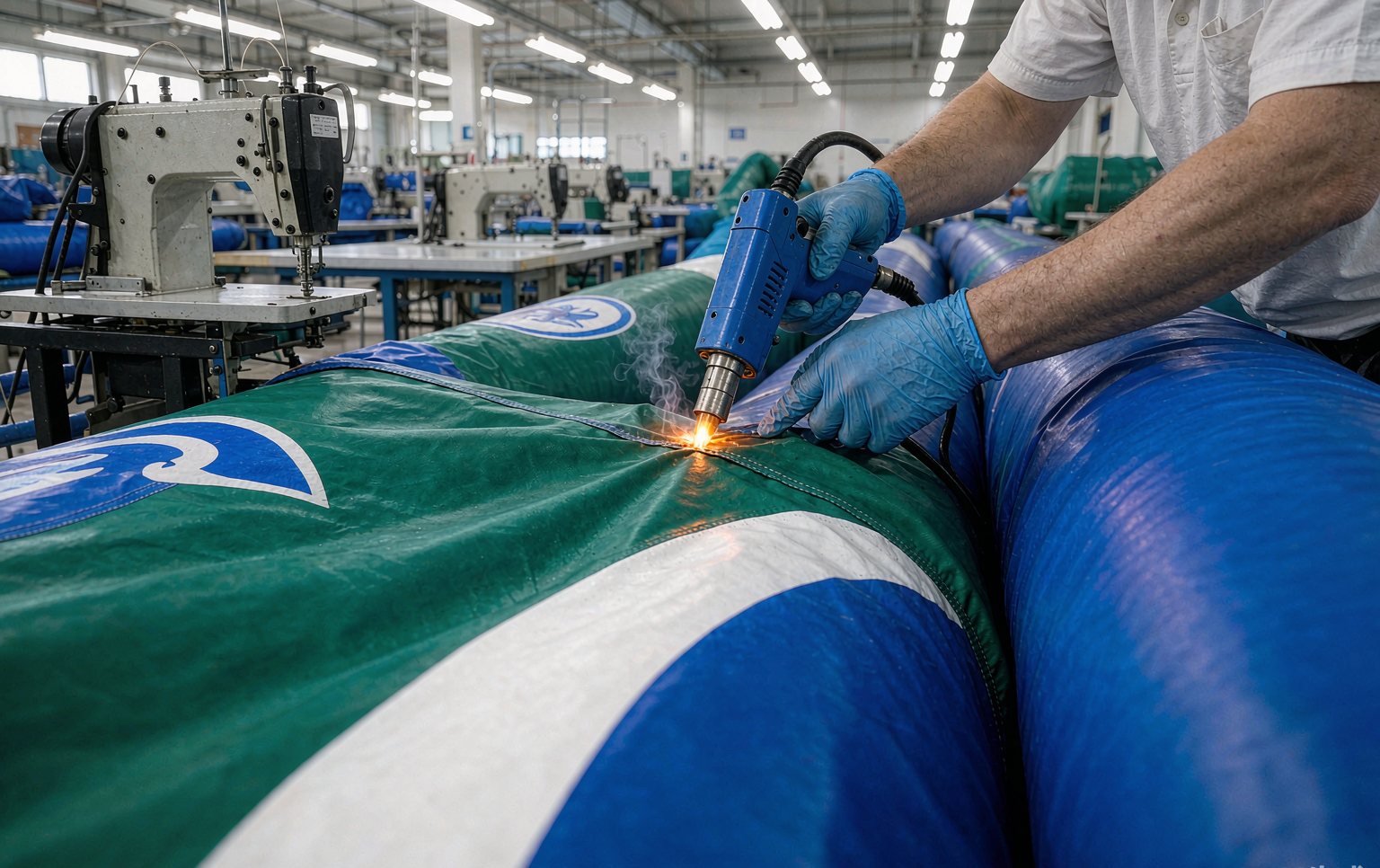
When you compare suppliers, the first specification to interrogate is material. Commercial-grade floating parks use 0.9mm PVC tarpaulin — a double-coated, high-frequency welded fabric — and this thickness is not arbitrary. Thinner 0.6–0.7 mm materials common in retail products will not survive daily commercial use, UV exposure and guest abrasion. Ask every bidder to state their exact fabric weight, coating process and welding method in the quotation itself, so offers are comparable line by line.
What quality 0.9mm PVC tarpaulin delivers:
- Tensile strength and tear resistance sufficient for anchor point loads and hundreds of daily users
- UV-stabilized top coating that resists fading and embrittlement under full sun seasons
- High-frequency (HF) welded seams, which are stronger and more airtight than glued seams used by low-end factories
- Anti-fungus and anti-abrasion treatment for prolonged water contact
- Commercial-grade valves and zippers rated for repeated inflation cycles
With proper care, a professional 0.9mm PVC aqua park lasts 5–8 seasons; budget imports often fail within one to two. When you inspect a sample unit or visit a factory, ask to see cross-sections of the welded seams and request the fabric’s technical data sheet — tensile values, coating weight and UV test hours should all be documented. Manufacturers confident in their material will provide these without prompting. Anxin Amusement also supplies permanent water park equipment for sale — fiberglass slides, pools and play structures — for operators who eventually want a hybrid water attraction alongside their floating park.
Anchoring Systems: Engineering the Park to Water Conditions
Anchor design is where floating aqua parks are won or lost. A park that drifts, yaws or stresses its seams in wind and current will generate complaints, downtime and safety incidents. Before purchasing an inflatable water park for sale, map your water body honestly:
Lake or lagoon (calm inland water): concrete blocks or mushroom anchors on chain or rope risers, typically 25–50 kg per anchor point, with scope ratios of 3:1 to 5:1. This is the standard configuration for most installations.
Sheltered coastal or bay water: heavier blocks (50–100 kg) plus additional cross-anchoring against tidal current; mooring lines must accommodate a tidal range, so risers and buoys are used to keep lines clear of guest areas.
Swimming pools: parks are tensioned to pool edge anchor points or weighted frames — no bottom penetration required.
Anxin Amusement provides a site-specific anchoring layout with every aqua park, calculated from your wind exposure, depth profile and seabed or lakebed composition. Anchor hardware is hot-dip galvanized to resist corrosion, and every line, shackle and buoy is load-rated for the park’s documented pull forces.
Lifeguard supervision plans, buoy-separated swim zones and daily pre-opening inspections complete the operational safety system.
Indicative USD Price Bands for an Inflatable Water Park for Sale
Pricing for an inflatable water park for sale is driven by footprint, module count, slide height and theming. The table below reflects typical ex-works ranges quoted by Chinese manufacturers in 2026; all figures are indicative, ex-works, configuration dependent.
| Configuration | Approx. Footprint | Concurrent Capacity | Indicative Price (USD, ex-works) |
|---|---|---|---|
| Compact lake park (tower, slide, bounce deck) | 100–200 m² | 30–60 guests | $20,000–$45,000 |
| Mid-size resort aqua park (circuit layout) | 300–600 m² | 80–150 guests | $45,000–$90,000 |
| Large destination floating park | 800–1,500 m² | 200–400 guests | $90,000–$150,000 |
| Fully custom themed park (branding, special modules) | 1,500+ m² | 400+ guests | From $150,000 |
Budget beyond the equipment itself: marine anchoring hardware, electric or petrol blowers, safety boats and rescue equipment, lifeguard staffing, water-quality compliance, insurance, and seasonal winterization storage. Realistically, add 15–25% of equipment cost for these first-season items. Ongoing annual costs are modest — routine cleaning, patch maintenance, blower servicing and re-certification inspections typically run 3–5% of equipment value per year — but skipping them is what turns a five-season asset into a two-season write-off. A well-run mid-size park charging $15–25 per guest can recover its investment in one to two strong seasons, which is why the category keeps expanding.
Compliance and Safety: EN 15649 and Beyond
Reputable floating aqua parks are designed and tested to EN 15649, the European standard covering inflatable play equipment — including material strength, seam integrity, anchoring forces, entrapment prevention and labeling. Buyers in the EU should insist on EN 15649 conformity; buyers elsewhere should ask which national or regional standards the manufacturer can document.
Anxin Amusement manufactures under CE, EN 13814, ISO 9001 and ASTM-aligned processes, with factory testing on every unit. Every park ships with a maintenance manual, repair kit, anchor plan and operation guidelines for lifeguards. Ask any supplier the same question set: Where were the welds tested? What is the maximum guest load per module? How are anchor points proof-tested? What documentation accompanies delivery? A serious manufacturer of an inflatable water park for sale answers these without hesitation — and backs the answers with a written warranty.
Warranty and Lifespan: What a 2-Year Warranty Really Covers
Anxin Amusement provides a 2-year warranty on structure and manufacturing, with lifetime technical support and spare-parts supply. In practice, a warranty is only as good as the factory behind it: parts availability, video-based troubleshooting support, and repair guidance during the season matter as much as the paper terms. Compliance and warranty should be evaluated together — a supplier who documents EN 15649 testing is far more likely to honor warranty claims than one who markets on price alone.
Expected lifespan with correct operation:
- Seasons 1–3: full commercial performance; only routine seam and valve checks required
- Seasons 4–6: first refurbishment — patch repairs, valve replacement, cosmetic recoating of high-wear decks
- Seasons 6–8: possible partial module replacement, often limited to the most-used slides
Because modules are replaceable individually, a well-maintained park never faces a single “end of life” — it evolves. That modularity also protects resale value if you upgrade to a larger layout later.
Shipping, Payment Terms and Lead Times
Most aqua parks ship as compressed, baled PVC on pallets inside standard 20ft or 40ft containers — a 400 m² park typically fits in one 40ft container together with blowers and anchoring kits. Sea freight to most destinations adds 20–45 days; air freight is viable for urgent module replacements.
Standard commercial terms are straightforward: 30% deposit by T/T, 70% balance before shipment. Lead times for an inflatable water park for sale run 25–45 days for standard configurations and 35–60 days for custom or large orders — roughly comparable to standard mechanical rides and faster than hard water-park construction by years. Plan your order so production finishes 4–6 weeks before your season opening, leaving buffer for freight and commissioning. Before committing, many buyers review how established suppliers structure full-park packages; our guide to theme park equipment suppliers covers factory audits, reference checks and contract essentials in depth.
Pre-Purchase Checklist for Buyers
- Confirm material spec in writing: 0.9mm PVC tarpaulin, HF-welded seams, UV-stabilized coating
- Demand EN 15649 conformity documentation plus CE marking for the inflatable package
- Get a site-specific anchoring layout matched to your water body, depth and wind exposure
- Verify warranty terms: 2-year structural warranty, spare-parts availability, lifetime technical support
- Check module replaceability so individual pieces can be serviced or upgraded without park-wide downtime
- Confirm capacity math: concurrent guest numbers, lifeguard ratios and throughput against your revenue model
- Clarify logistics: container packing list, freight terms, import duties, and winter storage requirements
- Request references from operating parks in climates similar to yours
Frequently Asked Questions
How much does a commercial inflatable water park for sale actually cost?
Indicative ex-works pricing runs from about $20,000 for a compact 100–200 m² lake park to $150,000+ for a large 800–1,500 m² destination layout. Final pricing depends on module count, slide height, theming and accessories, and excludes anchoring hardware, freight and first-season operating equipment.
Can a floating aqua park stay installed all year?
In warm climates with calm water, yes — parks operate 8–12 months with routine inspections. In regions with freezing winters or storm seasons, most operators drain, clean, dry and store the park indoors each off-season, which materially extends lifespan toward the 5–8 season range.
What water depth does an inflatable water park need?
Slide landings and jump zones generally require 2.5–3 m of water depth; bounce and obstacle sections perform safely at 1.5–2 m. Depths must be verified across the full footprint before the anchoring layout is finalized, and shallow edges should be buoyed off.
Is an inflatable water park for sale compliant with EN 15649?
Commercial floating parks from established manufacturers are designed and tested to EN 15649, covering material strength, seams, anchoring forces and entrapment prevention. Always request the conformity documentation and test reports before ordering, and confirm which additional local requirements apply in your jurisdiction.
How many staff does a floating aqua park require?
A mid-size park typically runs 4–8 lifeguards per shift depending on layout and local regulation, plus one supervisor and a maintenance-qualified technician. Manufacturer training — included by Anxin Amusement with every delivery — covers daily inspection routines, emergency response and seasonal care.
An inflatable water park for sale is one of the fastest, most capital-efficient routes into the attractions business — provided you buy on material, anchoring engineering and warranty, not on the lowest headline price. Anxin Amusement builds 0.9mm PVC tarpaulin floating parks to EN 15649-aligned standards, engineers the anchoring for your specific water body, and stands behind every delivery with a 2-year warranty, operator training and lifetime spare-parts support.
Request a quote today with your water body dimensions, season length and target capacity — our team will return a module-by-module layout and indicative pricing within a few business days.