If you are searching for a chair swing ride for sale, you are looking at one of the most reliable revenue generators in the amusement industry. Known worldwide as the wave swinger, wave spinner, or flying chair ride, this classic attraction combines graceful motion, strong visual presence, and family-friendly thrill levels that appeal to guests from age six to sixty. For park owners, FEC developers, and city planners, few investments deliver a better balance of capacity, footprint, and payback period. Before you request a quote, however, you need to understand the model range, the structural options, the wind engineering behind the canopy, and — most importantly — what a fair price looks like in 2026. This guide covers all of it from a manufacturer’s perspective.
For guests who want even more airtime, many parks pair this attraction with a flying chair ride, giving families two heights of airborne thrills on a shared midway.
If your guests crave stronger sensations, a dedicated pendulum rides zone is the natural next step when expanding beyond family attractions.
What Exactly Is a Chair Swing Ride?
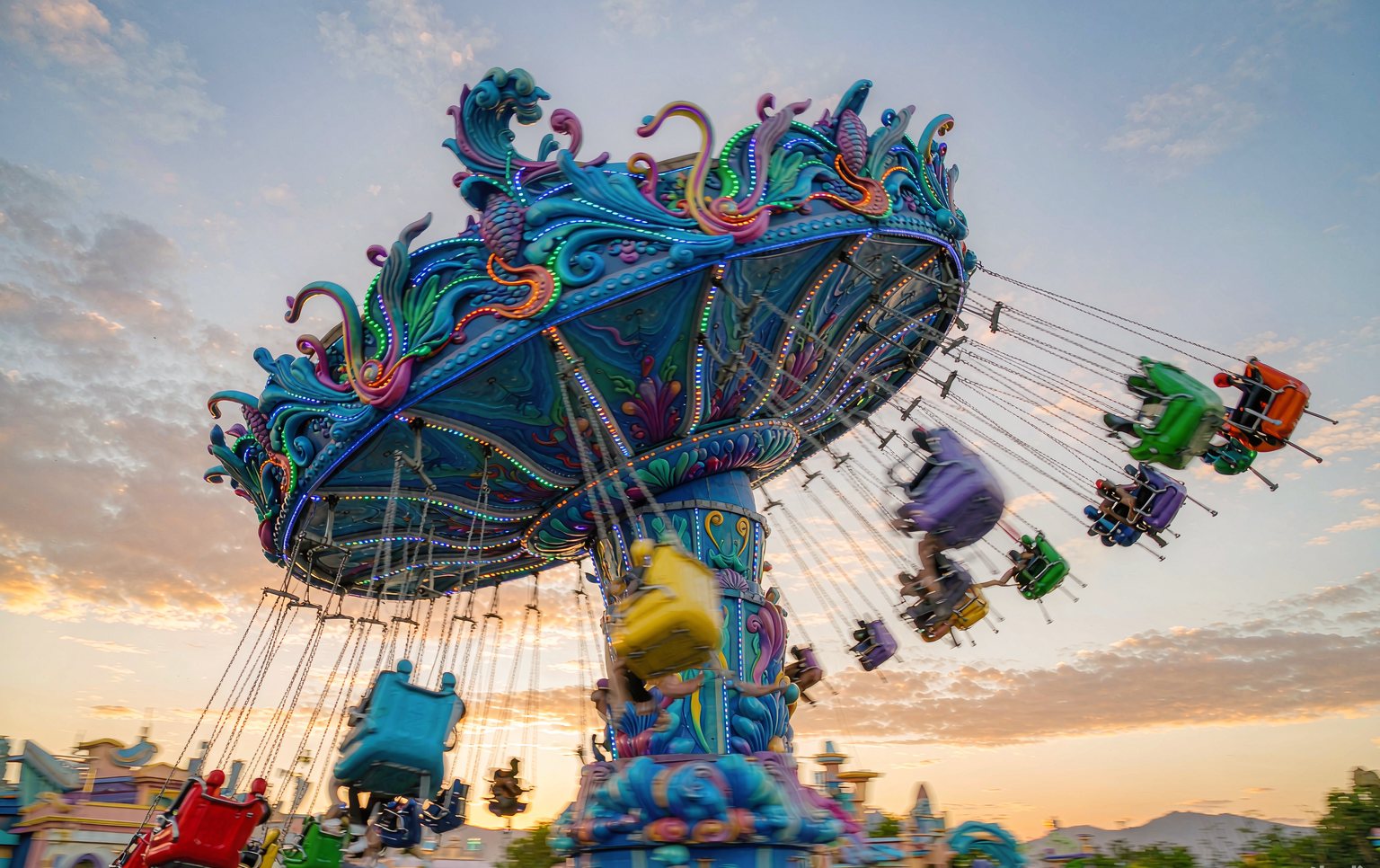
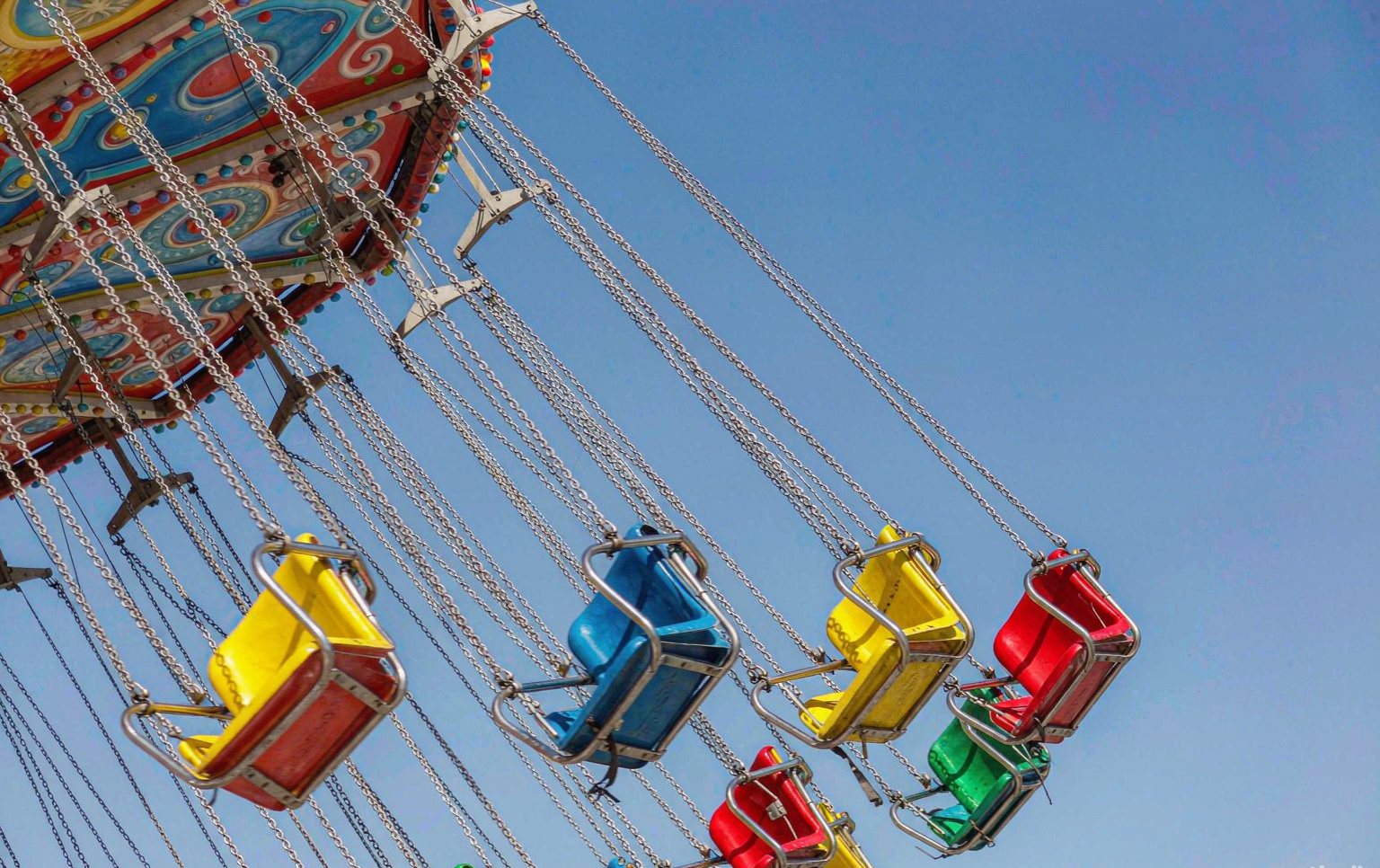
A chair swing ride for sale on today’s market is a rotating attraction in which passengers sit in suspended seats arranged in a circle around a central column. As the ride spins, centrifugal force lifts the chairs outward and upward, creating the sensation of flying. The top of the column carries a decorative canopy — typically shaped like a scalloped umbrella, a coconut tree crown, or a themed roof — which defines the ride’s silhouette and is the single most important element for theming and LED integration.
Operators love this category for three reasons. First, throughput: a 32-seat unit can cycle 900–1,100 riders per hour with a 3-minute operation. Second, sight lines: because riders fly outward in full view, the attraction acts as its own advertisement. Third, age breadth: unlike a drop tower or a pendulum ride, the flying chair welcomes families, which means a broader paying audience per cycle. That combination is why wave swingers remain one of the most replicated ride concepts in the world — and why quality differences between factories matter so much when comparing a chair swing ride for sale across suppliers.
Popular Models: 24, 32 and 48 Seats
Manufacturers typically offer the chair swing family in three capacity tiers. Choosing between them is a trade-off between budget, footprint, and revenue potential.
- 24-seat model — The entry tier. Diameter of roughly 9–10 meters, ideal for FECs, city squares, and small parks where space is tight. Lower power consumption (typically 15–22 kW) and the shortest lead time make it a common first purchase for new operators.
- 32-seat model — The workhorse and the most requested configuration. Around 11–12 meters in diameter, it hits the sweet spot between ticket revenue and operating cost, and it fits comfortably into a mid-size park lineup alongside carousels and family coasters.
- 48-seat model — The flagship. With a diameter of 14–16 meters and a taller central column, it anchors a themed zone and maximizes per-cycle revenue. Recommended where daily attendance exceeds 3,000 visitors or where the ride doubles as a visual landmark.
Seat design varies too: standard FRP chairs with lap bars, luxury seats with backrests and safety harnesses, or themed chairs shaped as baskets, teacups, or characters. Every unit we ship includes factory load-testing on each suspension chain and seat bracket before dispatch, along with a documented balance test of the rotating assembly.
Tilting Tower vs Fixed Tower: Which Structure Should You Buy?
One technical decision catches many first-time buyers off guard: the central tower can be fixed or tilting.
On a fixed-tower wave swinger, the canopy stays level and the chairs fly out at a constant angle. This is the classic configuration — simpler mechanics, lower cost, easier maintenance, and fully compliant with the same EN 13814 safety principles as larger rides.
On a tilting-tower model, the entire canopy assembly tilts a few degrees (usually 3–7°) while rotating, adding a gentle wave motion to the flight path. The effect is noticeably more dynamic, and it allows operators to increase the perceived thrill without raising speeds — a genuine advantage in markets where families want “one step more” than a standard flying chair. The trade-offs are a higher price, more complex hydraulic or mechanical actuation, and slightly more demanding inspections.
Our advice: choose the fixed tower for family zones and budget-sensitive projects; choose the tilting tower when you want the attraction to stand out in a competitive market or when positioning it as a mid-thill ride between kiddie attractions and your headline coaster. Many parks that buy one fixed-tower unit return two seasons later for a second, larger model once the first ride proves its numbers.
Canopy Theming and LED Package: Your Silent Marketing Team
The canopy is not decoration — it is marketing. A well-themed wave swinger works twelve hours a day as a landmark that photographs itself, and guest photos become free advertising across social platforms. When comparing a chair swing ride for sale from different factories, scrutinize the canopy package carefully:
- FRP sculpture quality — Look for automotive-grade gel coat, reinforced ribs, and UV-stable pigments that resist fading for 5+ years outdoors in high-sun destinations.
- LED integration — Full-perimeter RGB lighting under the canopy skirt, an illuminated center column, and programmable chase effects synchronized to ride motion. A lighting package can raise night revenue by 20–30% in warm climates where evening operation dominates.
- Custom themes — Ocean, jungle, candy land, aviation, or IP-adjacent color schemes. Custom paint and sculpture typically add 8–15% to the base price but transform the attraction’s social-media performance and its ability to anchor a themed zone.
- Audio — Integrated sound system with Bluetooth control for announcements and music playback during cycles.
Ask each supplier for close-up photos of a delivered canopy at least two years old, not just renderings of new production. Gel-coat chalking, faded sculpture, and cracked FRP seams are the tell-tale signs of a factory cutting corners on materials.
Wind Speed Limits and Site Requirements
Suspended-seat rides are more wind-sensitive than ground vehicles, and any serious proposal for a chair swing ride for sale must address wind engineering. Chairs on chains act like sails; uncontrolled swinging in gusts accelerates wear on suspension components and can push loads beyond design limits. For buyers in coastal destinations, we recommend confirming the local maximum wind speed record before selecting a chair swing ride for sale, because that figure drives the foundation and canopy design.
Industry practice sets operational limits at approximately Beaufort force 6 (10.8–13.8 m/s) — above that threshold, the ride should pause operation until winds subside. Your installation should include an anemometer mounted on the canopy or a nearby mast, wired to the control cabinet with an audible alarm. Foundations matter just as much: a 32-seat unit typically requires a reinforced concrete ring foundation of 10–12 meters diameter, and 48-seat models need engineered footings sized to local seismic and wind codes. Indoor or rooftop installations change the picture entirely — the structure must be verified against building load capacity. Always send your site’s soil report and local wind data to the manufacturer before fabrication; retrofitting foundations is far more expensive than designing them correctly the first time.
How Much Does a Chair Swing Ride Cost? Indicative Price Bands
Pricing for this category spans a wide range depending on size, theming, and structure type. The table below reflects typical ex-works (ex-factory) bands in USD — indicative figures, configuration dependent, excluding sea freight, installation, and civil works.
| Configuration | Seats | Diameter | Indicative Price (USD, ex-works) |
|---|---|---|---|
| Fixed tower, standard theme | 24 | 9–10 m | $28,000 – $45,000 |
| Fixed tower, LED canopy | 32 | 11–12 m | $45,000 – $75,000 |
| Tilting tower, full LED + custom theme | 32 | 11–12 m | $60,000 – $95,000 |
| Flagship fixed tower, luxury seats | 48 | 14–16 m | $80,000 – $150,000 |
| Flagship tilting tower, premium theming | 48 | 14–16 m | $100,000 – $150,000+ |
Budget additions beyond the table: sea freight (typically $4,000–$12,000 depending on destination and volume), on-site installation (10–15 days for this category, including test runs and operator handover), civil works, and customs duties. For a total landed-cost projection rather than an equipment-only figure, ask the factory to quote CIF or DAP terms — reputable suppliers will model this for free, and it removes the most common source of budget overruns for first-time importers.

Certification, Payment Terms and Lead Times
Before wiring any deposit, confirm the paperwork. Every export-grade flying chair should ship with:
- CE marking and EN 13814 compliance documentation
- ISO 9001-certified manufacturing records plus weld and FRP material certificates
- Factory load and balance test report for your specific unit
- Foundation drawings and a full installation manual in English
- An operator training plan and a 2-year warranty covering structural and drive components, with lifetime spare-parts support
Standard payment structure for international orders is 30% deposit by T/T, 70% balance before shipment, typically against photos and video of the completed factory test. Lead times run 25–45 days for standard configurations and 35–60 days for custom-themed or tilting-tower models. Ask for a production schedule with photo checkpoints at the steel structure, FRP molding, and pre-shipment stages so you can monitor progress without traveling to the factory. If a supplier resists these checkpoints, treat it as a red flag.
Buyer’s rule of thumb: if a quote arrives without foundation drawings, without test documentation, and without a named warranty scope, the lowest price on your desk is not the lowest cost of ownership.
6. How do I evaluate a supplier before I buy?
Beyond the equipment itself, the supplier relationship determines your total cost of ownership. Verify manufacturing experience (ask for photos of rides still operating after 5+ years), confirm spare-parts availability for at least a decade, and request references from parks in your climate zone. A factory with 15+ years of history and deliveries to dozens of countries has already solved the export logistics, documentation, and after-sales questions that trip up newer workshops. Every chair swing ride for sale in our catalog comes with full documentation, and for buyers planning a complete attraction lineup, our amusement rides for sale catalog shows how the wave swinger pairs with other family and thrill attractions.
Frequently Asked Questions
1. What is the minimum space needed for a chair swing ride?
Plan for the ride diameter plus a 1.5–2 meter safety clearance ring. A 32-seat chair swing ride for sale with an 11-meter diameter therefore needs roughly a 14–15 meter operating envelope, plus queue space. Indoor installations require a minimum clear height of about 6–7 meters depending on the model.
2. How many operators does a wave swinger need?
One trained operator plus one attendant at the gate during peak hours. Cycle times of 2.5–3.5 minutes with a 1-minute load/unload window are typical, and modern PLC controls include automatic cycle sequencing to reduce staffing pressure.
3. What daily revenue can a 32-seat model generate?
At a $4 ticket, 900 riders per hour, and 6 effective operating hours, theoretical gross revenue exceeds $20,000 per day. Realistic planning figures for a mid-size park are 25–40% of theoretical throughput. Most operators recover the equipment cost within 6–14 months in season-strong markets.
4. Can the ride be customized to my park’s theme?
Yes. Canopy shape and paint, chair styling, center-column sculpture, LED color programs, and even the ticket-booth façade can all be themed. Share your park’s concept drawings during quotation so the factory prices the customization into the first offer instead of as a change order later.
5. What maintenance does a flying chair ride require?
Daily visual checks of chains, seats, and lap bars; monthly lubrication of the central bearing and drive assembly; and an annual inspection of welds and suspension hardware. Chain replacement intervals run 3–5 years depending on usage and climate. A supplier offering guaranteed spare-parts supply is essential — confirm spare availability for at least 10 years before signing.
Request a Quote for Your Chair Swing Ride
The wave swinger has survived seventy years of industry evolution for a simple reason: it delivers joy visibly, reliably, and profitably. Whether you need a compact 24-seat unit for an FEC, a themed 32-seat centerpiece, or a flagship 48-seat tilting tower, the fastest way to a firm number is a direct conversation with the factory. Send us your site dimensions, expected attendance, and target opening date, and our engineering team will return a configured quotation with layout drawings, freight options, and a production schedule.
Ready to buy? Request a quote today or browse the full ride lineup on our website. To plan the ride into a complete attraction mix, start with our theme park manufacturers buyer’s guide. As a manufacturer with 15+ years of experience and rides operating in 24+ countries, Anxin Amusement supports every chair swing ride for sale with installation supervision, operator training, and lifetime technical service.