In the global amusement industry, safety is the single most important factor determining the success and longevity of any park or attraction. For investors and operators, understanding the complex world of amusement ride safety standards is not just a regulatory requirement—it’s a critical business decision. Two of the most prominent and often-discussed standards are the European CE mark (governed by EN 13814) and the American ASTM F24 standards.
Navigating the differences between these two frameworks can be daunting. This comprehensive guide will demystify amusement ride safety standards CE ASTM, breaking down what they mean for your project, how they compare, and why choosing a manufacturer who understands both is essential for your peace of mind and operational success.
🛡️ Understanding the CE Mark and EN 13814 Standard
The “CE” marking is a manufacturer’s declaration that a product complies with all applicable European Union (EU) directives. For amusement rides, the key directive is the Machinery Directive, and the harmonized standard that provides the technical specifications is EN 13814: Amusement rides and amusement devices – Safety.
The CE certification process is rigorous and holistic, covering the entire lifecycle of a ride:
- Design & Risk Assessment: Every potential hazard must be identified and mitigated through design. This includes structural integrity, electrical systems, and control logic.
- Manufacturing & Quality Control: The manufacturing process must be controlled to ensure every ride is built to the exact specifications of the approved design. This often involves third-party inspections of the factory’s quality management system (often ISO 9001).
- Third-Party Inspection (Notified Body): For most significant rides, an independent, EU-recognized organization called a “Notified Body” (like Germany’s TÜV) must review the design calculations and inspect the final product before it can be CE marked.
- Technical File: The manufacturer must compile a comprehensive technical file containing all design drawings, calculations, risk assessments, test reports, and user manuals. This file must be available for inspection by authorities for at least 10 years.
Key Focus of EN 13814:
- Safety Factors: It specifies precise safety factors for materials (e.g., a safety factor of 5 for steel ropes in passenger restraint systems).
- Non-Destructive Testing (NDT): It mandates rigorous NDT, such as X-ray or ultrasonic testing, on all critical welds to ensure there are no hidden flaws.
- Control Systems: It requires redundant safety circuits. For example, an emergency stop must be a hard-wired, dual-channel system, meaning two independent circuits must both fail for the safety function to be compromised.
🇺🇸 Demystifying the ASTM F24 Standard
In the United States and many other parts of the world, the benchmark for safety is set by ASTM International, specifically committee F24 on Amusement Rides and Devices. Unlike the CE mark, which is a legal requirement for sale in Europe, ASTM F24 is a set of voluntary consensus standards. However, they are so widely respected and adopted by local jurisdictions and insurance companies that compliance is effectively mandatory.
The ASTM F24 standards are a series of documents, each covering a specific aspect of ride safety:
- F2291: Standard Practice for Design of Amusement Rides and Devices. This is the core document, outlining the engineering principles for structural design, load calculations, and material selection.
- F1159: Standard Guide for the Design, Manufacture, Operation, and Maintenance of Electric Control Systems. This covers all electrical and control system safety.
- F770: Standard Practice for Ownership, Operation, Maintenance, and Inspection of Amusement Rides and Devices. This standard focuses on the operational side, providing guidelines for daily, monthly, and annual inspections.
Key Focus of ASTM F24:
- Performance-Based: ASTM standards are often more performance-based than prescriptive. They define the required outcome (e.g., the ride must withstand certain forces) rather than dictating the exact method to achieve it.
- Focus on Operations: A significant portion of the ASTM framework is dedicated to the ongoing operation and maintenance of the ride, recognizing that safety is a continuous process.
- Material Specifications: It provides detailed requirements for materials, including steel grades, weld procedures, and corrosion protection, ensuring long-term durability.
⚖️ CE vs. ASTM: A Head-to-Head Comparison
While both CE (EN 13814) and ASTM F24 aim for the same goal—maximum safety—they have different approaches and areas of emphasis. Understanding these nuances is key for any international project.
| Feature | CE Marking (EN 13814) | ASTM F24 Standards |
|---|---|---|
| Jurisdiction | Mandatory for the European Economic Area (EEA). | Voluntary, but widely adopted in the USA and globally. |
| Core Philosophy | Prescriptive and process-oriented. | Performance-based and operation-oriented. |
| Certification Body | Requires a “Notified Body” (e.g., TÜV) for most rides. | No central certification body; compliance is self-declared or verified by engineers. |
| Key Documentation | A comprehensive, legally-required Technical File. | Design calculations, manuals, and inspection records. |
| Primary Focus | Design, manufacturing process, and risk assessment. | Structural design, operational procedures, and maintenance. |
Structural Integrity and Materials: Both standards demand high-grade steel and robust welding. EN 13814 is very specific about NDT methods and the qualifications of welders. ASTM F2291 provides detailed load combinations (dead load, live load, wind load, seismic load) that the structure must withstand. A high-quality manufacturer will design to meet or exceed the stricter of the two requirements for any given component.
Electrical and Control Systems: This is a critical area of convergence. Both standards require redundant safety circuits for emergency stops, restraint locking, and overspeed protection. They mandate the use of safety-rated PLCs (Programmable Logic Controllers) and sensors to ensure that a single point of failure cannot lead to a hazardous situation.
Restraint Systems: The safety of the passenger restraint is paramount. Both standards require that restraints be fail-safe and often redundant. For example, a hydraulic lap bar might also have a mechanical locking pin as a backup. The systems are tested to withstand forces far greater than those experienced during normal operation.
🏭 The Anxin Amusement Commitment to Global Safety
At Anxin Amusement, we understand that our clients operate in diverse regulatory environments. That’s why our engineering and manufacturing processes are built from the ground up to comply with both CE and ASTM amusement ride safety standards.
When you partner with us, you are not just buying a ride; you are investing in a product that has been engineered for global compliance and operational safety.
- Dual-Standard Design: Our engineering team designs every ride, from our iconic Ferris wheels to our thrilling drop towers, to satisfy the core requirements of both EN 13814 and ASTM F2291.
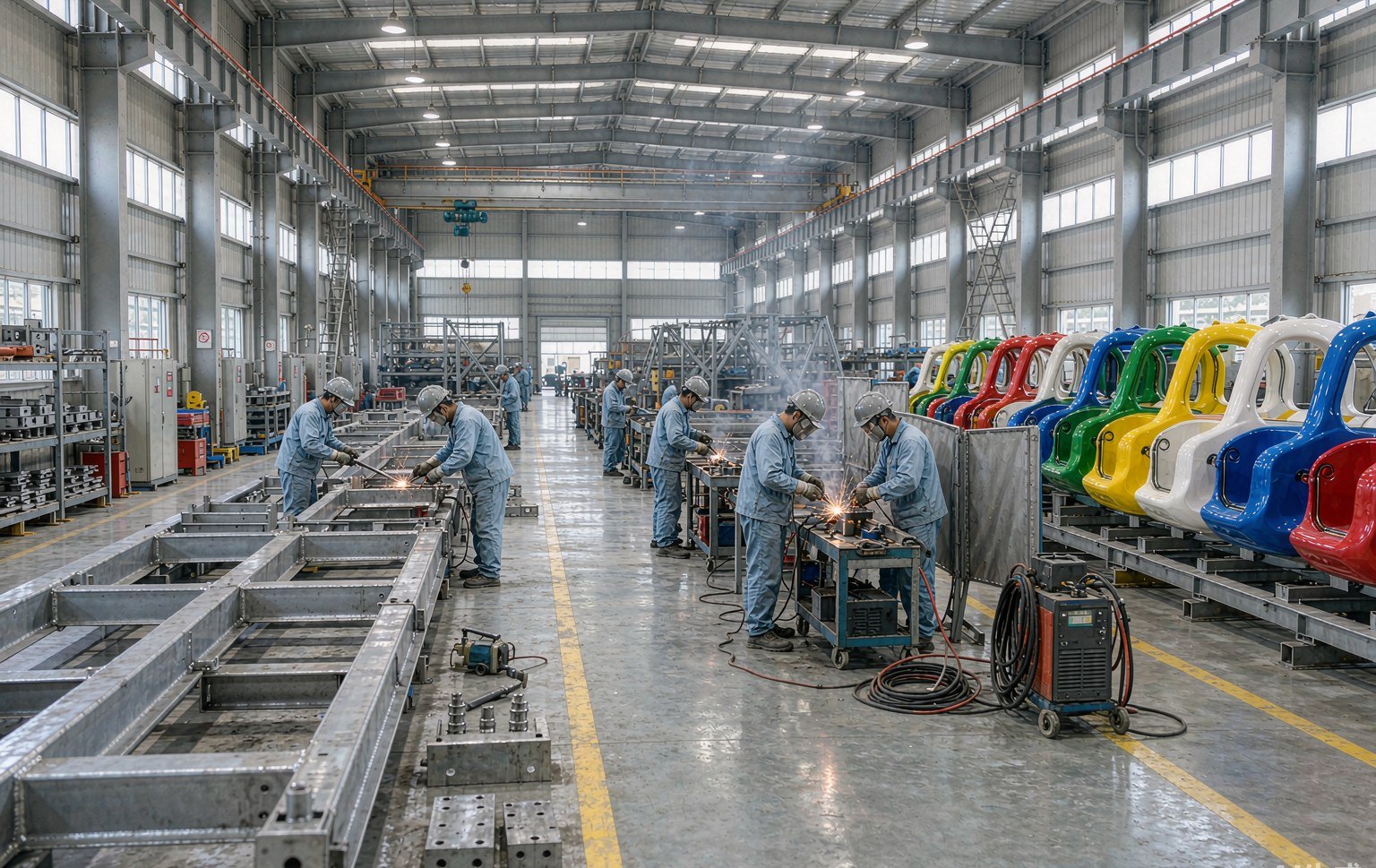
- Rigorous Manufacturing: Our factory in Zhengzhou is equipped with advanced CNC machinery and robotic welding arms to ensure precision and consistency. Every critical weld undergoes NDT, and our quality control team performs inspections at every stage of production, in line with ISO 9001 principles.
- Comprehensive Documentation: We provide a full set of documentation with every ride, including detailed assembly drawings, electrical schematics, parts lists, and operation manuals, making it easier for you to gain local approval, whether you are in Europe, North America, or elsewhere.
- Proven Global Track Record: With rides successfully operating in over 24 countries, our equipment has been inspected and approved by authorities worldwide. Our commitment to safety is validated by our CE certification and our adherence to ASTM principles.
Conclusion: Safety as a Foundation for Success
Choosing the right amusement ride is a significant investment. Understanding the underlying amusement ride safety standards CE ASTM is the first step in making an informed decision that protects your guests, your staff, and your bottom line.
While the frameworks differ, their ultimate goal is the same: to create a safe and enjoyable experience for everyone. By choosing a manufacturer like Anxin Amusement, which is deeply versed in both, you ensure that your attraction is built on a foundation of world-class engineering and an unwavering commitment to safety.
Ready to build your dream park with confidence?
Contact Anxin Amusement today to discuss your project. Our team of experts can guide you through the process, ensuring your new attractions meet the highest international safety standards.