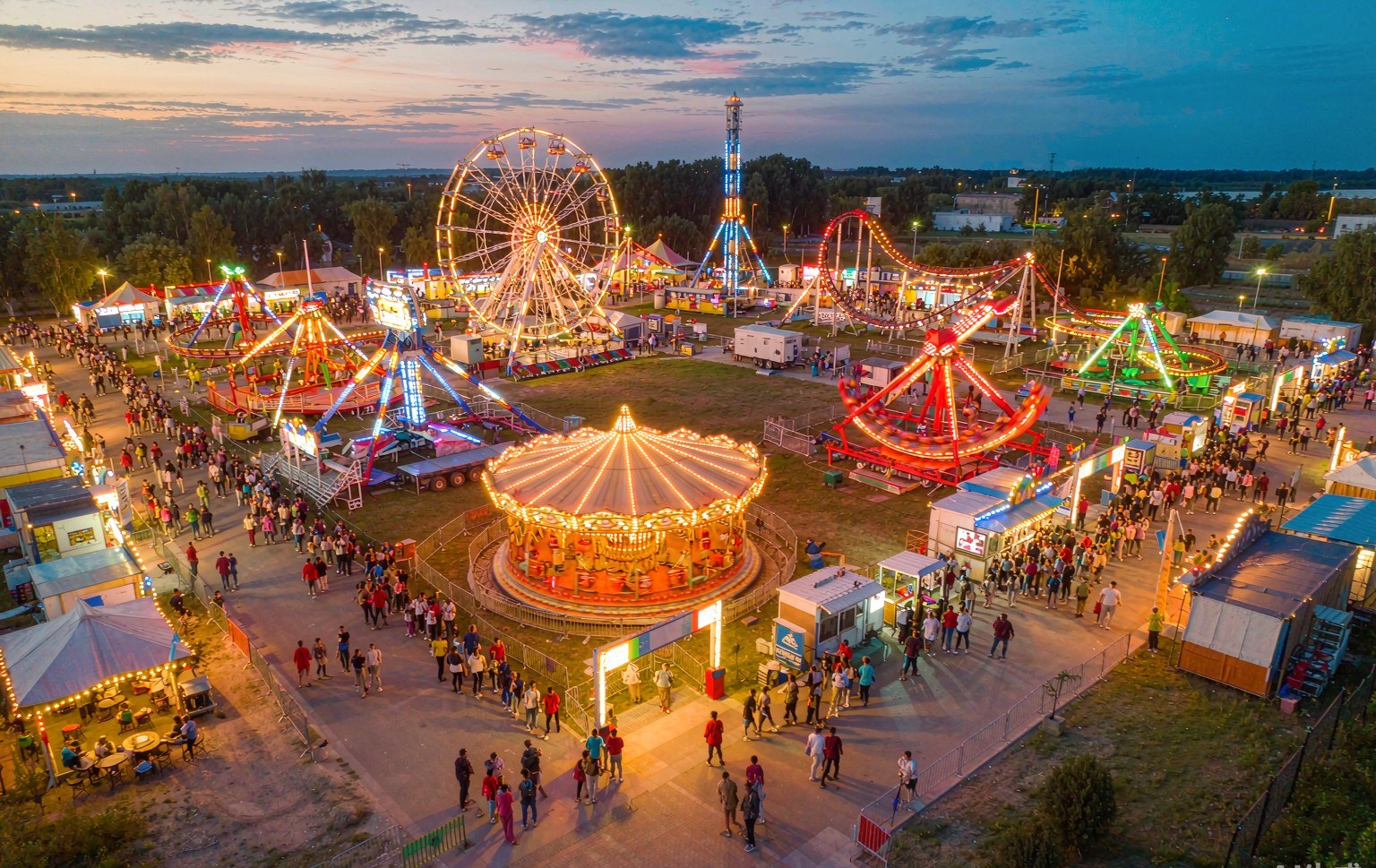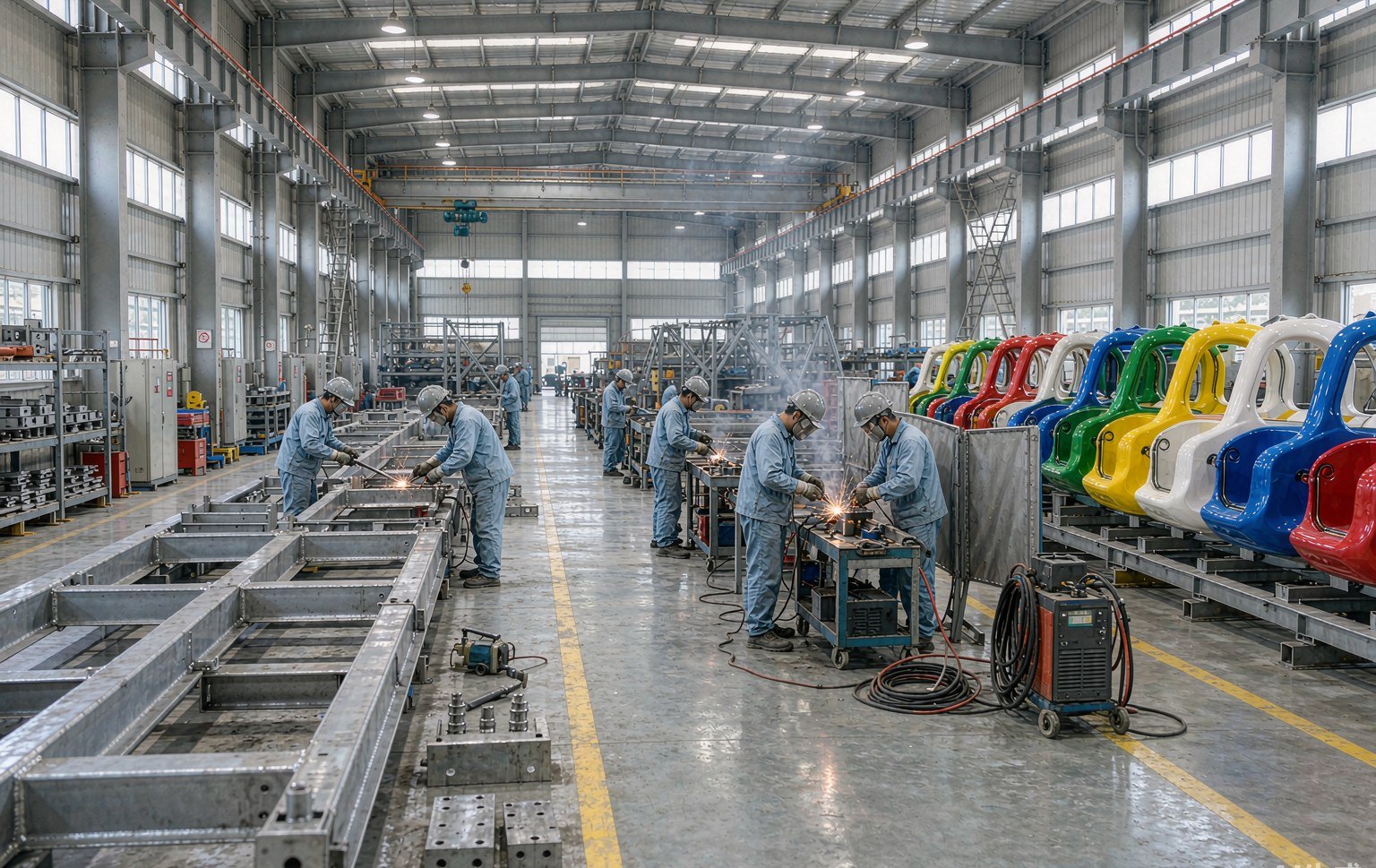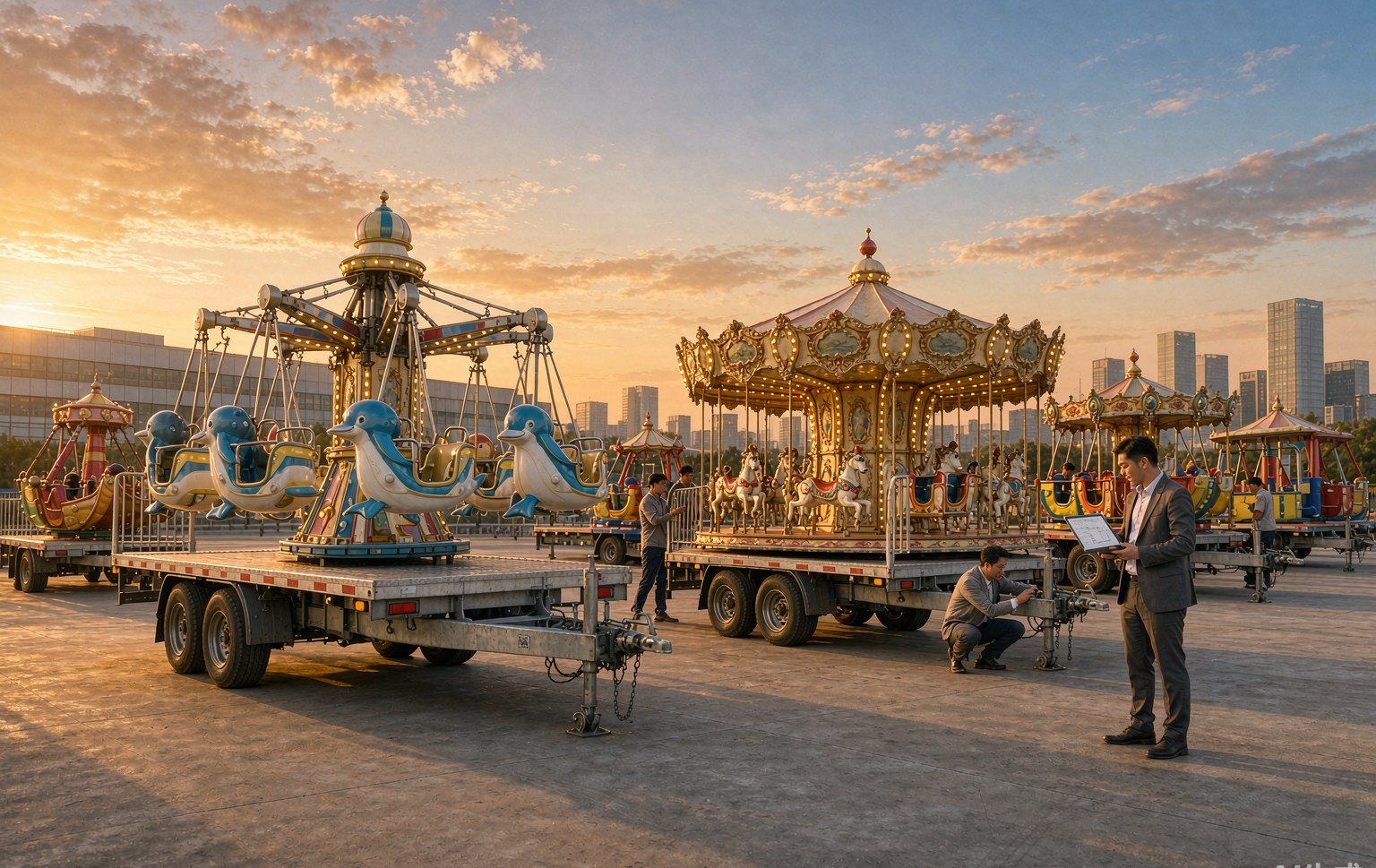
Trailer mounted amusement rides for sale are the fastest route from capital to revenue in the amusement industry. Instead of waiting for foundations, concrete and a fixed site approval, you tow the attraction to wherever paying guests already are: fairs, city squares, shopping mall car parks, resorts, festivals and private events. For event entrepreneurs, rental companies and park operators adding seasonal capacity, that flexibility changes the entire economics of the business.
But “mobile” does not automatically mean “profitable”. Two trailer rides with the same price tag can deliver completely different returns once you factor in throughput per hour, power requirements, setup time, crew size, spare parts availability and compliance documentation. This checklist explains exactly what to verify before you wire a deposit for any trailer rides.
Why trailer-mounted rides outperform fixed attractions for most operators
Built to move: the trailer chassis advantage
A well-engineered trailer ride carries its own road-tow chassis, outrigger legs and towing lights. Setup is a matter of levelling, unfolding the legs and connecting power – typically 30 to 90 minutes with no civil works. When a three-day event ends, you do not abandon the asset; you take it to the next town, the next mall or the next season.
Revenue that relocates with demand
Fixed attractions are limited by the traffic that reaches their address. A mobile ride follows the calendar: school holidays in one city, food festivals in another, Christmas markets after that. Operators routinely double or triple annual operating days compared with a single-site ride.
Lower entry cost, faster payback
Because there is no foundation, fencing, permanent power upgrade or building work, capital goes into the ride itself rather than the ground under it. That shortens the payback period dramatically – often to a single to two operating seasons for a well-chosen model.
The 9-point B2B due diligence checklist
1. Capacity and realistic throughput
Ask for seats per cycle, cycle time (including loading and unloading), and theoretical guests per hour. Then reduce the figure by 30-40% for real-world conditions. A ride marketed as “600 guests per hour” usually delivers 350-450 in daily operation.
2. Power supply and self-sufficiency
Most trailer rides run on 380V three-phase power. Confirm the installed power in kW, the voltage tolerance, and whether the ride can operate from a generator set. If your calendar includes sites without grid power, a matched generator is not an optional extra.
3. Trailer chassis and towing legality
Check axle configuration, braking, suspension, lighting and overall towing weight against the regulations in your market. A ride that cannot be legally towed by your vehicle – or that needs an escort vehicle – quietly destroys the mobility advantage you paid for.
4. Safety systems and interlocks
Request a written description of emergency stop, low-voltage protection, overload protection, speed limitation, restraint systems and gate interlocks. Vague answers are a warning sign.
5. Compliance and documentation package
For most export markets you should expect CE or equivalent conformity documents, test reports, electrical diagrams, structural calculation summaries, an operation manual and a maintenance manual with a spare parts list. Confirm the certificates match the exact model and capacity you are buying.
6. Spare parts and serviceability
Ask which components are wear items, the recommended spare parts starter kit, whether parts can be ordered individually, and the typical lead time. Rides that use uncommon motors or custom control boards can sit idle for weeks waiting for a part.
7. Setup time and crew size
A two-hour setup with four people is fine for a weekly fair; it is a problem nightly. Confirm how many staff are needed to run the ride and to move it, because labour is a permanent operating cost.
8. Theming and customization depth
Colour, LED schemes, canopy graphics and trailer branding are usually customizable. Confirm what is standard, what costs extra, and whether custom changes affect warranty, lead time or local compliance.
9. Total landed cost, not the factory price
Add shipping, insurance, import duties, port-to-site transport, unloading equipment, generator, spare parts package, training and any compliance testing. The cheapest quotation is frequently the most expensive project.
What realistic payback looks like
Consider a 38-seat ball shooting ride – one of our most requested models. Assume a ticket price of 3.00, an average cycle of 4 minutes including loading, and a conservative 45 operating cycles per day at 70% occupancy.
| Metric | Conservative day | Good day |
|---|---|---|
| Guests carried | 1,197 | 1,600 |
| Ticketed revenue | 3,590 | 4,800 |
| Labour (2 operators) | -320 | -320 |
| Power and consumables | -90 | -110 |
| Gross daily contribution | 3,180 | 4,370 |
Even at a conservative 120 operating days per year, that is a contribution in the region of 380,000 – which is why operators who run trailer rides seriously rarely stop at one unit. See the 38-seat dolphin ball shooting ride for a full specification.
Choosing the right ride type for your market
Match the ride to your audience instead of buying the biggest model available:
- Interactive ball shooting rides – highest revenue per guest, best for festivals and family events.
- Self-control plane rides – the classic high-capacity crowd builder, easy to operate.
- Trailer carousels – the safest bet for holiday markets, malls and family attractions; see the 24-seat trailer carousel.
- Trackless trains – transport-style attractions that work indoors and outdoors; see the electric trackless train.
For a wider view of what sells best, browse the featured amusement rides page.
Frequently asked questions
How long does a trailer ride take to set up?
Most models level and deploy in 30 to 60 minutes, plus power connection and a safety check. Complex double-row carousels can take two to three hours with a trained crew.
Do trailer rides need a foundation?
No. The trailer chassis and outrigger legs distribute the load on any hard, level surface such as asphalt or concrete paving.
What warranty and support should be included?
Look for a manufacturer that supplies a spare parts starter kit, English manuals, operator training, remote technical support and a documented warranty on structural and mechanical components.
Further reading
- Mobile amusement rides manufacturer: the 10 factory vetting questions
- Mobile carnival rides for sale: building a profitable trailer ride fleet
- Browse every trailer-mounted ride we build
- See the best-selling amusement rides
Next step
Anxin Amusement builds trailer mounted amusement rides for operators in more than 60 countries. Send us your target market, site size and budget, and our engineers will recommend the right configuration and prepare a complete quotation – including shipping, spares and setup – within 24 hours. Request your free quote.