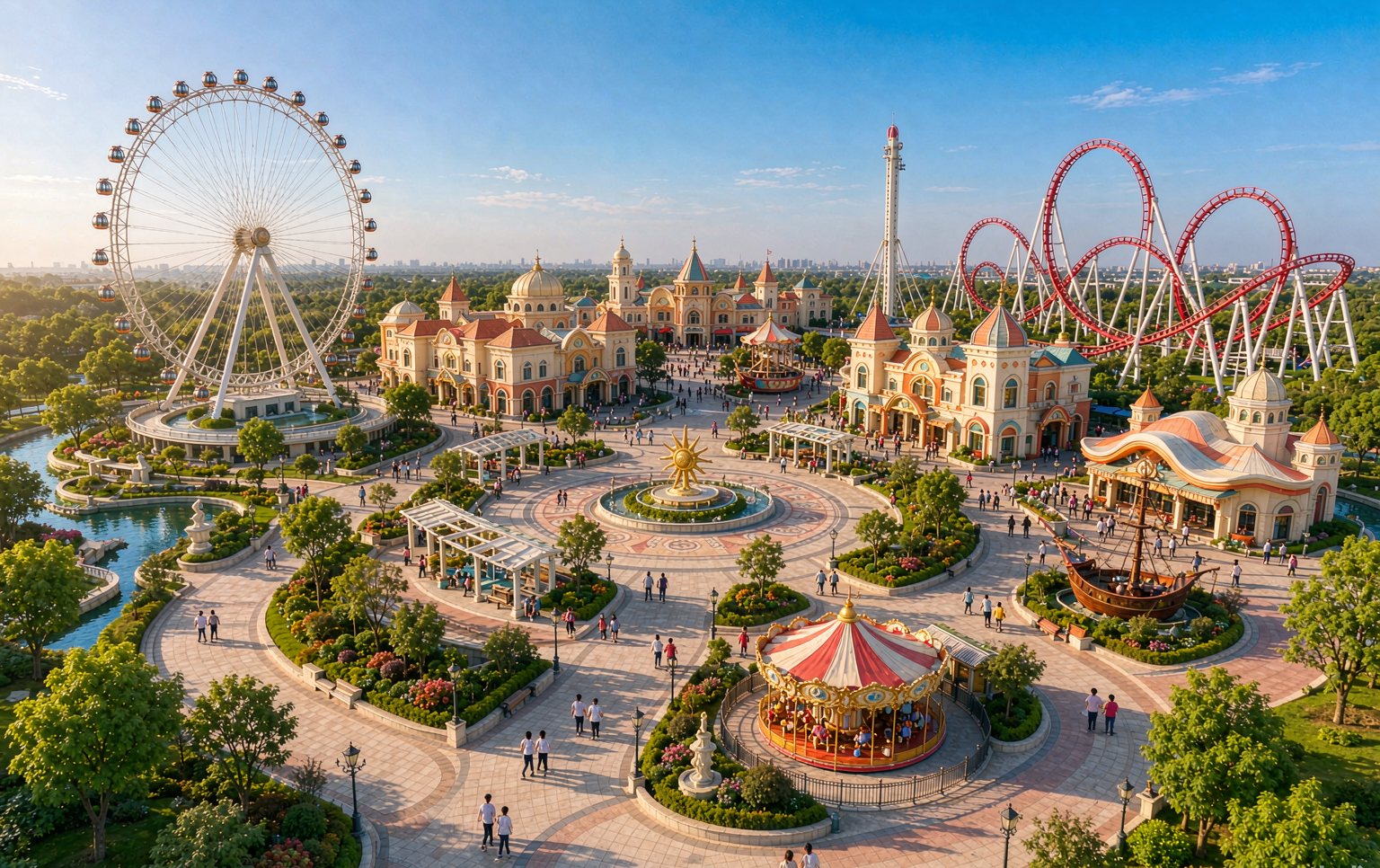
Roller coaster construction companies sit at the intersection of structural engineering, entertainment design, and heavy logistics. For theme park developers, FEC operators, and investors, the builder they select decides whether a signature attraction opens on budget — or becomes a multi-year liability. This guide explains how these firms actually work, from feasibility and fabrication through installation, testing, and handover, so you can evaluate them with confidence.
What Roller Coaster Construction Companies Actually Do
Most roller coaster construction companies deliver a turnkey package rather than a single service. That scope typically covers structural design verification, track and support fabrication, foundation engineering, electrical and control systems, site erection, testing, and the documentation package regulators require before the ride can carry a single guest.
That breadth matters because a coaster is never a standalone machine. It is a system that has to integrate with the park’s power supply, maintenance access routes, evacuation plans, and guest-flow design. A supplier that only fabricates steel leaves those interfaces to someone else — and interfaces are where projects slip, budgets grow, and opening dates move.
For operators in fast-growing markets, the strongest partners also provide spare parts programs, operator training, and multi-year technical support. In practice, the gap between an average and an excellent contractor becomes visible two or three seasons after opening, not on opening day.
Scope also varies by ride class. A family or kiddie coaster may be largely a fabrication-and-delivery exercise, while a launched thrill machine with multiple trains, zone control, and a themed station can involve dozens of engineering interfaces. Match the vendor’s specialization to the ride you intend to build: a supplier that excels at compact family coasters is not automatically the right partner for a high-speed inversion machine.
The Project Lifecycle: From Feasibility to Handover
Reliable roller coaster construction companies follow a staged process, and each stage ends with a defined deliverable and a sign-off. Skipping or compressing a stage is one of the most common causes of cost overruns and disputes later.
1. Feasibility and Concept Engineering
The builder studies the plot: available footprint, height and setback limits, soil bearing capacity, prevailing wind loads, seismic exposure, and guest throughput targets. The output is a ride concept with a clear envelope, a capacity estimate, and a realistic budget range.
2. Detailed Design and Load Analysis
Engineers model the track geometry, vehicle dynamics, and g-force profile, then run fatigue and structural analysis on every support. Compliance with EN 13814 or ASTM F2291 is documented here — not retrofitted after fabrication, when changes are expensive.
3. Fabrication and Factory Testing
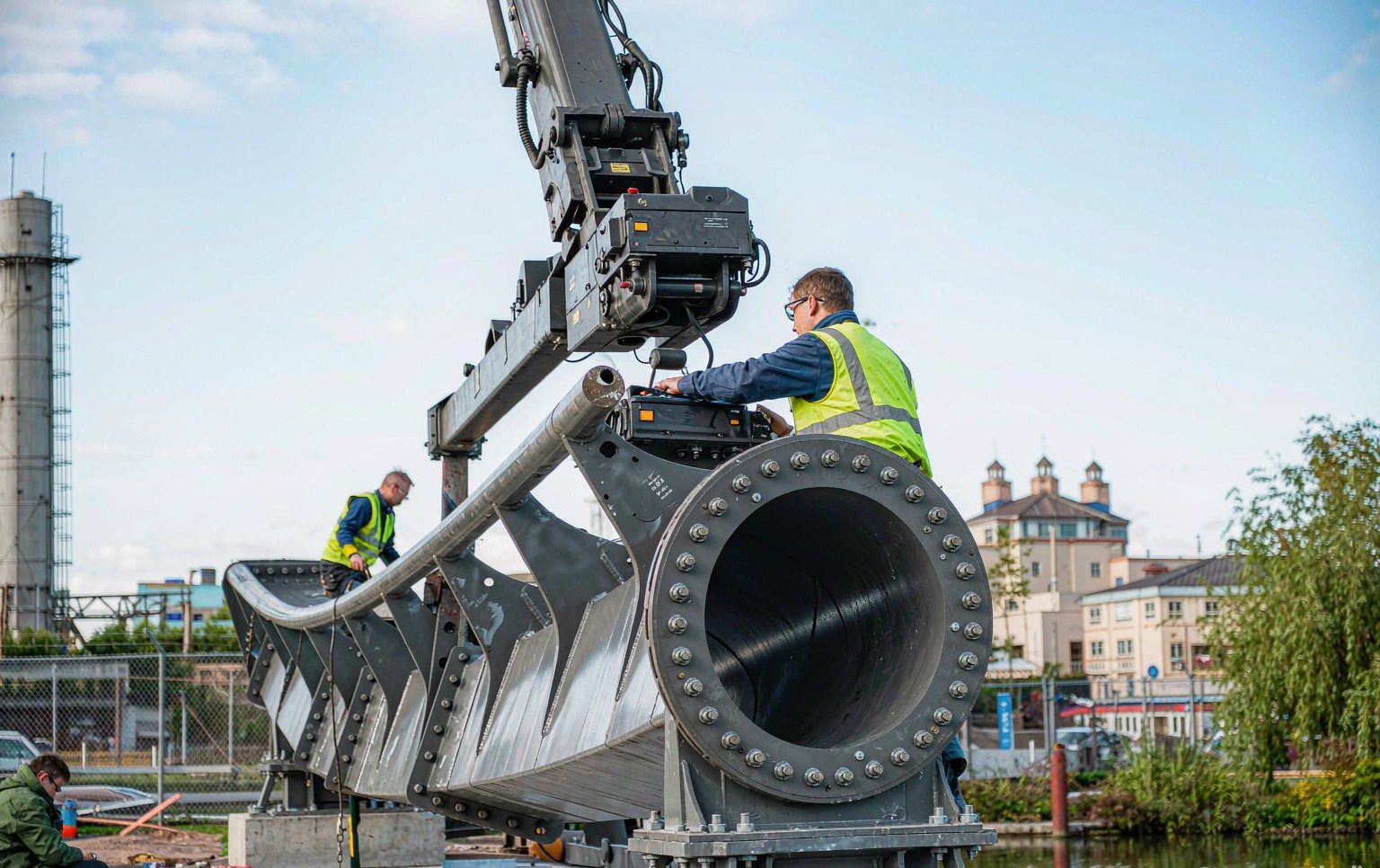
Track, columns, and station components are fabricated off-site under controlled conditions, with non-destructive weld testing, dimensional checks, and trial assembly. Control systems are bench-tested against the ride’s actual logic before they leave the factory floor.
4. Site Works and Erection
Foundations are poured to the structural engineer’s tolerances, then columns, track sections, lift systems, and brake runs are installed. For a standard coaster, on-site assembly usually runs 10–25 days, depending on layout complexity and crane access.
5. Commissioning and Handover
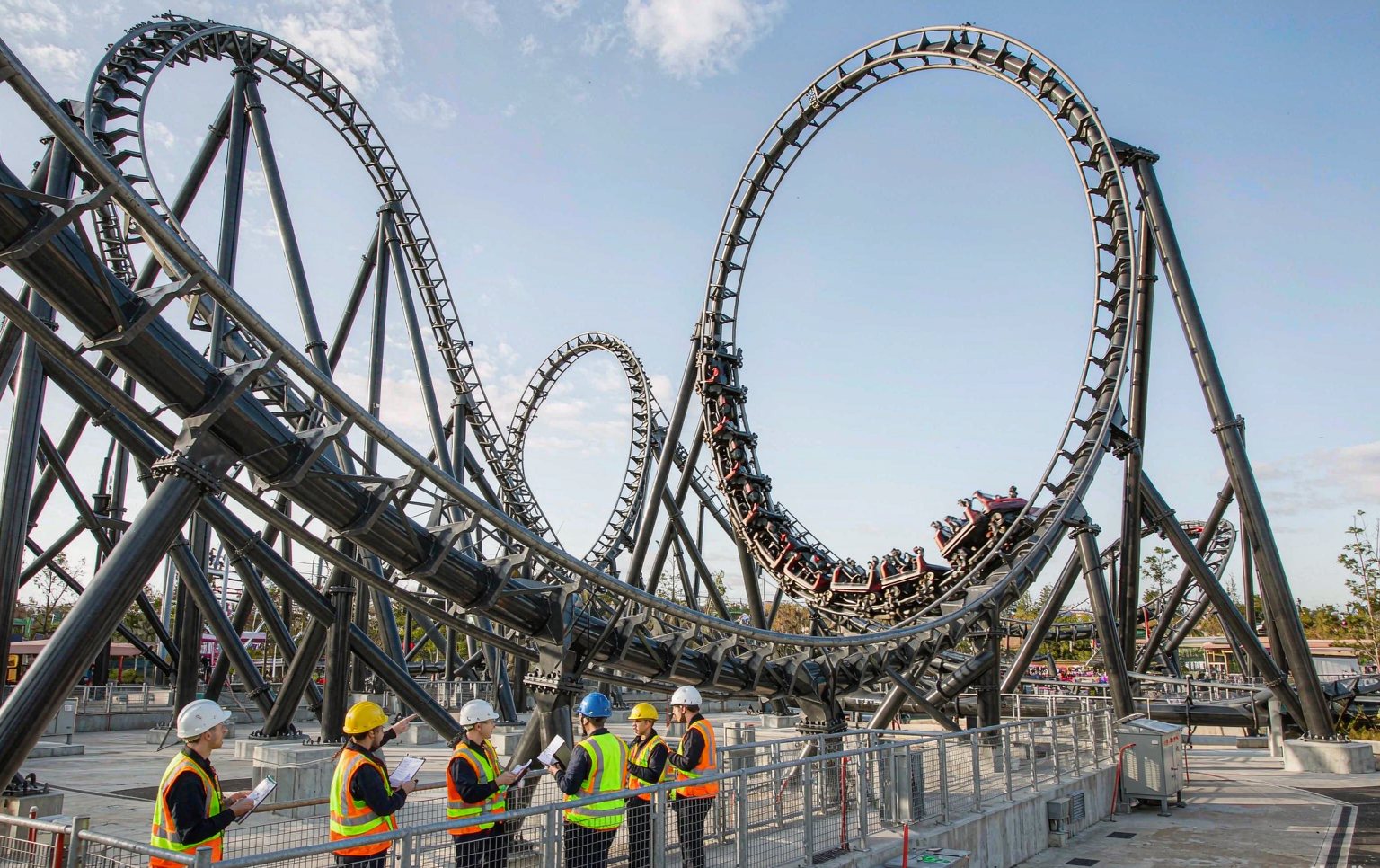
The final stage covers dry runs, loaded testing with weighted dummies, sensor calibration, emergency-stop drills, operator training, and delivery of the maintenance and compliance documentation. Only then does the ride move into daily operation.
Each stage should produce paperwork you can audit: design review minutes, welding and inspection records, factory acceptance test reports, and site commissioning logs. Parks that inherit a coaster from another operator often discover that missing documentation is the most expensive part of the asset to reconstruct.
Key Roles Inside a Coaster Construction Team
When you audit roller coaster construction companies, look past the sales team and ask who will actually be accountable during erection and commissioning. A competent team normally includes:
- Project manager — owns the schedule, interfaces, and reporting to the park.
- Structural engineer — responsible for the load path, supports, and foundation loads.
- Controls engineer — programs ride logic, safety interlocks, and restraint systems.
- Site erection supervisor — manages rigging crews, crane plans, and lift sequences.
- QA and safety manager — enforces weld standards, inspection records, and site safety rules.
- Commissioning lead — runs testing, calibration, and handover training.
- Logistics and spare parts coordinator — handles shipping, customs, and the long-term parts pipeline.
Ask for the names and credentials of the people in these seats. If the answer is a generic org chart, treat it as a warning sign about how your project will be staffed once the contract is signed.
Steel vs. Wooden Coasters: What Builders Must Decide
The material choice shapes cost, maintenance, and the story the ride tells, so it should be settled before you invite roller coaster construction companies to quote. Steel track allows tighter radii, inversions, and a smoother ride, with modular fabrication and a shorter installation window. Wooden and hybrid structures offer a distinctive, heritage-driven experience but demand more on-site labor, heavier annual inspection, and a maintenance crew with timber expertise.
Other structural decisions with long-term consequences include launched versus lift-hill propulsion, inverted versus sit-down trains, and single-train versus dual-station layouts. Coastal parks should also weigh corrosion protection and repainting frequency in their life-cycle cost model, because salt air punishes any structure that is under-protected. In hot, humid climates, humidity control and daily inspection routines matter just as much as the original finish specification.
How to Compare Roller Coaster Construction Companies
Use the same evaluation framework across every vendor so that bids become genuinely comparable, and score each row rather than relying on overall impressions.
| Evaluation Criteria | What to Ask | Warning Sign |
|---|---|---|
| Track record | References from parks similar in size, climate, and visitor profile | Only renders and videos, no operating installations |
| Certifications | CE, EN 13814, ISO 9001, and ASTM compliance with test reports | “Compliant” claims with no documentation |
| Fabrication capacity | In-house cutting, welding, and coating versus heavy subcontracting | Factory audit not permitted |
| Installation team | Dedicated crews, crane plans, and a named site supervisor | Local labor sourced with no supervision model |
| Lead time | Milestone schedule for standard and custom rides (typically 25–45 and 35–60 days) | A single delivery date with no milestones |
| After-sales | Spare parts availability, warranty terms, and technical support | No parts list and no response commitment |
Notice that the table forces roller coaster construction companies to expose their schedule assumptions early. A vendor that cannot name its fabrication slots, crane window, or commissioning duration has not planned your project at all — it has only priced it.
Cost, Lead Time, and Site Logistics Realities
Budgets for a coaster are driven by track length, height, number of inversions, train count, station complexity, theming, and terrain. Freight is a frequently underestimated line item: long track sections ship in containers or on flat racks, and oversize loads may require road permits, escort vehicles, and crane capacity able to lift the heaviest modules. In logistics terms, roller coaster construction companies are as much freight managers as they are engineers.
Confirm the shipping terms (FOB, CIF, or DDP), who clears customs, who pays port and inland handling, and who is liable if a module is damaged in transit. A park that assumes the vendor handles all of this may discover that a single missed vessel pushes the opening by several weeks — and that the delay cascades into staffing, marketing, and season-planning costs.
Schedule risk is rarely about the steel itself. It comes from site readiness: permits, foundation pours, crane availability, and weather windows. Build the installation calendar around your rainy season rather than against it, and agree in writing who is responsible for standby costs when a crew is on site but cannot work. Parks that lock down these details in the contract usually open within their planned window; those that rely on verbal assurances rarely do.
Safety Standards, Certification, and Testing
Safety is the non-negotiable selection factor. Reputable roller coaster construction companies test every unit in the factory before shipment, then re-verify on site during commissioning. Ask for the ride’s design standards, the adequacy of restraint and anti-rollback systems, and the emergency evacuation procedure for a train stopped at its highest point.
Compliance frameworks such as CE marking, EN 13814, ISO 9001 quality systems, and ASTM standards give you a shared language with regulators, insurers, and local inspection bodies. A two-year warranty backed by a documented spare parts supply and lifetime technical support is a reasonable baseline for a serious manufacturer. Anything materially thinner should be priced accordingly — or avoided.
Contract Models and Risk Allocation
The commercial structure determines who absorbs which risk. A turnkey or design-build contract places most interface risk with the vendor, which is usually what a park wants for its first coaster. A supply-only agreement shifts foundation works, rigging, and electrical integration back to the park — viable only if you already have a competent engineering team on site.
Whichever model you choose, tie payments to milestones: design approval, factory acceptance test, shipment, mechanical completion, and successful commissioning. Hold a retention percentage until handover documents and training are delivered, and define liquidated damages for schedule slippage in advance rather than negotiating them mid-crisis.
Two clauses deserve particular attention. First, the spares and support agreement: confirm which components the manufacturer guarantees for five or ten years, and at what price basis, because a coaster that cannot be repaired is not an asset. Second, the currency and insurance terms, especially for cross-border orders where exchange-rate movement or a cargo claim can quietly erode the margin you approved at the feasibility stage.
Frequently Asked Questions
How long does it take to build a roller coaster?
Experienced roller coaster construction companies typically need 35–60 days for custom or large equipment, while smaller standard rides can ship in 25–45 days. Add sea freight, customs clearance, and 10–25 days of on-site assembly, then allow buffer time for commissioning and local inspection before you announce a public opening date.
How much does a roller coaster cost?
Cost depends on scale. A compact family coaster and a record-seeking launched coaster differ by an order of magnitude in steel weight, train count, and control complexity. Ask for a broken-down budget covering design, fabrication, freight, installation, testing, and theming so that competing offers can be compared like for like.
Do roller coaster construction companies handle installation as well as manufacturing?
The stronger ones do. In-house installation crews reduce the interface risk between fabrication tolerances and site tolerances, and they arrive already familiar with the ride and its tooling. If a vendor subcontracts erection, insist on the supervisor’s track record and the quality-control procedure used on site.
What certifications should I look for?
At minimum, look for CE marking where applicable, EN 13814 design and safety compliance, ISO 9001 quality management, and ASTM alignment for your target market. The most credible roller coaster construction companies provide factory test reports for the specific unit you are buying, not a generic certificate for the product family.
Can a park add a coaster in phases to manage cash flow?
Yes. Many parks buy the full track layout but phase the investment — launching with a shorter circuit and adding a second train, a station upgrade, or theming in a later season. Discuss phased delivery early, because it changes fabrication batching, spare parts planning, and freight sequencing for the builder.
Choosing a Builder You Can Grow With
Good roller coaster construction companies do more than deliver steel on time. They help you phase capital expenditure, meet the standards your insurer and regulator expect, and keep the ride running profitably for a decade. Evaluate references, certifications, installation capability, and after-sales support — then weigh those factors exactly as heavily as you weigh price.
If you are planning a new coaster or expanding an existing park, review Anxin Amusement’s custom ride solutions, including thrill rides and landmark attractions. With 15+ years of manufacturing, 200+ rides delivered across 24+ countries, and CE, EN 13814, ISO 9001, and ASTM compliance, learn more about our factory and support programs and request a project consultation today.