Why Buyers See Such Different Offers for Bumper Cars
If you have recently compared quotes, you already know that bumper cars for sale can range from a five-figure starter package to a full arena system costing several times more. The reason is simple: bumper cars are not a single product but a system of vehicles, power delivery, flooring, and control equipment. Two suppliers can quote the same number of cars and still be thousands of dollars apart because one price includes the ceiling grid and arena floor while the other assumes you already have them.
This guide is written for FEC owners, park operators, and investors who are evaluating bumper cars for sale as a capital purchase. It explains the three power technologies, the arena requirements that catch first-time buyers off guard, indicative price bands from a direct factory, fleet sizing logic, and the commercial terms you should expect when importing from a manufacturer such as Anxin Amusement.
Electric vs Battery-Powered: The Three Systems Behind Bumper Cars for Sale
When you shortlist bumper cars for sale, the most important technical decision is how each car receives power. There are three established systems, and each one changes your building requirements, operating cost, and guest experience.
Ceiling-Grid (Net-Grid) Bumper Cars
The classic system. A conductive steel grid suspended from the ceiling supplies DC power through a pole that rises from the rear of each car, while the metal floor completes the circuit. Grid cars deliver constant, full-power performance all day long — no charging breaks, no battery degradation, and consistent speed from opening to closing. The trade-off is architectural: you need a clear indoor height of roughly 4.5 to 6 meters and a building you can permanently modify. For dedicated arenas inside shopping malls or stand-alone bumper car buildings, grid systems remain the benchmark for ride quality and throughput.
Floor-Grid (Ground-Grid) Electric Bumper Cars
Floor-grid systems replace the ceiling with conductive strips embedded in the arena floor. This removes the height restriction and is popular in venues with low ceilings, mezzanines, or temporary structures. Performance is comparable to ceiling-grid cars, though floor construction must be precise — strip alignment and insulation directly affect reliability. If you are renovating an existing hall where hanging a grid is impossible, floor-grid electric models are usually the strongest option among the bumper cars for sale on the market.
Battery-Powered Bumper Cars
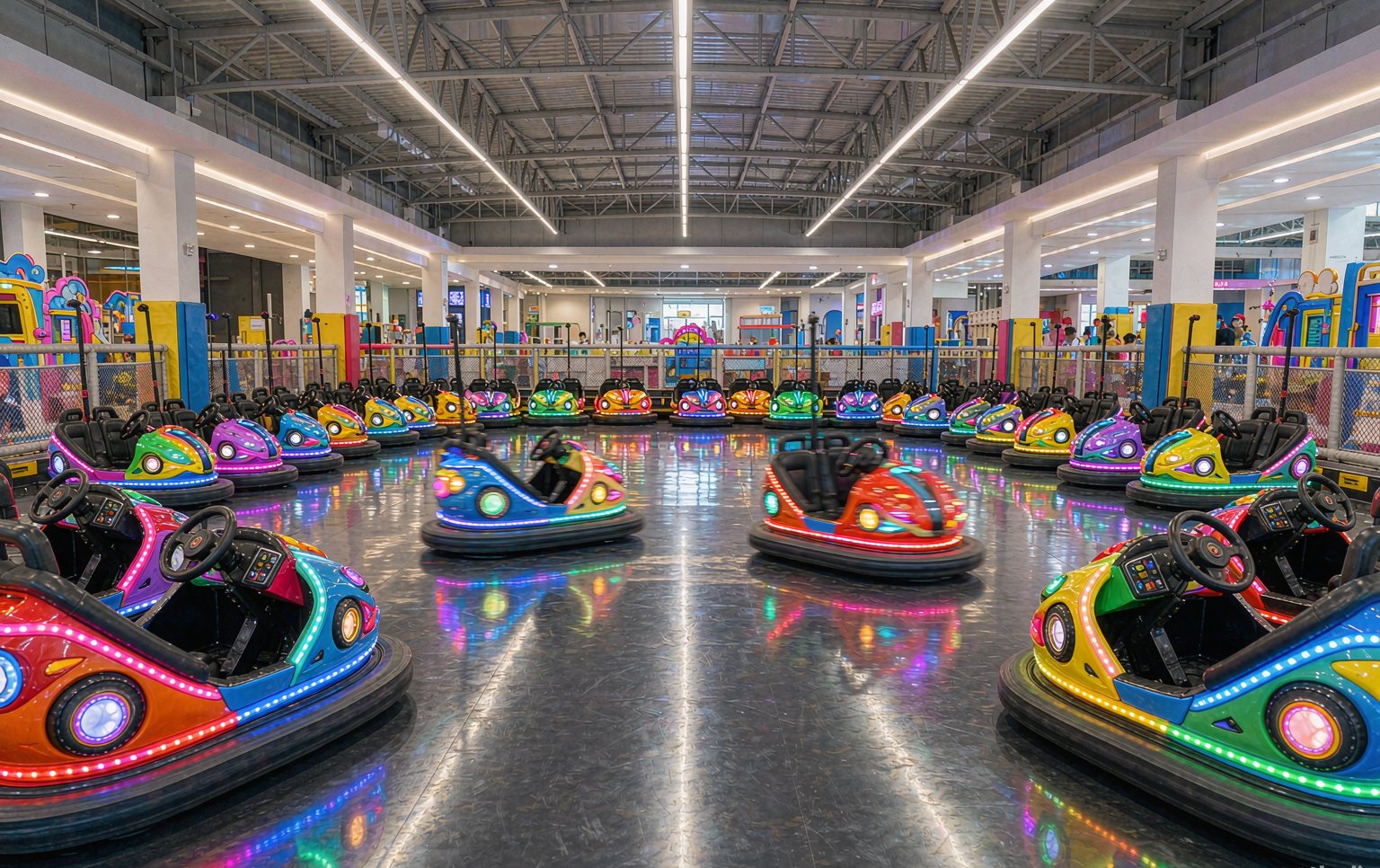
Battery cars carry lithium or gel batteries on board and need no conductive floor or ceiling at all. They run on any flat, smooth surface — concrete, epoxy, even outdoor slabs — which makes them ideal for FECs that want flexibility, seasonal outdoor operation, or venues where construction is not permitted. Modern lithium versions charge in 4 to 6 hours and run a full session per charge. The compromise is weight and speed: battery cars are typically a little slower, and you must plan a charging routine and spare battery rotation if you operate high-traffic sessions all day.
As a rule of thumb from our 15+ years of manufacturing: choose ceiling or floor grid for a permanent, dedicated arena with high daily throughput; choose battery power when flexibility, low construction cost, or multi-use space matters more than maximum speed.
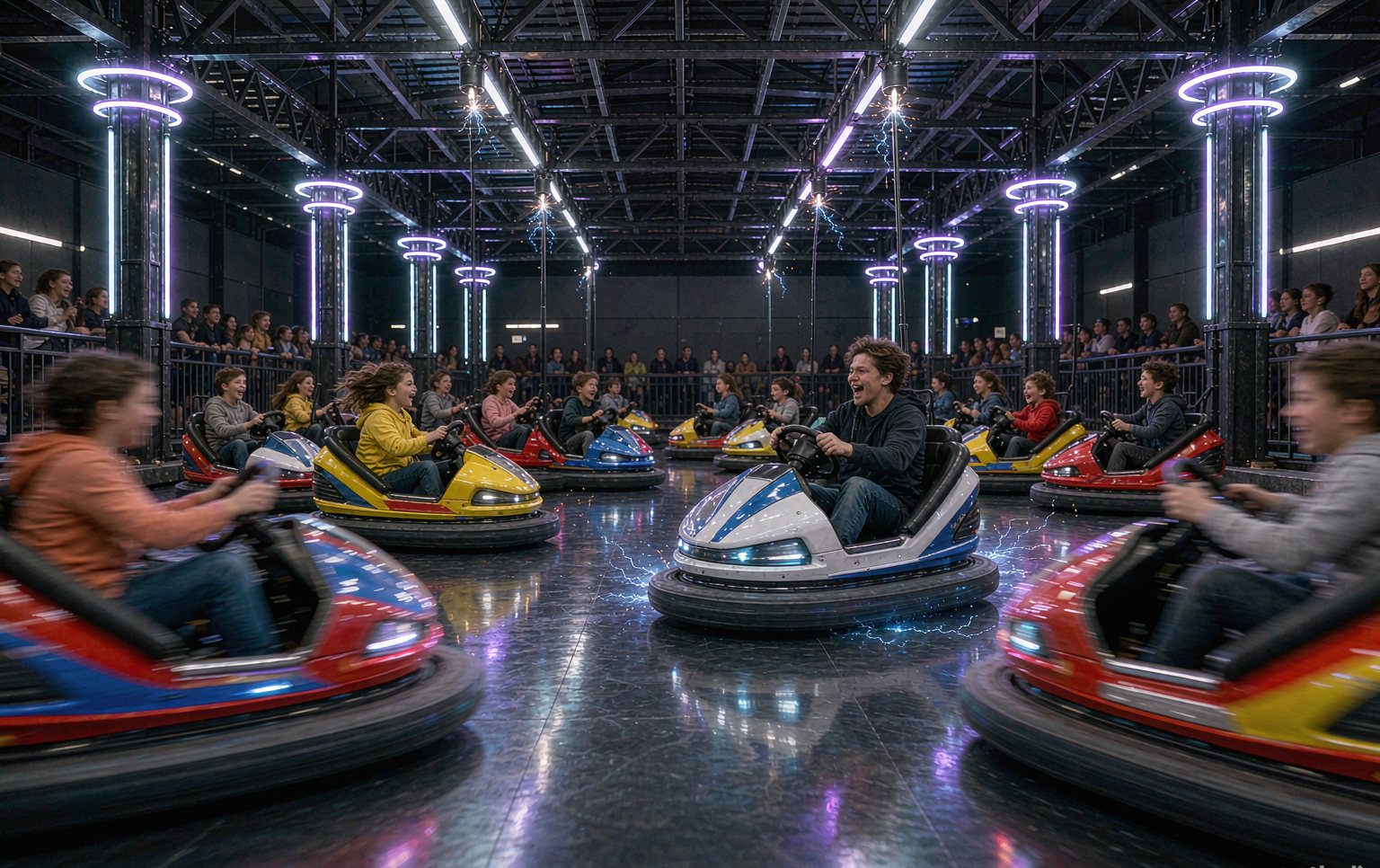
Arena Requirements: Floor, Ceiling and Space Planning
Many buyers comparing bumper cars for sale focus on the cars and discover late that the arena is half the project. Plan these elements before you sign anything:
- Ceiling-grid systems: a structural ceiling 4.5–6 m high, capable of carrying the suspended grid (the factory supplies load drawings), plus a conductive steel or wire-brush floor treatment.
- Floor-grid systems: a level concrete slab where conductive strips can be embedded or laid; the surface is then finished with a wear layer.
- Battery systems: any flat surface with a smooth finish; add rubber bumper edging or perimeter barriers to protect walls and guests.
- Arena size: budget roughly 4.5–6 m² per car. A 20-car fleet needs about 100–140 m² of ridable area plus circulation space for queuing and an operator station.
- Power supply: grid systems need a dedicated transformer and rectifier cabinet (usually 380V/50Hz or specified to local standards); battery systems need charging outlets and a storage corner.
- Drainage and climate: for semi-outdoor installations, floor-grid and battery systems tolerate humidity better than exposed ceiling grids.
If you are fitting bumper cars into a larger family zone, it is worth reviewing our dedicated family and kiddie rides category to see how different ride footprints combine on one floor plan.
Bumper Cars for Sale: Indicative Price Bands (2026)
Prices below are indicative, ex-works, and configuration dependent. A complete package normally includes the cars, control cabinet, floor or grid materials, and spare parts; installation and shipping are quoted separately.
| Package | Configuration | Indicative Price (USD, ex-works) |
|---|---|---|
| Battery bumper car starter set | 8–10 cars, charging station | $12,000 – $20,000 |
| Battery bumper car fleet | 12–20 cars, spare batteries | $20,000 – $38,000 |
| Ceiling-grid arena package | 10–20 cars, grid, floor, control cabinet | $30,000 – $45,000 |
| Floor-grid arena package | 10–20 cars, floor strips, control cabinet | $28,000 – $42,000 |
| Themed / custom cars | Custom FRP bodies, lighting, branding | +15% – +30% on base package |
Several factors move you within these bands: car size (single vs two-seat), FRP body thickness and paint quality, LED lighting packages, remote control and timing systems, and certification requirements for your market. Among the bumper cars for sale available today, the biggest long-term cost difference is usually not the sticker price but the durability of the FRP shell, the drive system, and the availability of spare parts — which is why factory credentials matter more than the quote on top.
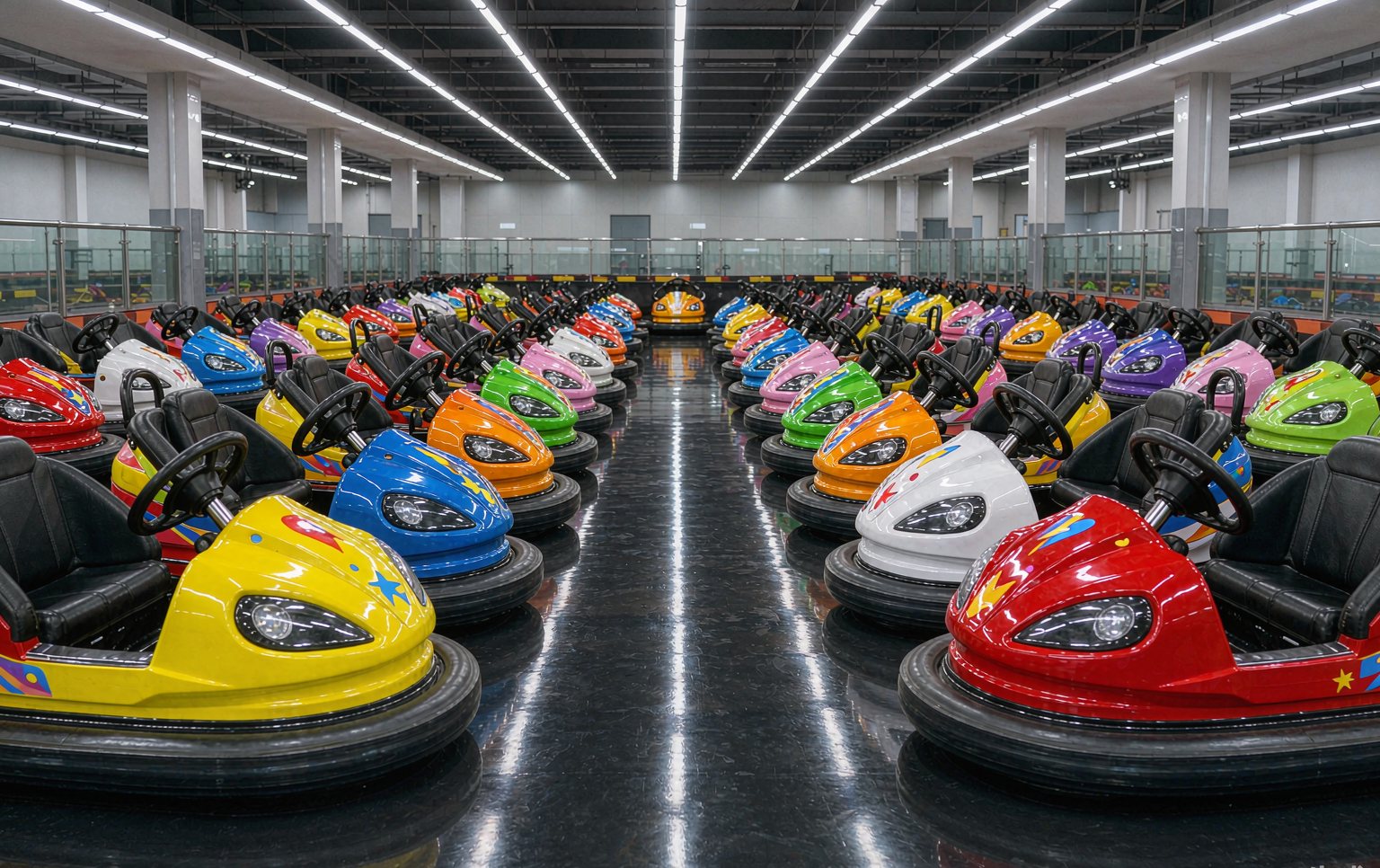
Fleet Sizing: How Many Cars Should You Buy?
The right fleet size depends on your session model. A typical ride cycle lasts 3–5 minutes, and each car seats one adult or one adult with a child (two-seat cars carry a parent and child comfortably). Work backward from throughput:
- Estimate peak-hour demand. If you expect 150 riders per hour at peak, and each 4-minute cycle plus loading takes 5 minutes, a 15-car fleet delivers roughly 12 cycles × 15 cars = 180 riders per hour — comfortable headroom.
- Match arena size to fleet. Never exceed one car per 4.5 m² of ridable area, or the ride becomes frustrating instead of fun.
- Plan for maintenance. Buy 10% more cars than your peak plan requires, or confirm the manufacturer stocks complete spare car kits, so one car out of service never closes the arena.
- Mix seat types. A typical family mix is 70% single-seat and 30% two-seat cars, which keeps both teenagers and parents happy.
For smaller venues, 10–12 cars is the practical minimum for a satisfying experience; regional parks and large FECs commonly run 20-car arenas.
Payment Terms, Lead Times and Shipping
Most reputable Chinese factories, including Anxin Amusement, work on a 30% deposit / 70% balance before shipment (T/T). This protects both sides: the deposit schedules production, and the balance is paid after factory testing — ideally after you or your inspector witness a live test of the finished bumper cars for sale in the workshop.
Standard lead time is 25–45 days from deposit for standard configurations; custom theming, special voltages, or large fleets typically run 35–60 days. Before the balance payment, insist on a factory test report covering insulation resistance, control system function, and a full-load running test. Shipping is usually by sea in full or consolidated containers — a 20-car battery fleet fits roughly in one 40 ft container, while grid packages add floor steel and the control cabinet. Ask the factory to quote CIF to your nearest port so you can compare landed cost, not just ex-works price. If your wider project includes large rides, our guide to amusement park ride pricing explains how freight and installation shape total investment.
Warranty, Certification and After-Sales Support
A credible supplier of bumper cars for sale should offer all of the following as standard, not as negotiable extras:
- 2-year warranty on the cars and control system, with lifetime technical support and a spare-parts supply guarantee.
- Certifications: CE marking and EN 13814 compliance for Europe, ASTM compliance for the US market, and ISO 9001 manufacturing quality — Anxin Amusement factory-tests every unit before dispatch.
- Documentation: electrical drawings, foundation or grid load drawings, and an English operation and maintenance manual.
- Operator training: video or on-site training for your staff, plus remote diagnostics support.
Be cautious with offers that skip certification documentation — they often surface as problems during local inspection, insurance underwriting, or after an incident.
Buying Checklist for Bumper Cars for Sale
Before you transfer any deposit, work through this checklist:
- Confirm power system (ceiling grid / floor grid / battery) against your building’s height, floor, and modification limits.
- Verify the arena area calculation: cars × 4.5–6 m² plus queue space.
- Get the indicative price broken down: cars, grid or floor materials, control cabinet, spares, packing.
- Confirm CE / EN 13814 / ASTM documentation for your market.
- Agree 30/70 payment terms with a pre-shipment factory test.
- Fix the lead time in the contract, including custom-theming time.
- Reserve a 10% spare-parts package (fuses, brushes, wheels, control boards).
- Request CIF freight quotation and confirm container loading plan.
Frequently Asked Questions
How much do commercial bumper cars for sale cost?
Indicative ex-works pricing runs from about $12,000 for an 8–10 car battery starter set to $45,000 for a complete 10–20 car grid arena package with floor, grid, and control cabinet. Final cost depends on car count, seat configuration, theming, and certification requirements.
What is the difference between grid-powered and battery bumper cars?
Grid cars (ceiling or floor) receive continuous power through conductive surfaces, giving full speed and unlimited daily runtime but requiring special flooring and ceiling construction. Battery cars are slower but run anywhere on a flat floor with zero arena construction, trading performance for flexibility and simpler installation.
How long does a set of bumper cars last?
With proper maintenance, a quality fleet operates 8–12 years or more. The FRP body, drive motors, and floor or grid conductors determine lifespan, which is why shell thickness, paint process, and spare-parts availability should weigh heavily in your supplier choice.
How many bumper cars do I need for 100 square meters?
At 4.5–6 m² per car, a 100 m² arena supports roughly 16–20 cars, though you should reserve space for queuing and the operator station. For battery models, 100 m² comfortably hosts a 15–18 car fleet with generous driving room.
What should I check before ordering bumper cars for sale from a factory?
Verify the power system matches your venue, confirm certifications (CE, EN 13814, ASTM), review the itemized quotation, agree 30/70 payment terms with a witnessed factory test, and lock in spare-parts pricing. A supplier evaluation checklist is covered in depth in our factory selection guide.
Request a Quote for Bumper Cars
Bumper cars remain one of the highest-revenue-per-square-meter attractions in any FEC or family zone, but the difference between a smooth project and an expensive lesson is almost always in the planning: the right power system, a correctly sized arena, and a factory that stands behind its warranty. Anxin Amusement has delivered more than 200 rides to 24+ countries over 15+ years, with CE, EN 13814, ISO 9001 and ASTM compliance, a 2-year warranty, and full installation and training support.
Send us your venue dimensions and target budget, and our engineers will return a layout drawing and an itemized quotation within days. To compare us against other bumper cars on the market, request a quote through our contact page or explore our custom park solutions to plan the entire attraction around your fleet.