
A Flying Tower Ride Owns the Horizon for Less Than a Coaster
Drive past a park with a tall tower and you can almost read its attendance from the road. Height sells: a 50-metre mast is visible from three kilometres and pulls families off the motorway in a way no flat ride can. Operators shopping for a flying tower ride for sale are buying a vertical signature — guests lifted into open air, spun outward until their feet fly, and a silhouette that photographs better than anything else on the plot.
This guide covers how the ride works, the model classes built today, 2026 pricing, site requirements, and the chain details that decide whether you pass inspection. Anxin Amusement builds to EN 13814 and ASTM F2291 criteria, ships with erection supervision, and supports the large-ride inspection file. Request a quote with your site coordinates and height limit, and we will return a matched model with itemised pricing within 48 hours.
How a Flying Tower Ride Actually Works
Every flying tower ride for sale shares one architecture: a lattice or tubular mast, a rotating crosshead that travels up and down that mast, chains carrying double seats, and a drive package at the base or in the head.
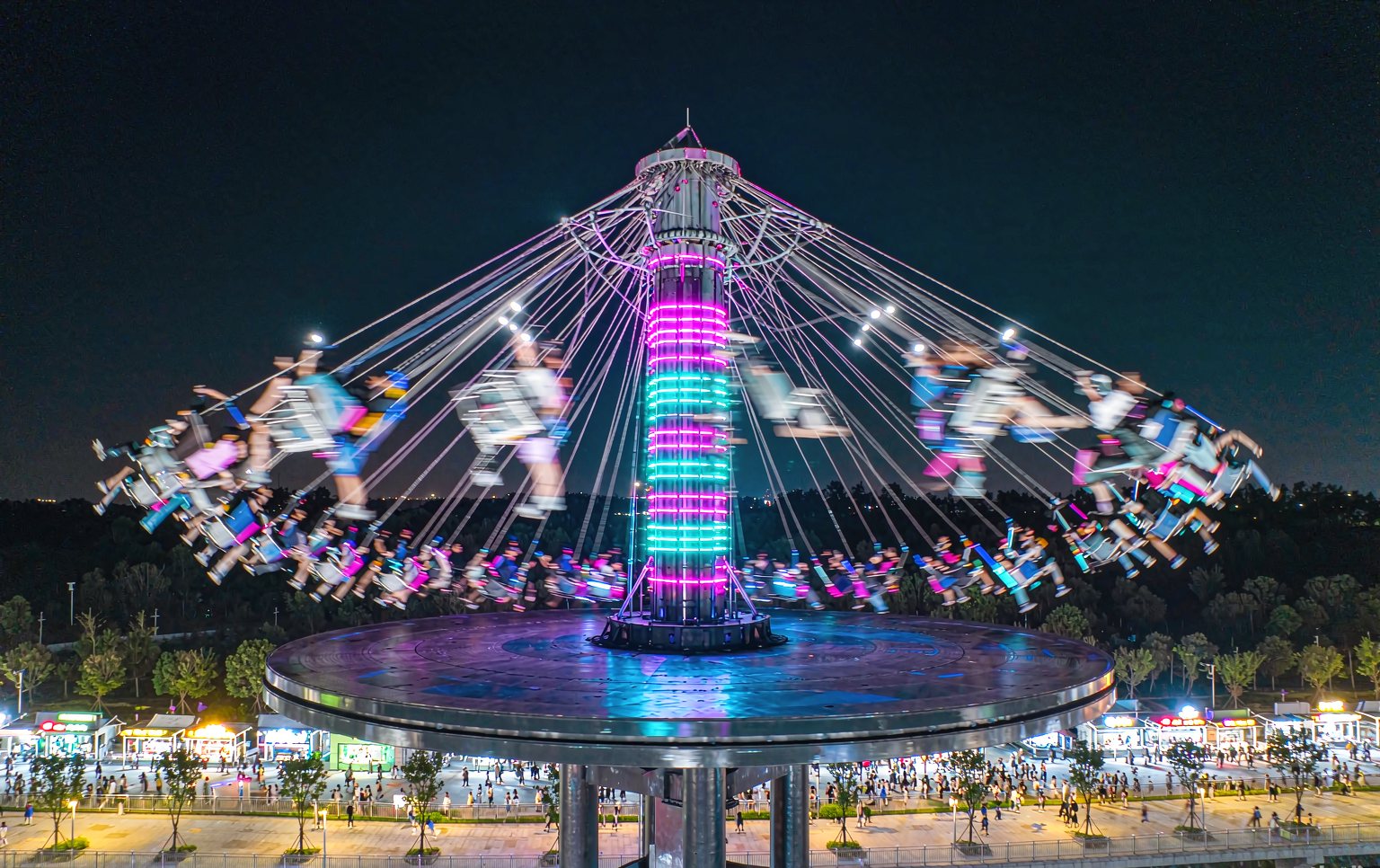
Guests board while the crosshead sits low and turns slowly. The frame then climbs and accelerates at once. At 9 to 11 rpm, centrifugal force throws the seats outward until they hang at a flare angle near 40 to 50 degrees — at a 40-metre flight height, roughly 50 km/h with nothing between rider and park but a chain and a lap bar. The crosshead holds at the top for 90 to 120 seconds, then descends to the boarding position. A cycle runs about three minutes.
Three details separate a real machine from a cheap one: the frame must be guided so it cannot cock on the mast under asymmetric load, the drive must hold a controlled descent through a power failure, and every chain must be duplicated. Ask for the drawing that shows all three before you compare any flying tower ride for sale quotation.
Flying Tower, Swing Tower or Drop Tower?
Buyers confuse these three constantly, and the confusion costs money because they solve different problems. A flying tower climbs and rotates at once, so the sensation is flight. A swing tower ride — the star flyer layout — keeps its rotating head fixed at the top of the mast. A drop tower trades rotation for one vertical fall.
| Attribute | Flying tower | Swing tower (star flyer) | Drop tower |
|---|---|---|---|
| Motion | Rotates while climbing and descending | Rotates at a fixed head height | Vertical lift, then free fall |
| Typical height | 31–56 m total, 15–40 m flight | 20–55 m | 20–60 m |
| Riders per cycle | 24–36 | 12–40 | 12–24 |
| Sensation | Sustained high-altitude flight | Airborne swing at height | Weightlessness, one hard brake |
| Footprint | Ø22–30 m | Ø14–24 m | Ø10–16 m |
| Indicative price | $140,000 – $420,000 | $200,000 – $800,000 | $120,000 – $600,000 |
| Best for | Signature landmark, wide age band | Thrill-led parks, height prestige | Compact plots, pure thrill |
The flying tower wins on throughput per metre of mast and on accessibility: a 120 cm height rule admits most of the family, while a drop tower filters out children and nervous adults. If your brief is maximum fright in minimum space, read our drop tower comparison instead.
Model Classes Built Today
Suppliers converge on three sizes. Names vary, numbers do not: every flying tower ride for sale on the market fits one of them.
Compact Class: 31 to 35 Metres
Twenty-four to thirty-two riders on a Ø22 to 24 metre footprint, flight height 15 to 18 metres, 45 to 67 kW drive. The entry point for FECs, resort courtyards, and municipal parks with a strict planning cap — and the class most often ordered as a first flying tower ride for sale purchase. Total height still clears surrounding buildings, so the landmark effect survives the smaller mast.
Mid Class: 43 to 46 Metres
Thirty-two riders on Ø26 metres, flight height 27 to 30 metres, 67 kW. The best balance of drama and cost for a regional park: tall enough to dominate a midway, compact enough for a plot that also carries a coaster. Most buyers comparing a flying tower ride for sale land here after modelling attendance against capacity.
Flagship Class: 52 to 56 Metres
Thirty-six riders on eighteen double seats, flight height 37 to 40 metres, 75 to 82 kW, footprint Ø26 to 30 metres. This is the version on postcards. It needs a Class A inspection regime in China, a dedicated power feeder, an engineered pile foundation, and a 130 to 200 tonne crane for erection.
What a Flying Tower Ride Costs in 2026
Price tracks total height, seat count and control package far more than decoration. The bands below are indicative ex-works ranges for budgeting.
| Class | Total / flight height | Seats | Footprint | Indicative price (ex-works) |
|---|---|---|---|---|
| Compact 31–35 m | 31–35 m / 15–18 m | 24–32 | Ø22–24 m | $140,000 – $210,000 |
| Mid 43–46 m | 43–46 m / 27–30 m | 32 | Ø26 m | $215,000 – $310,000 |
| Flagship 52–56 m | 52–56 m / 37–40 m | 36 | Ø26–30 m | $295,000 – $420,000 |
| Themed or LED show package | — | — | — | +12% – 25% |
All prices are indicative, ex-works, and configuration dependent. Three lines sit outside the equipment figure. Freight runs three to five 40-foot containers. The foundation — a reinforced block or pile cap sized from our reaction-force drawings — costs $25,000 to $90,000. Erection needs a crane and rigging crew, $18,000 to $55,000 locally, and third-party inspection adds $8,000 to $20,000. Budget a landed total of 1.25 to 1.45 times the equipment price.
Terms are 30 percent deposit and 70 percent before shipment by T/T, with 45 to 70 days production and four to seven weeks of freight. A flying tower ride for sale at half these bands is usually a 20-metre fairground tower relabelled.
Site, Foundation and Wind Load
Tower rides fail inspection on site issues more often than on manufacturing defects. Confirm six things before comparing any flying tower ride for sale quotation:
- Foundation: the mast transmits a large overturning moment, not just vertical load. We supply reaction forces at the base plate and anchor bolts; your engineer converts them into a pile cap or raft. Reject any supplier offering a “standard base” without soil data.
- Clearance envelope: the seats sweep a circle wider than the base. Keep that circle plus 3 metres clear of fences, roofs, and overhead lines at full flare.
- Wind: machines stop automatically above roughly 12 to 14 m/s at seat height via anemometer interlock, and carry a documented storm stow procedure. Coastal sites should specify a higher design wind speed.
- Power: 380V three-phase 50Hz drawing 45 to 82 kW, with 220V/60Hz and 440V/60Hz variants. Specify a dedicated feeder and a generator transfer scheme — a tower full of guests cannot wait for the grid.
- Lightning and earthing: a 50-metre steel mast is the tallest object on most sites. Fit lightning protection, earth the structure, and bond the control cabinet.
- Access and drainage: a service road for the erection crane, and paving sloped away from the base so anchor bolts stay dry.
If the tower anchors a new zone rather than filling a gap, our park planning and design team places it in the master plan first — sightlines, queue geometry, utility routing — instead of discovering later that the swept circle blocks a fire lane.
Chains, Restraints and the Safety Case
Everything that makes a flying tower ride for sale commercially attractive makes its safety case unforgiving: riders are 40 metres up, restrained by a chain and a bar, with no car around them.
Chain and Suspension
Seats hang on round-link chains from the rotating frame, and quality is measurable. Each seat should carry two independent chains rated for the full seat load, with a secondary attachment that keeps it captive if one fails. Chain grade, proof load, and fatigue class belong on the material certificate. Wear is checked by elongation — most makers set a rejection limit near 3 percent — so a serious supplier ships a gauge and a replacement schedule. Cheap offers use commercial chain with no traceability — the most common reason a used tower cannot be re-certified.
Restraints and Control
Expect a lap bar with a secondary lock or an over-shoulder harness with a redundant latch, verified by an operator every cycle. The control system should provide dual braking, an overspeed governor, a seat-swing sensor, and a PLC that refuses to release restraints until the frame reaches the boarding position.
Evacuation and Rescue
Inspectors ask one question that decides the file: how do you get thirty-six people down from forty metres without power? A compliant design offers an auxiliary drive or manual lowering winch, a documented brake-release procedure, a rescue harness kit, and staff who have rehearsed it. We hand over a written evacuation plan, a bilingual maintenance manual, and a commissioning protocol with no-load, weighted-dummy, and full-capacity tests.
Throughput, Ticket Price and Payback
A three-minute cycle on 36 seats is 720 riders per hour theoretical. Real throughput lands between 380 and 500 because of loading, height checks, and restraint verification — still the highest of any ride in its class. At a $6 ticket and 450 riders a day over 300 operating days, a flagship flying tower ride for sale grosses about $810,000 a year against a crew of three. Most operators recover the equipment cost within three to five seasons.
Questions That Expose a Broker
The category attracts intermediaries, because a flying tower ride for sale is high-ticket and one photograph generates enquiries. Grade suppliers on these points:
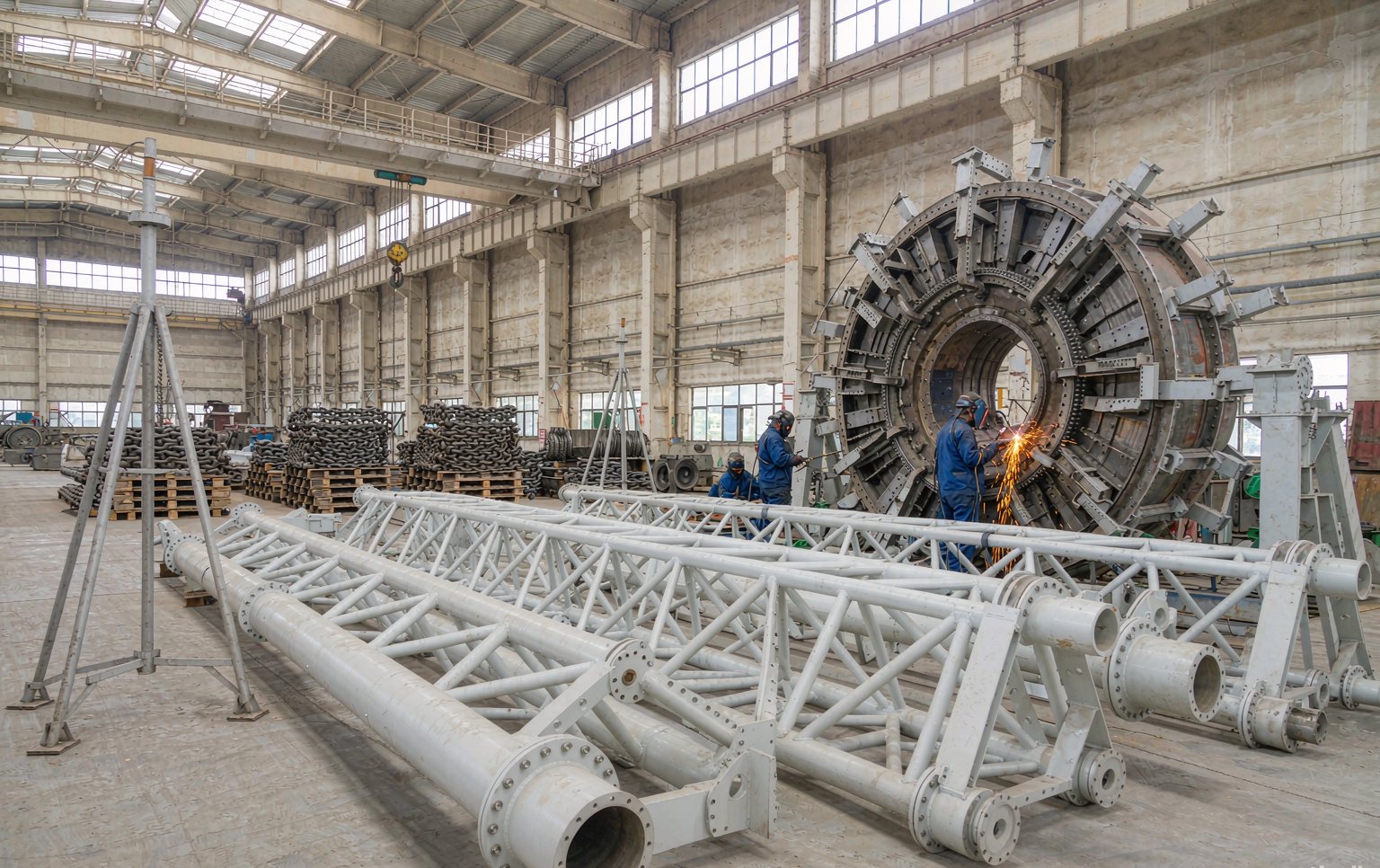
- In-house fabrication: does the factory cut, weld, and machine its own mast sections and crosshead? Ask for a live video walk-through of the welding bay, not a showreel.
- Reference towers: how many are running, where, and can you speak to two operators without a salesperson listening?
- Documentation: calculations, weld inspection records, chain certificates, schematics, and the EN 13814 file included by default rather than quoted as an option.
- Erection record: has the supplier erected a taller tower, and who signs the alignment survey?
- Spares: chains, brake pads, guide rollers, and PLC modules available for ten years, with a first-year kit in the shipment.
Schedule the opening backwards from crane availability and inspection slots, not from the deposit date. A tower waiting on a Class A inspection is expensive scenery.
Frequently Asked Questions
How much does a flying tower ride cost?
Indicative ex-works pricing in 2026 runs $140,000 to $210,000 for a 31 to 35 metre compact model, $215,000 to $310,000 for a 43 to 46 metre machine, and $295,000 to $420,000 for a 52 to 56 metre flagship. Freight, foundation, crane hire, and inspection add 25 to 45 percent. Figures are indicative and configuration dependent.
How much land does it need?
A compact flying tower ride for sale needs roughly Ø22 to 24 metres plus a 3-metre safety margin, so a fenced plot near 30 x 30 metres. Flagships want Ø26 to 30 metres plus clearance for the swept envelope and a crane service road.
How many riders per hour can it handle?
Theoretical capacity on 36 seats at a three-minute cycle is 720 per hour. Practical throughput is 380 to 500 once loading, height checks, and restraint verification are counted.
Is it safe to operate in wind?
Yes, within rated limits. Towers stop automatically above roughly 12 to 14 m/s at seat height, and carry a documented stow procedure for storms. Coastal sites should specify a higher design wind speed and reinforced cladding.
What is the difference between a flying tower and a swing tower?
A flying tower climbs and rotates at the same time, so riders fly outward while gaining height. A swing tower keeps its rotating head at a fixed height and swings chained chairs from there. The flying tower gives a longer sustained-flight sensation; the swing tower a sharper airborne swing.
What are the payment and delivery terms?
30 percent deposit, 70 percent before shipment by T/T. Production takes 45 to 70 days for standard models and 60 to 85 days for themed or tall machines, with freight adding four to seven weeks.
Request a Flying Tower Quotation
Send your site coordinates, planning height limit, target riders per hour, and theming references, and our engineers will return a matched model, a layout showing the swept envelope and foundation loads, and an itemised quotation within 48 hours. Every flying tower ride for sale from our factory ships with structural calculations, chain certificates, erection supervision, operator training, and a ten-year spares commitment. Request a quote today, browse the wider range of thrill rides for sale, or ask our custom amusement rides team about a themed tower.