Sourcing indoor playground equipment for sale is one of the highest-leverage capital decisions a family entertainment center (FEC), shopping mall, or franchise operator will make. Unlike outdoor rides, a soft-play park runs year-round, is immune to weather, and generates revenue from admissions, parties, and food service simultaneously. But the market is crowded with suppliers whose quotations vary by a factor of three for seemingly identical footprints. This buyer’s guide breaks down what you are actually paying for — structures, surfacing, compliance, installation, and support — so you can compare quotes like an operator, not a first-time buyer.
Operators who treat the purchase as a procurement project consistently outperform those who buy on visuals alone. What decides profitability is invisible in a catalog photo: steel gauge, foam density, fire ratings, and documented compliance. This article walks through each checkpoint in order.
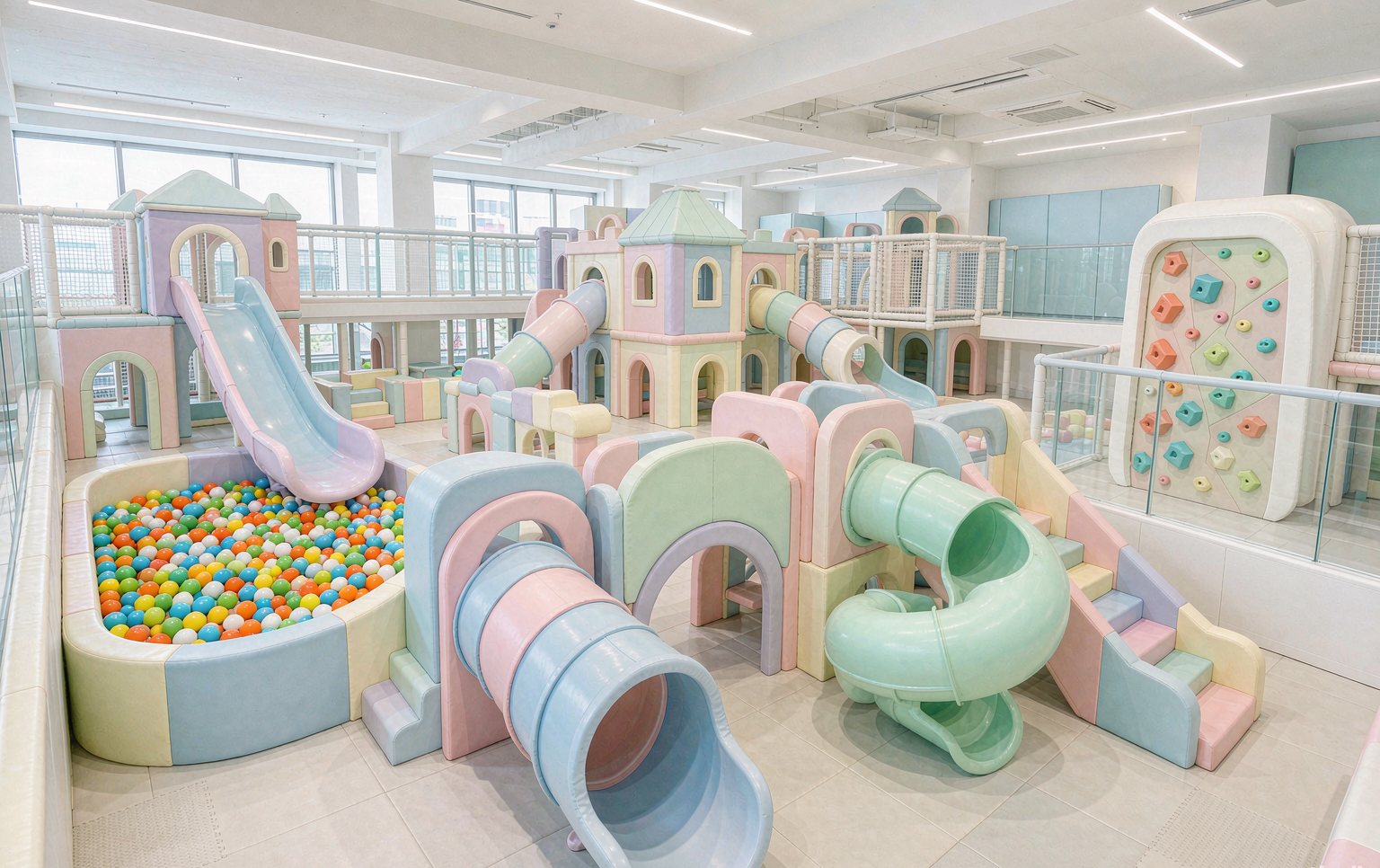
What Counts as Indoor Playground Equipment?
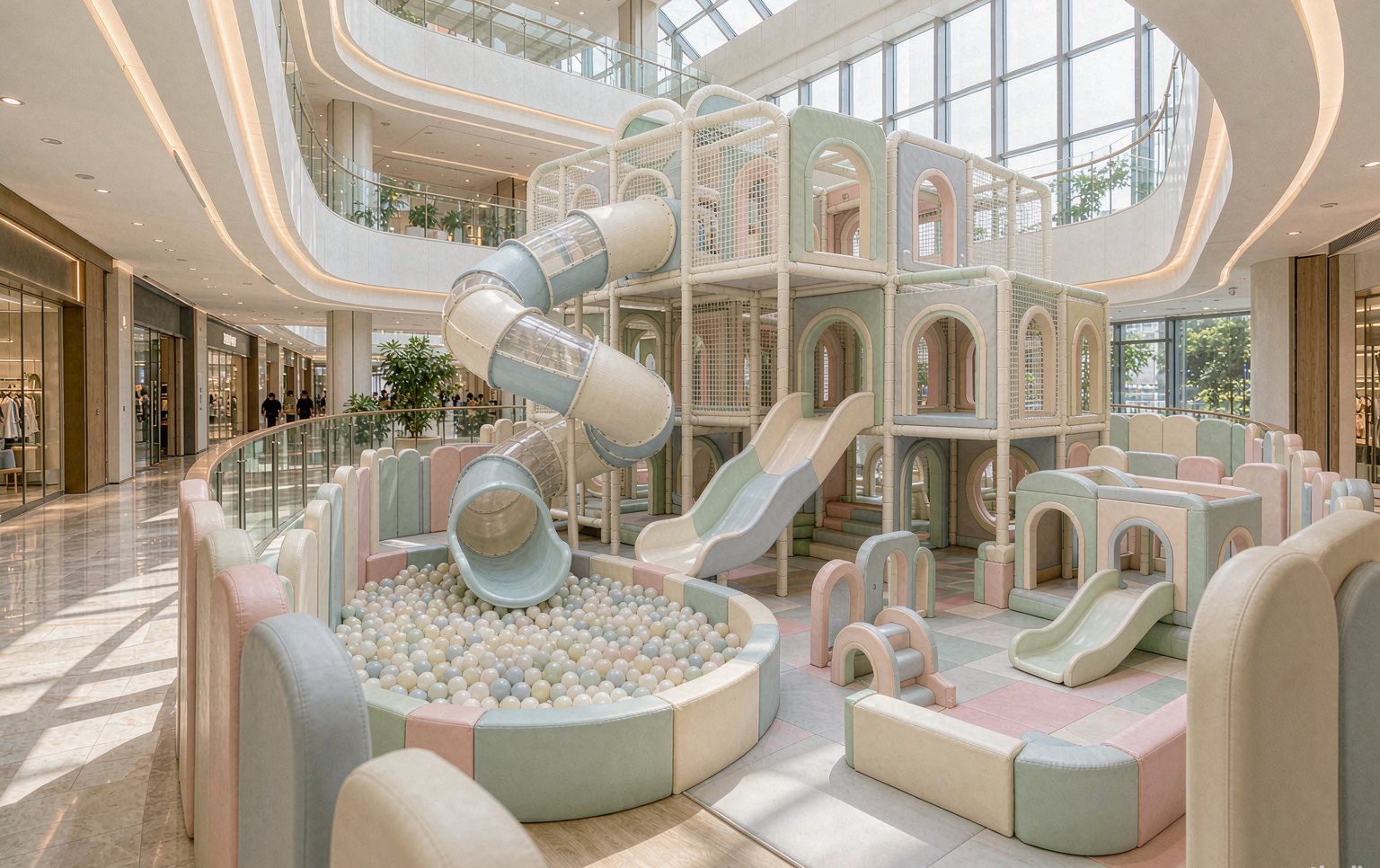
A complete package is more than slides and ball pits. When suppliers quote indoor playground equipment for sale, they are typically pricing a system of interconnected modules:
- Soft-play structures: multi-level steel-framed towers wrapped in EPE foam and PVC/leather cladding, with crawl tubes, obstacle bridges, spiral slides, and Web climbs.
- Toddler zones: soft building blocks, mini carousels, sensory panels, ball pools with pit balls, and low enclosed crawlers for ages 0–3.
- Active-play elements: donut gliders, wave slides, trampoline corners, ninja-course modules, and interactive play panels.
- Sports and attractions: indoor football pitch netting, dodgeball zones, or branded climbing walls for older juniors.
- Support systems: safety matting and EPDM flooring, protective netting, LED theming, party rooms, seating/parent areas, and entrance gates with wristband control.
The ratio of these components — not the raw square meters — is what separates a profitable layout from a crowded one. A well-zoned 600 m² park will outperform a poorly planned 1,000 m² space on revenue per square meter every time.
Site Requirements: Ceiling Height and Floor Loading Come First
Before you compare a single price, verify that your building can physically host the equipment. Two numbers matter most:
- Ceiling height. A single-level soft-play structure needs a clear height of 3.5–4 m. Two-level structures require 4.5–5.5 m, and three-level flagship towers want 6 m or more. Measure to the lowest obstruction — sprinklers, beams, and ducting, not the slab.
- Floor loading. Multi-level structures concentrate weight on support columns. Most commercial slabs (200–250 mm reinforced concrete) handle typical playground loads of 3–5 kN/m², but mezzanine or upper-floor installations need a structural engineer’s sign-off before fabrication begins.
Also confirm column grids (a 8–10 m span gives design freedom), freight access (a loading dock or a wide double door for steel frames), and fire-exit corridors that must remain clear. Suppliers like Anxin Amusement provide free CAD layout drawings that map every column and exit before a deposit is paid — insist on this step.
Zoning by Age Group: Toddler, Junior, and Sports Areas
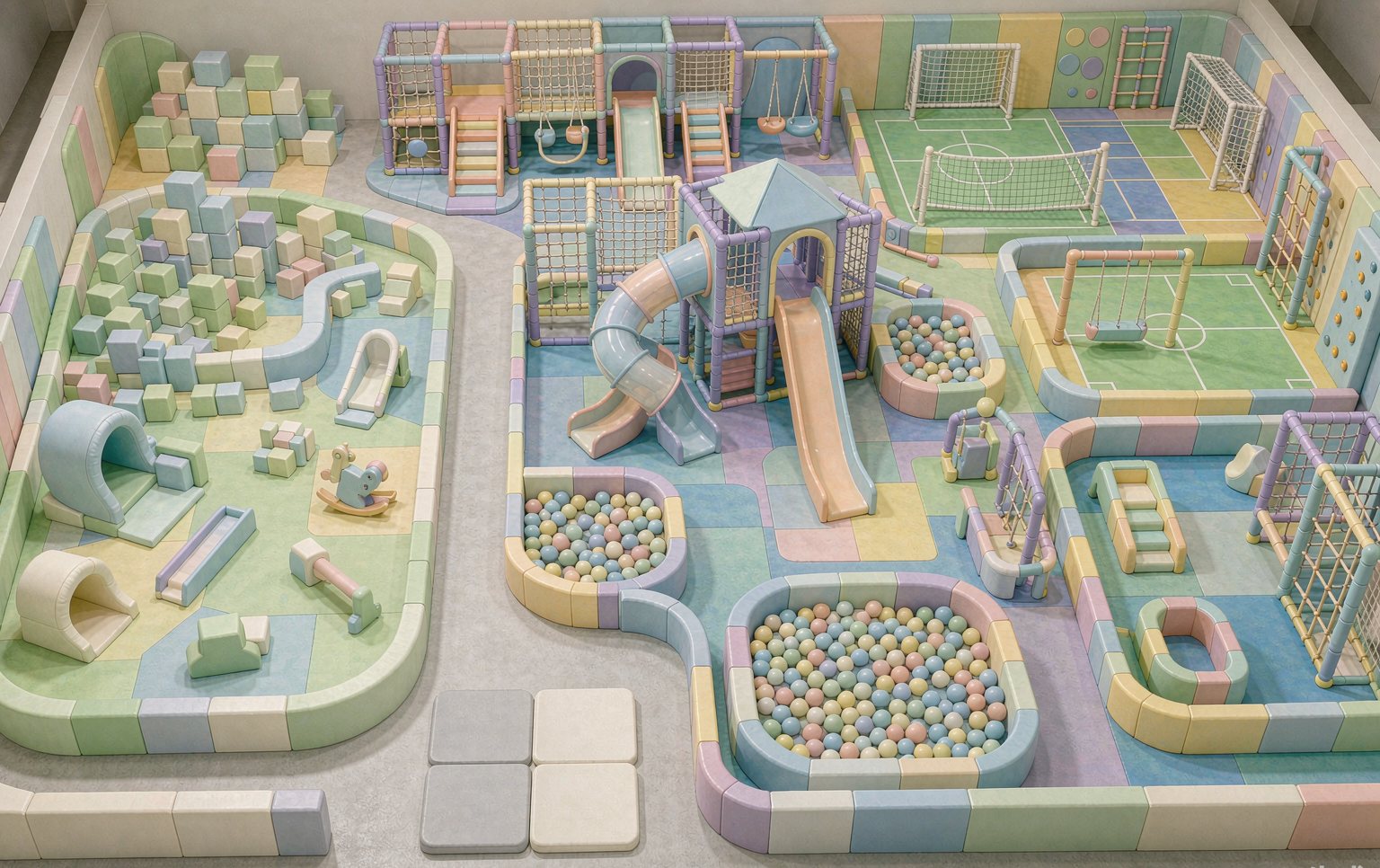
Modern operators plan capacity in three bands. Each band needs its own footprint, its own equipment class, and its own sightlines for supervisors.
- Toddler zone (0–3 years): roughly 15–20% of floor area. Soft crawlers, mini slides, ball pools with 40–60 mm balls, and panel play. Revenue here comes from weekday mornings and memberships.
- Junior zone (3–8 years): the heart of the park, 50–60% of area. The main multi-level structure, spiral slides, bridges, and interactive modules. Birthday parties are booked around this zone.
- Sports/adventure zone (8+ years): 20–30% of area. Ninja courses, climbing walls, dodgeball, or trampoline interfaces. This zone extends dwell time for older siblings and drives weekend throughput.
Separate the bands with netting and one-way gates, and place seating where parents can see at least two zones at once. If your concept includes electric kiddie rides or coin-operated units alongside the play structure, review the compatible options in the family & kiddie rides category — many mall operators pair a small ride carousel with soft play to capture both spend profiles.
Turnkey Supply vs Buying Components Separately
When you evaluate indoor playground equipment for sale, one of the first structural decisions is whether to buy a turnkey package from a single factory or assemble the park from multiple vendors. A turnkey package — structure, flooring, netting, theming, and gates from one manufacturer — carries a single point of accountability. If a crawl tube arrives 80 mm too wide for the opening it was designed for, one supplier fixes it. Mixed-vendor parks routinely suffer from mismatched netting sizes, flooring heights that create trip lips, and warranty disputes about whose defect caused a failure.
Turnkey supply also compresses the schedule: the factory designs the layout, engineers the structure, and pre-assembles modules, so installation crews work from a single set of drawings. The trade-off is less flexibility: swapping one attraction for another mid-project means renegotiating with one party rather than adding a purchase order. For most first-time operators, especially those opening in a leased mall space with a fixed handover date, the schedule certainty is worth more than the 5–8% that component sourcing might theoretically save.
Safety Standards: EN 1176-10 and ASTM F1918
Compliance is non-negotiable, and it differs from the standards governing outdoor amusement rides. Two documents matter for contained play:
- EN 1176-10 (Europe and much of Asia, the Middle East, and Latin America): the fully enclosed play equipment standard. It governs head and torso entrapment gaps, fall heights, impact attenuation of surfacing, netting strength, and structural stability.
- ASTM F1918 (North America): the Standard Safety Performance Specification for Soft Contained Play Equipment, covering entrapment, protrusions, and protective surfacing zones.
Ask any supplier for material certificates (fire ratings on foam and PVC, lead-free paint test reports, and galvanized steel specs), not just a logo on a brochure. Reputable factories factory-test every structure and ship third-party inspection reports with the goods. Note that EN 1176-10 and ASTM F1918 apply to contained play structures — if your park adds motorized attractions, those units fall under ride-specific standards instead, a distinction explained in our theme park manufacturers guide.
Operator tip: insurers increasingly ask for EN 1176-10 or ASTM F1918 documentation before issuing an FEC liability policy. Buying non-compliant equipment to save 10% upfront can make the entire park uninsurable.
Indoor Playground Equipment Prices: Indicative USD Bands by Area
So what does indoor playground equipment for sale actually cost? Pricing is driven by structure levels, theming depth, flooring type, and attraction mix. The table below shows indicative ex-works bands for standard commercial configurations:
| Park Area | Typical Configuration | Indicative Price (USD, ex-works) |
|---|---|---|
| 300–500 m² | 1–2 levels, toddler + junior zones, basic flooring | $50,000 – $90,000 |
| 500–800 m² | 2 levels, 3 zones, themed panels, party room shell | $90,000 – $150,000 |
| 800–1,200 m² | 2–3 levels, sports zone, ninja modules, full theming | $150,000 – $200,000 |
| 1,200–1,500 m² | 3-level flagship, attractions mix, premium flooring and LED theming | $200,000 – $250,000 |
These figures are indicative, ex-works, and configuration dependent. They exclude shipping (sea freight typically adds 6–12% depending on destination and volume), import duties, local installation labor, and civil works such as flooring poured on site. Custom theming — branded characters, sculpted façades, integrated LED shows — can add 15–30% to the structure cost but measurably lifts admission pricing power. Two parks of identical area can sit $40,000 apart purely on theming depth, which is why operators comparing indoor playground equipment for sale should always normalize quotes to a common specification sheet before deciding. For a fully costed concept matched to your building, request a tailored proposal through the custom solutions team.
Installation, Payment Terms, and Lead Times
Understanding the logistics protects your schedule and your cash flow.
Payment terms. The industry norm is 30% deposit with the order and 70% balance before shipment, via T/T. Some suppliers accept a letter of credit for orders above $100,000. Never pay 100% upfront; the deposit-to-balance structure is itself a signal of a factory’s confidence.
Lead times. Standard packages ship in 25–45 days after drawing approval and deposit. Fully custom or large-format parks run 35–60 days, because theming and unique modules are fabricated to order. Add 15–35 days of sea freight depending on your port.
Installation. Plan on 10–25 days on site. Options are: a supplier installation team (recommended for three-level structures — crews typically work at $80–$150/day per technician plus flights and accommodation), supervised self-installation with your local labor (saves 30–40% on a two-level park), or video-guided assembly for simple single-level layouts. Structural anchor points and flooring should be ready before the container arrives to avoid idle crew days. Confirm with the factory how your indoor playground equipment for sale is packed — numbered module crates with a packing list cut installation time noticeably compared with mixed bulk pallets.
Pre-Purchase Checklist
Run every quote through this checklist before signing:
- Building verified: ceiling height, floor loading, column grid, freight access
- Layout drawings (CAD, 2D + 3D) with capacity calculation included free of charge
- Compliance documentation: EN 1176-10 and/or ASTM F1918 test reports, material certificates
- Itemized quotation: structure, flooring, netting, theming, packaging, and Incoterms (EXW/FOB/CIF)
- Warranty terms: minimum 2-year structural warranty with lifetime technical support and spare parts supply
- Installation plan: crew, supervision, or video support — with a day-count estimate
- Payment schedule: 30/70 T/T, with drawings approved before the deposit
- References: photos and contact details of parks delivered in the last 24 months
How to Vet Suppliers of Indoor Playground Equipment for Sale
The fastest way to filter the market is to ask for evidence, not adjectives. A serious manufacturer of indoor playground equipment for sale will provide, without prompting: factory audit reports or a live video walk-through, weld and material certificates, test reports from an accredited lab for EN 1176-10 or ASTM F1918, and a reference list of parks opened within the last two years that you can contact directly. If a supplier answers every technical question with “yes, no problem” but produces no documents, treat the quotation as decorative.
Look at engineering depth as well. Factories that design their own structures in-house can adapt a module to your column grid or mezzanine; trading companies reselling catalogs cannot. Ask who fabricates the foam cladding, who prints the theming, and who holds the spare-parts inventory — three “we outsource that” answers in a row is a red flag. Finally, weigh after-sales capability: lifetime technical support, spare parts supply, and operator training matter more over a five-year horizon than a 3% difference in unit price. Anxin Amusement’s company profile documents its certifications and delivery record, and established operators often cross-check a new supplier against guides like our amusement ride supplier checklist.
Frequently Asked Questions
How much does indoor playground equipment for sale cost per square meter?
As a planning rule, budget $150–$250 per square meter for complete commercial packages, depending on levels, theming, and flooring. A 600 m² park therefore lands in the $90,000–$150,000 ex-works range, before freight and installation.
What ceiling height do I need for a two-level indoor playground?
A minimum of 4.5–5.5 m of clear height, measured to the lowest obstruction such as sprinklers or beams. Three-level structures need 6 m or more. Always confirm the building survey before approving final drawings.
Which safety standard applies: EN 1176-10 or ASTM F1918?
It depends on your market. Europe, the UK, Australia, the Middle East, and much of Asia follow EN 1176-10 for contained play equipment; the United States and Canada follow ASTM F1918. Many manufacturers certify to both, which future-proofs the equipment if you expand into additional territories.
How long does it take to manufacture and install a commercial indoor playground?
Standard packages are manufactured in 25–45 days and custom parks in 35–60 days, followed by 10–25 days of on-site installation. From deposit to grand opening, most operators should plan 3–4 months including freight and local fit-out.
Can I mix indoor playground equipment with rides or trampolines?
Yes, and the most profitable FECs do. Soft play anchors the 0–8 demographic while trampoline courts, ninja courses, or small electric rides extend the age range. Keep motorized attractions in their own zone with their own compliance documents, since they are governed by ride standards rather than EN 1176-10.
Conclusion: Get a Quotation Built Around Your Building
The best deal on indoor playground equipment for sale is never the lowest number on a spreadsheet — it is the package that matches your building, your zoning plan, and your market’s safety rules, installed on schedule and backed by a real warranty. Anxin Amusement has delivered complete play and attraction packages to operators in 24+ countries, with CE-certified manufacturing, 2-year warranties, and installation crews that hand over parks ready for inspection.
Send us your floor plan and ceiling height, and receive a free CAD layout, capacity calculation, and itemized quotation within 48 hours. Request a quote today and turn your space into a revenue-generating indoor playground.