
If you are comparing quotes for a pirate ship ride for sale, you are evaluating one of the most reliable revenue generators in the amusement industry. The swinging ship has survived more than a century of ride innovation because it delivers a genuine thrill experience with a simple, proven mechanical concept, high hourly throughput, and relatively low operating costs. This guide explains what buyers should check before signing a purchase contract: capacity options, swing mechanics, foundation and clearance requirements, lap-bar safety systems, certification, indicative pricing, and realistic payment and delivery terms.
Why a Pirate Ship Ride Still Earns Its Footprint
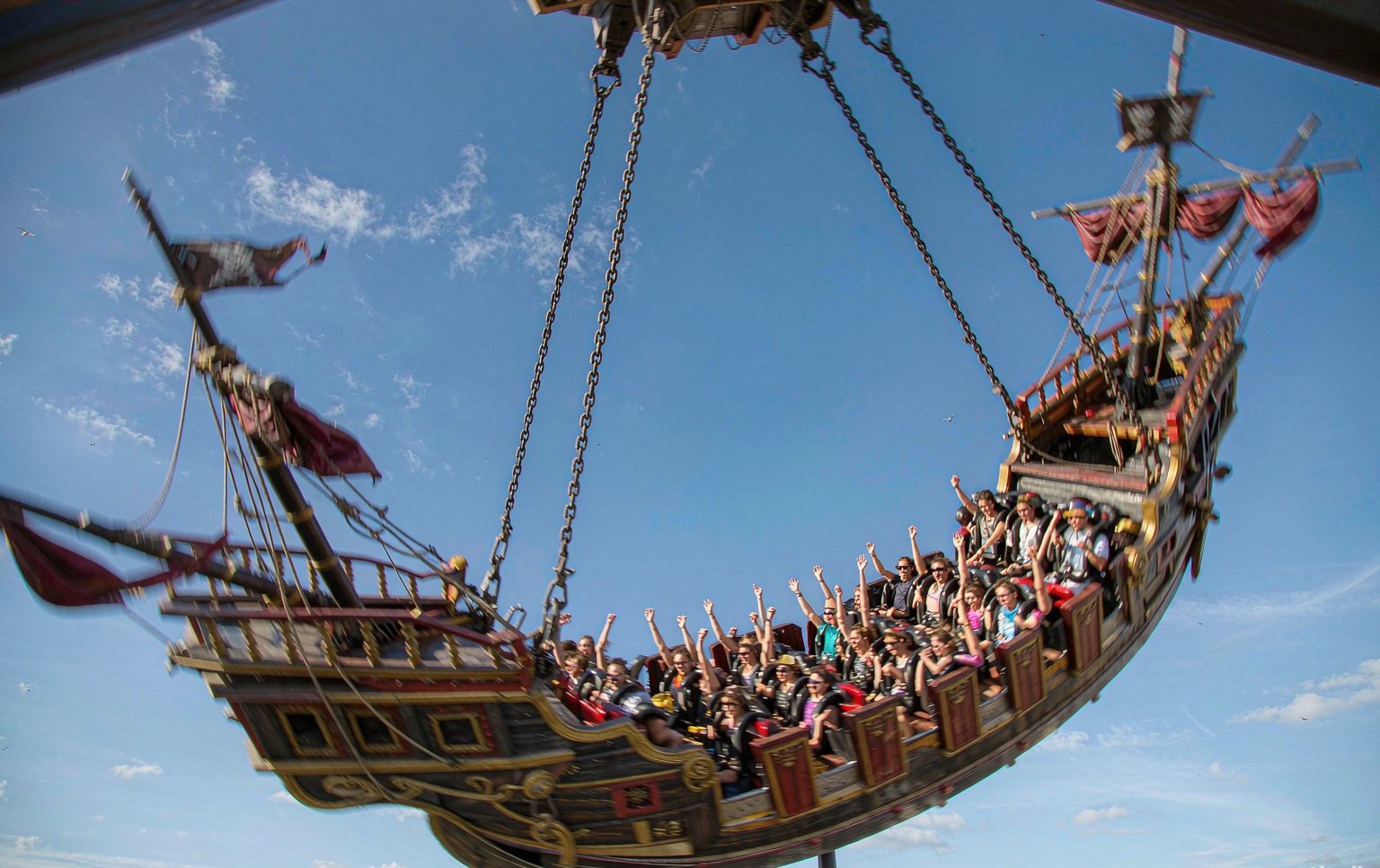
Every attraction in your park competes for space, capital, and labor. The pirate ship wins that competition on three fronts. First, throughput: a 40-seat swinging ship can move 600 to 800 riders per hour in peak conditions, which is comparable to far more expensive thrill machines. Second, universality: the front rows attract teenagers and adults seeking a thrill, while the center rows remain comfortable for families, so one ride serves multiple guest segments. Third, simplicity: the drive system, bearings, and structure are straightforward to maintain, and spare parts are inexpensive and widely available.
For new parks and family entertainment centers, a pirate ship also provides strong visual marketing. The sweeping arc of the ship, combined with rider reactions, acts as free advertising visible from across the midway. When operators browse our broader range of amusement rides for sale, the pirate ship consistently ranks among the highest revenue-per-square-meter purchases, and it pairs naturally with a pirate-themed land where every attraction reinforces the story.
Capacity Options: 24-Seat and 40-Seat Pirate Ships
Chinese ride manufacturers, including Anxin Amusement, typically offer the pirate ship ride for sale in two standard capacities, plus custom configurations on request.
24-seat model. The compact workhorse. Footprint of roughly 8 by 5 meters plus clearance zones, ideal for FECs, city parks, and traveling carnival operators. Single-side boarding or dual-platform boarding is available. It delivers family-thrill intensity at the lowest capital cost and can often be installed on smaller foundations.
40-seat model. The flagship. With two rows of 20 seats per side, a 40-seat ship maximizes throughput where queue capacity exists. It requires a larger footprint, stronger foundations, and typically a higher swing angle to justify its size. This is the standard choice for regional theme parks and destination attractions.
Whichever capacity you choose, ask the supplier to confirm seat pitch, minimum rider height, and boarding times in writing. A well-designed ship completes a full load-and-swing cycle in under two minutes; awkward platform layouts or single-side boarding can add 30 seconds per cycle, quietly eroding 20% of your daily capacity. Any quotation for a pirate ship ride for sale should also state whether seating rows, canopies, and hull sculpting are modular, because the ability to replace individual seat rows or refresh the theming extends the commercial life of the asset considerably.
When deciding between the two, model your queue realistically rather than optimistically. A 24-seat unit running at 60% utilization often outperforms a 40-seat unit sitting half-empty. Our team covers this capacity-planning logic in more depth in our guide to thrill rides for sale.
Swing Angle, Ride Height and Rider Experience
The intensity of a swinging ship is defined by its maximum swing angle. Standard configurations range from 45 to 60 degrees, with the most common production settings around 50 to 55 degrees for family-thrill positioning.
- 45 degrees: moderate airtime, suitable for family-oriented parks and younger riders; lowest structural loads.
- 50–55 degrees: the industry sweet spot; strong weightless sensation at the top of the arc without excluding family guests.
- 60 degrees: maximum thrill; taller ride envelope, stronger foundations, and stricter restraint and clearance engineering.
Ride height matters as much as angle. A 40-seat ship swinging at 55 degrees can present a total structure height above 12 meters and a rider apex close to 10 meters, so you must verify local height restrictions, aviation or zoning permits, and neighboring-structure clearance before ordering. Many suppliers can specify the swing angle at order stage; some drives also allow operators to limit the angle seasonally, which is useful for quieter weekday operations.
Foundations and Site Clearance: What Your Site Must Provide
A pirate ship generates dynamic, cyclical loads — not just static weight. Your civil works must be engineered for repeated swing forces at the pivot supports, and this is where under-budgeted projects most often stall. Before your pirate ship ride for sale is shipped, confirm the following with your supplier’s foundation drawings:
- Concrete foundations: typically reinforced concrete pads or footings per the manufacturer’s load drawings, with anchor bolts cast to template tolerance. Soil bearing capacity should be verified by a local geotechnical report.
- Level, drained platform: boarding platforms must remain within height tolerance as soil settles; plan drainage away from pit areas.
- Clearance envelope: maintain the manufacturer’s stated safety clearance in all directions from the maximum swing arc — a common rule of thumb is no public access within the swept envelope plus a fenced buffer.
- Power supply: standard models run on 380V/50Hz three-phase (other voltages on request), usually 15–40 kW connected load depending on capacity.
- Queue and exit routing: separate entry and exit gates reduce boarding time and are increasingly expected by local inspectors.
Installation on a prepared foundation generally takes 10 to 15 days for a 24-seat unit and 15 to 25 days for the 40-seat model, including commissioning and operator training.
Lap-Bar Safety Systems and Certification Standards
Because riders sit in open rows with their feet forward, restraint engineering is the most scrutinized part of any pirate ship inspection. Quality manufacturers fit self-locking over-the-shoulder or lap-bar restraints — most modern ships use mechanically locking lap bars with dual independent locking mechanisms, so a single failure cannot release a seat. Additional safety features to require in your specification:
- Redundant mechanical locks plus pneumatic or hydraulic assist on premium models
- Seat belts as secondary restraint on high-angle configurations
- Emergency stop buttons at the operator console and both platforms
- Anti-climb fencing and interlocked platform gates that prevent departure until all restraints are confirmed
- Anti-slip decking, handrails, and structural steel shot-blasted and marine-grade painted for corrosion protection
Certification is non-negotiable for B2B buyers. Anxin Amusement manufactures to CE and EN 13814 requirements, operates under an ISO 9001 quality system, and builds to ASTM F2291 design compliance where required by North American clients. Every unit undergoes 72-hour factory load testing, weld inspection, and full-swing commissioning before dispatch, and third-party pre-shipment inspection (SGS, TÜV, or your nominated agency) is welcomed.
During factory acceptance, ask for a video of the restraint test performed on your actual unit — any pirate ship ride for sale should demonstrate cycle-locking on every seat before it is packed. Insist on photos of the completed restraint installation, the painted structure, and the drive room, because resolving a specification mismatch before shipment costs nothing, while resolving it on site costs weeks.

How Much Does a Pirate Ship Ride Cost?
Pricing for a pirate ship ride for sale is configuration dependent. The table below shows indicative ex-works (EXW) USD price bands for 2026; shipping, installation, and civil works are extra. Treat these figures as budgeting references, not quotations.
| Configuration | Capacity | Swing Angle | Indicative Price (EXW) |
|---|---|---|---|
| Compact 24-seat ship, standard theming | 24 riders | 45–50° | $25,000 – $40,000 |
| Premium 24-seat, full marine theming, LED package | 24 riders | 50–55° | $40,000 – $55,000 |
| Standard 40-seat ship | 40 riders | 50° | $50,000 – $65,000 |
| Flagship 40-seat, custom theme, 55–60°, premium restraints | 40 riders | 55–60° | $65,000 – $80,000 |
All prices are indicative, ex-works, and configuration dependent. Options that move you up a band include upgraded FRP sculpting and hand-painted theming, LED perimeter lighting and music synchronization, pneumatic restraint assist, stainless fastener packages for coastal or humid climates, and dual-platform boarding. For context on how this purchase fits your total budget, see our breakdown of amusement park rides price factors.
Inspection Checklist, Payment Terms and Lead Times
Professional buyers protect themselves with a structured acceptance process. Before final payment, complete this checklist:
- Verify weld inspection reports and material certificates for primary structural members
- Witness the 72-hour continuous factory load test at full capacity (sandbags accepted)
- Confirm restraint lock function on every seat, plus emergency stop response time
- Check CE / EN 13814 documentation, wiring diagrams, and multilingual manuals are included
- Verify spare parts package: bearings, drive belts, restraint spare locks, control spares
- Confirm anchor-bolt template and foundation drawings match your civil contractor’s work
- Document container loading with photos for insurance purposes
Payment terms. The industry standard from Chinese manufacturers is 30% deposit with order confirmation and 70% balance before shipment, paid by T/T. Letters of credit are negotiable for larger orders. The balance-before-shipment structure is precisely why the factory inspection checklist above matters — complete it before funds move.
Lead times. Standard 24-seat and 40-seat ships ship in 25 to 45 days after deposit; heavily customized theming or non-standard voltages extend to 35 to 60 days. Ocean freight adds 15 to 40 days depending on destination, and on-site installation typically runs 10 to 25 days. A well-organized factory slots your pirate ship ride for sale into the production schedule within days of the deposit clearing, so ask for a written production timeline — not just a delivery date — and plan your grand opening backward from these figures.
Frequently Asked Questions
What footprint do I need for a 40-seat pirate ship ride?
Plan for approximately 15 by 8 meters of total operating area including the swing envelope, boarding platforms, and fenced safety clearance, on top of queue space. Every pirate ship ride for sale in our range is issued with a certified site plan, which your civil contractor should receive before groundworks begin.
Is a pirate ship ride profitable for a small park?
Yes — it is one of the best revenue-per-investment rides available. With 24 seats, a ticket price of $3–5, and modest utilization, operators commonly recover the investment within one to two seasons. High throughput, low staffing (one operator), and minimal maintenance keep the operating margin strong.
Can the swing angle be adjusted after installation?
On most modern drives, yes. Many control systems allow the operator to set a maximum angle within the certified design range, which is useful for running a gentler program for school groups or off-peak hours. The certified maximum must never be exceeded, and any changes should follow the manufacturer’s settings.
What certifications should I require when buying a pirate ship ride for sale?
Require CE marking and EN 13814 design conformity as a baseline, ISO 9001 manufacturing quality systems, and ASTM F2291 compliance for North American jurisdictions. Ask for the actual certificates and test reports for the specific unit — not just brochures — and consider nominating a third-party inspector for pre-shipment verification.
How long does a pirate ship ride last?
With correct maintenance, a quality steel-framed pirate ship operates reliably for 15 to 20 years or more. Annual non-destructive testing of welds, bearing lubrication schedules, restraint maintenance, and repainting every 5 to 8 years are the main lifecycle costs. Confirm spare parts availability for at least 10 years in your purchase contract.
Request a Quote for Your Pirate Ship
A pirate ship ride for sale is one of the fastest-payback investments you can make in a park, an FEC, or a traveling show. Anxin Amusement has delivered over 200 rides to more than 24 countries, backs every unit with a 2-year warranty and lifetime technical support, and provides foundation drawings, installation crews, and operator training with every order.
Send us your site dimensions, target capacity, and city, and our engineers will return a tailored quotation with foundation drawings and delivery scheduling — typically within 48 hours. Request a quote today, or explore our custom amusement rides capabilities if you need bespoke theming for your pirate ship.