Between the purchase contract and the grand opening lies the phase where projects most often go wrong: installation. Amusement ride installation covers site preparation, foundations, mechanical assembly, electrical hookup, and commissioning — and each step depends on decisions made months earlier, at purchase. This guide sets out what buyers must prepare, what suppliers should provide, and how the commissioning checklist turns a delivered machine into an operating attraction.
Start Before the Contract Is Signed
Installation failures usually trace back to the quotation. Before ordering, confirm in writing:
- What the delivery includes — equipment only, or installation drawings, supervision, and commissioning as well?
- Foundation drawings with loads, dimensions, and tolerances — needed months before the container arrives.
- Electrical requirements — voltage, frequency, connection points, and who supplies cabling and breakers.
- Site responsibilities — foundations, drainage, fencing, and queue areas are buyer-side work in most contracts.
- Local approvals — technical documentation your inspector or authority will require.
A supplier who cannot provide these documents early is telling you how the installation will go.
Site Preparation Checklist
- Foundations poured to the supplier’s drawings, cured for the specified period, with anchor bolt positions surveyed — tolerances of a few millimeters matter for rotating equipment.
- Utilities — power supply sized for starting currents (not just running load), grounding per local code, and lighting for evening operation.
- Access — a route for trucks and cranes, level lay-down space for unpacking, and unloading equipment booked for delivery day.
- Safety zones — fencing, barriers, and queue layout per the supplier’s layout drawing, completed before assembly starts.
- Weather windows — outdoor assembly in rain or high wind is how damage and accidents happen; schedule accordingly.
Assembly: Who Does What
Three common service models exist:
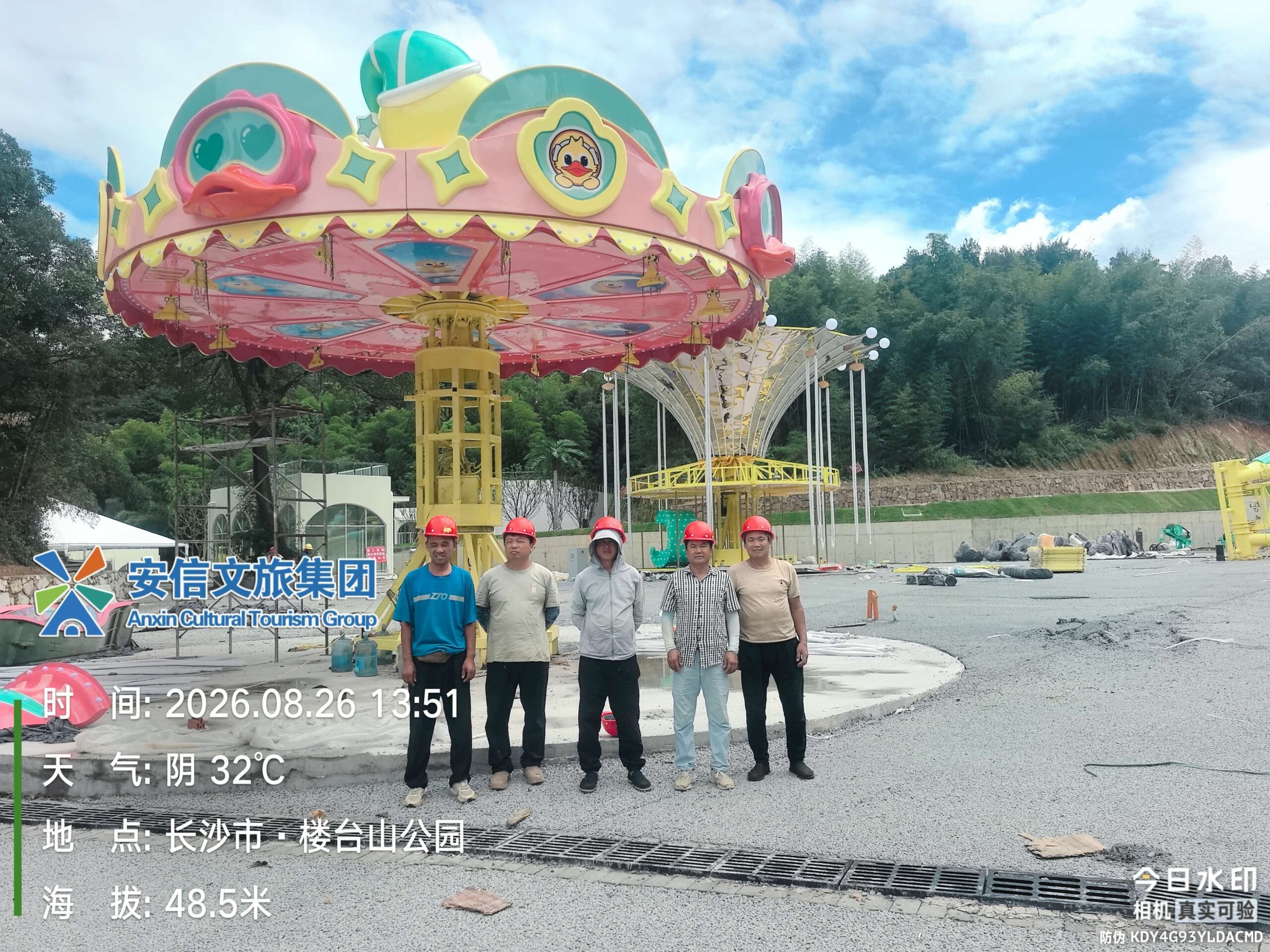
- Supplier installation team — the supplier’s engineers assemble and commission; the buyer provides labor and site works. Best for complex rides and first-time operators.
- Supervised installation — the supplier sends one or two engineers to direct a local crew. The standard model for mid-size equipment; it controls cost and builds local maintenance knowledge.
- Self-installation from drawings — viable for simple equipment (inflatables, small kiddie rides) but risky for anything with rotating structures or control systems.
Whichever model you choose, keep a daily photo log and hold the assembly to the drawings. Unauthorized field modifications — cutting a brace, relocating a sensor, substituting a bolt grade — void certifications and create the failures inspectors look for.
Commissioning: The Checklist That Matters
Commissioning converts an assembled machine into an approved ride. A professional commissioning sequence includes:
- Pre-power checks — torque verification on anchor and structural bolts, wiring continuity, insulation resistance, grounding test.
- Empty test runs — several full cycles without passengers, checking speeds, timing, brakes, and emergency stop function.
- Loaded test runs — test weights or staff as passengers, verifying restraint function and cycle times under load.
- Safety device verification — every interlock, sensor, and emergency stop tested individually and documented.
- Operational training — operators and maintenance staff trained on start-up, shutdown, emergency procedures, and daily inspections.
- Handover documents — commissioning report, test records, manuals, and the maintenance schedule signed by both parties.
Do not open to the public on the day of the last test. Most authorities and insurers expect a documented inspection period between commissioning and first paying guests — confirm your local requirement.
Common Installation Failures
- Foundations poured without the supplier’s drawings, then redrilled on site.
- Undersized power supply causing breaker trips during start-up — discovered, of course, on opening weekend.
- No unloading equipment booked, so containers sit for days.
- Skipping the empty-cycle tests to “save time,” which is how alignment and sensor faults reach paying guests.
- No maintenance staff involved during commissioning — the people who will run the ride never saw it being built.
Final Thoughts
Successful ride installation is a procurement decision, not an on-site improvisation. Buyers who lock installation scope into the contract, prepare the site against real drawings, and insist on a documented commissioning sequence open on schedule — and keep opening.
Anxin Amusement provides installation drawings, supervised installation, commissioning, and operator training for its ride and playground equipment worldwide. Contact us to scope the installation phase of your project.